A quick note before we start: this article is practical guidance for builders, not legal advice. SMS rules come from the TCPA, FCC rules, carrier rules, and CTIA industry guidance, and they change. Have a qualified telecom attorney review your actual flows before you send to real customers.
The problem double opt-in solves
Your SMS chatbot collects a phone number from a visitor in chat. The bot starts sending updates. Then one day someone replies, “I never signed up for this.” Maybe a typo. Maybe a coworker entered someone else’s number. Maybe the person changed their mind.
Double opt-in fixes this with a second step: after someone gives you a number, you send one text asking them to confirm, and you only start messaging after they reply yes. One extra message, one extra moment of friction. In exchange, you get proof that a real human holding that phone agreed to hear from you.
What double opt-in is (and what it is not)
Single opt-in is one step. The user takes one action (enters a number in a form, texts a keyword, gives a number to your chatbot) and is subscribed. Fast, and the list grows quickly.
Double opt-in adds a second step. The user gives the number, then receives a confirmation text and must reply affirmatively, typically “YES,” before they are subscribed. Only then do they get the welcome message.
Single opt-in verifies that someone submitted the number. Double opt-in verifies that the person holding the phone wants your messages. Anyone can type any number into a chat box, and that is the whole reason this pattern exists. Salesforce’s messaging documentation draws the same line: explicit opt-in is the customer’s consent, and double opt-in is that consent plus a confirmation of it (source: https://help.salesforce.com/s/articleView?id=sf.messaging_consent_status.htm&language=en_US&type=5).
One distinction that gets muddled online: double opt-in is not a federal legal requirement. The TCPA’s standard for marketing texts is prior express written consent, and properly documented single opt-in can meet it. Double opt-in is an industry best practice recommended by CTIA and carrier guidance. The CTIA Short Code Monitoring Handbook states that for recurring programs “double opt-in is optional” (premium billed services are the exception). Builders use it because two timestamped records are much harder to dispute than one. One carrier-side exception to know: some use cases, like abandoned cart reminders under T-Mobile’s code of conduct, effectively require double opt-in, so check your carrier’s rules for your specific program. For what the TCPA actually requires, see our guide on TCPA consent for SMS chatbots.
When the extra friction is worth it
The number came from a chat conversation, not the phone itself. This is the classic SMS chatbot problem. A visitor chats with your bot and types a number. You have no proof the number belongs to the person typing. A confirmation text to that number is the only way to check. This is exactly the case in our SMS chatbot lead qualification flow, where the bot collects a number mid-conversation.
The list was imported, migrated, or bought. Any list that did not come from direct contact with the device owner is risky: imported CRM contacts, numbers from a merged business, a purchased list, or an old list you are waking up after months of silence. The person holding that number today may not be the person who originally consented, since carriers recycle numbers. Double opt-in reduces the risk, though it cannot fix a list that never had valid consent in the first place.
The stakes of a complaint are high. Regulated industries, high-visibility brands, and senders on a registered short code face more scrutiny. Carrier reviewers for A2P 10DLC campaigns look specifically for verifiable consent flows, and a double opt-in exchange is the easiest thing to point at.
Wrong-number texts are a pattern in your data. If support gets “stop texting me” replies from people who never signed up, your intake has a hole. Typos, shared devices, and recycled numbers all produce numbers that look fine but belong to strangers. Texting a non-consenting party is what the TCPA punishes at $500 to $1,500 per message. A confirmation gate catches these before the first marketing text goes out.
When single opt-in is fine
The user texted you first. When someone sends JOIN to your number, consent comes from the device itself. The phone owner took the action, so the extra verification adds little. One qualifier: the inbound message proves device control, but your consent records should still cover the program and message type the user is signing up for. Log the inbound keyword with its timestamp.
The number was captured in person. A point-of-sale signup where the customer enters their own number gives you direct confirmation of intent. Send the required confirmation message as a courtesy and a record, but a full double opt-in exchange is usually overkill.
The messages are purely transactional. Order confirmations, appointment reminders, delivery updates, and one-time verification codes serve an existing interaction. They do not need a marketing-style confirmation gate. But the moment the messages start selling, you are back in marketing territory. The abandoned cart flow shows the boundary: reminders can be transactional, but promotional follow-ups are marketing.
The confirmation exchange, step by step
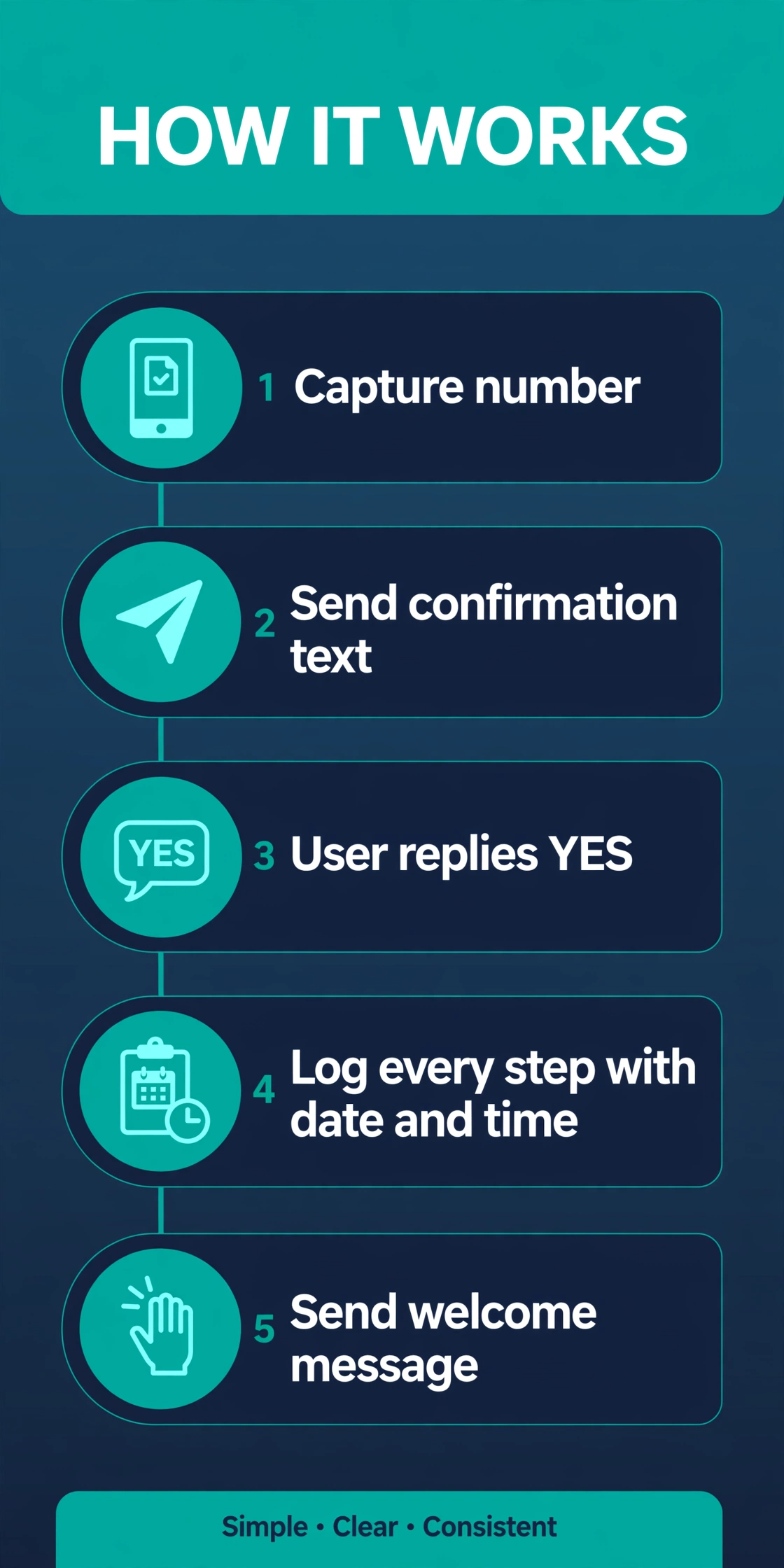
Step 1: the chatbot collects the number. The bot asks for the phone number in chat. The disclosure shown beside the number field must name the brand, say what kinds of messages will follow, and state the frequency and opt-out method. The number enters a “pending” state, not the active list.
Step 2: you send the confirmation request. This text must carry the required disclosures, because it may be the only message this person ever receives from you: brand or program name, what they are signing up for, message frequency, “Message and data rates may apply,” and how to get help and opt out. For example:
Acme Dentistry: Reply YES to confirm SMS appointment reminders (up to 4 msgs/month). Msg and data rates may apply. Reply STOP to cancel, HELP for help.
Send it within seconds of the chat signup; a delay of hours makes it feel like a cold text. Check the send time against quiet hours too (see our quiet hours guide and the quiet hours checker).
Step 3: the user replies YES. Log the timestamp, sender number, exact reply text, and campaign ID. This is the second half of your consent record.
Step 4: you send the welcome. The user is now subscribed. Confirm they are in, repeat the frequency and opt-out instructions briefly, then let the chatbot take over:
You’re in. Acme Dentistry will send appointment reminders (up to 4 msgs/month). Reply STOP to cancel. Want to book? Tell me what day works.
If they never reply: give the pending signup a window (24 to 48 hours is common), allow at most one reminder, then retire the number. Do not add it to the list “just this once” and do not message it again. Industry estimates put confirmation-step drop-off around 15 to 25 percent (a vendor figure, not a universal one), and those are numbers that never belonged on your list anyway: typos, wrong numbers, and unenthusiastic signups. Also decide what a NO does: anything that is not a YES ends the signup. Reply once confirming no messages will be sent, then close it out.
Implementation notes for builders
Track three states. Your subscriber record needs at least: pending (confirmation sent), confirmed (YES received), and expired (timeout reached). Every message the bot considers sending should check this state first. A queued welcome for a pending number will blast someone who never confirmed.
Log both steps separately. Step one: when and where the number was collected, plus the exact disclosure wording shown in chat. Step two: when the confirmation text was sent, when the YES arrived, and the exact reply text. Two timestamped records are what make double opt-in stronger evidence than single opt-in.
Normalize the YES. Accept at minimum YES, Y, and START, and strip whitespace and punctuation before comparing. Log unexpected replies anyway, since they may be opt-outs or HELP requests in disguise. A STOP during the pending window means stop immediately, confirmation flow or not. See our guide to opt-out keywords for the full handling rules.
Do not nurture pending numbers. No drip sequence against the waiting room: the initial ask plus at most one reminder, then silence.
Keep the confirmation text short. It must carry the brand name, frequency, rates disclosure, and opt-out and help instructions. Keep the brand description and frequency tight so the whole thing stays readable on a phone screen. Test it on a real phone, not just a dashboard preview.
FAQ
Is double opt-in required by law for SMS?
No. The TCPA requires prior express written consent for marketing texts, and properly documented single opt-in can satisfy that. Double opt-in is a best practice recommended by CTIA and carrier guidance. The CTIA Short Code Monitoring Handbook lists it as optional for recurring programs (premium billed services are the exception). Builders use it for stronger evidence and number verification, not because a statute demands it.
What is the difference between single and double opt-in?
Single opt-in subscribes the user after one action, like entering a number in a form. Double opt-in adds a second step: the user receives a confirmation text and must reply YES before they are subscribed. Double opt-in verifies intent and number ownership; single opt-in is faster but gives a thinner consent record.
What should a double opt-in confirmation text say?
Include your brand or program name, what the user is confirming, the expected message frequency, “Message and data rates may apply,” and how to opt out (Reply STOP) and get help (Reply HELP). It may be the only message the number owner ever sees from you, so it must stand alone as a complete disclosure.
How long should I wait for the confirmation reply?
There is no legal deadline; 24 to 48 hours is common practice. After the window closes, retire the pending number and do not message it. One reminder within the window is acceptable; repeated nudges defeat the purpose of the gate.
Should I use double opt-in when the user texts me first?
Usually not necessary. When the user messages your number first, consent already comes from the device owner, which is what the confirmation step verifies. Log the inbound keyword and timestamp. Reserve double opt-in for numbers collected through forms, chat widgets, imports, or any path where the owner is not proven.
Does double opt-in hurt list growth?
Somewhat. Drop-off at the confirmation step is real, though published estimates vary and none come from a neutral primary source. But those are typos, wrong numbers, and unenthusiastic signups. Most builders find the remaining list delivers better engagement and fewer complaints, which matters more than raw size.
The bottom line
Double opt-in is about matching the verification to the uncertainty. When the number came from the device itself, single opt-in is enough. When the number came from a chat box, a form, or someone else’s database, the second step is the only way to know you are texting the right person. Build the confirmation exchange once, log both steps, and you get a list you can defend and a bot that texts people who actually asked for it.
Want this set up for you?
I build SMS chatbots and API integrations for businesses. If you would like what this guide describes, done for you, get in touch.