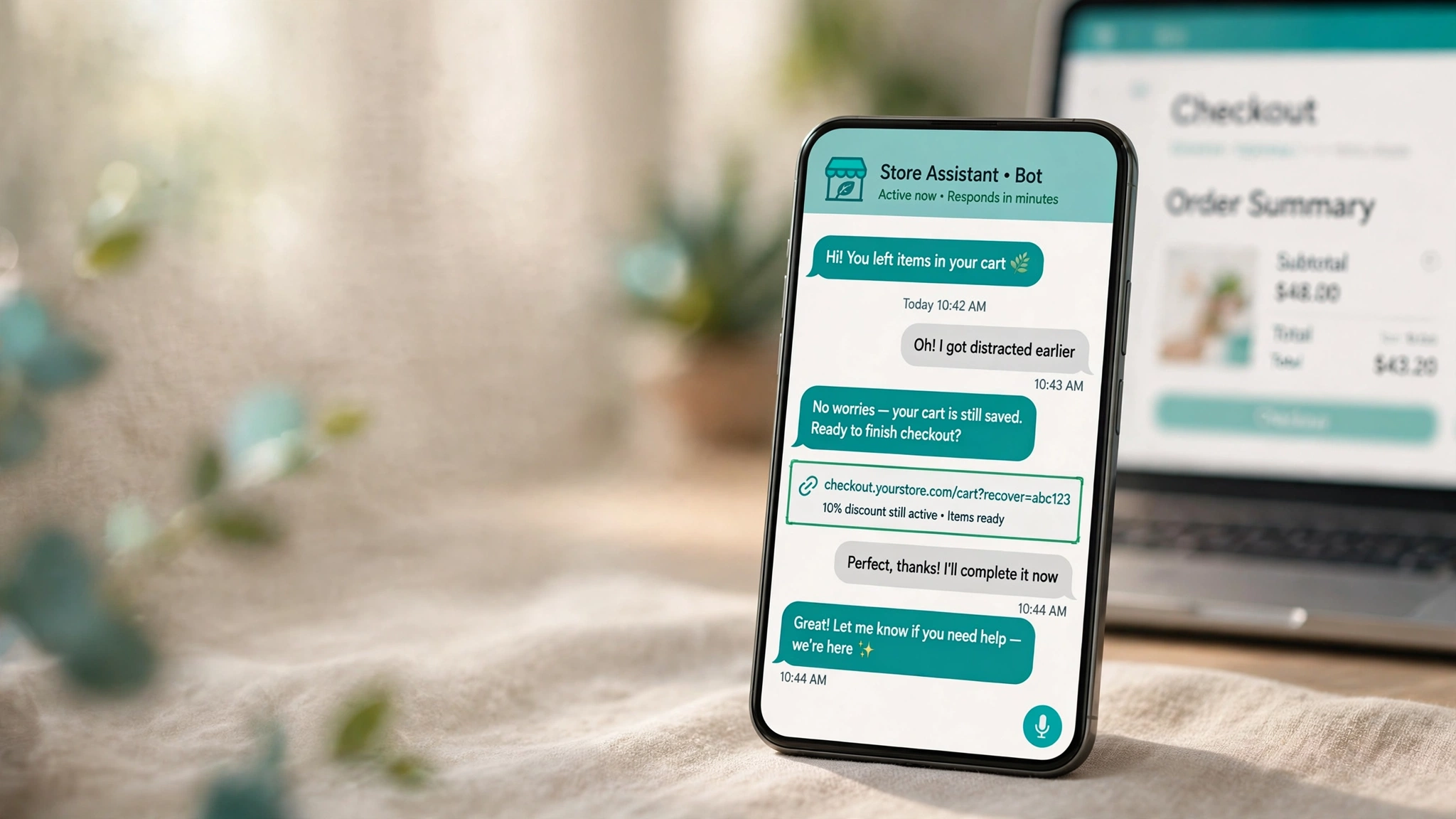
Most abandoned cart texts are dead ends. A shopper leaves a cart. The store fires off a one-way reminder with a link, and the conversation ends there. If the shopper had a question about sizing, shipping costs, or delivery time, that text did nothing to answer it.
An abandoned cart SMS chatbot works differently. It starts the same way, with a well-timed reminder. Then it stays in the conversation. When the shopper replies with a question, the bot answers it. When the objection is price, the bot can offer a discount at the right moment. When the shopper is ready, the bot hands them a direct path back to checkout.
What an Abandoned Cart SMS Chatbot Actually Is
A standard abandoned cart SMS is a broadcast. It goes out, and nobody reads the replies. An abandoned cart SMS chatbot is two-way by design. It connects to your store, watches for abandoned carts, and opens a text conversation with the shopper who left them behind.
That matters because most abandoners are not distracted. They hit a specific doubt: shipping cost, sizing uncertainty, an unclear delivery date, or a price just a little too high. A one-way reminder cannot resolve any of those. A chatbot can, because it is there when the shopper types back “how much is shipping” or “does this run small.” Unlike a website support bot that waits for visitors, the recovery bot starts the conversation already knowing the cart contents and total.
The payoff is threefold: objections get handled in the moment instead of going unanswered, discounts get held back until the shopper signals price resistance, and replies that need a person get handed off instead of fumbled.
The Recovery Sequence: Timing That Works
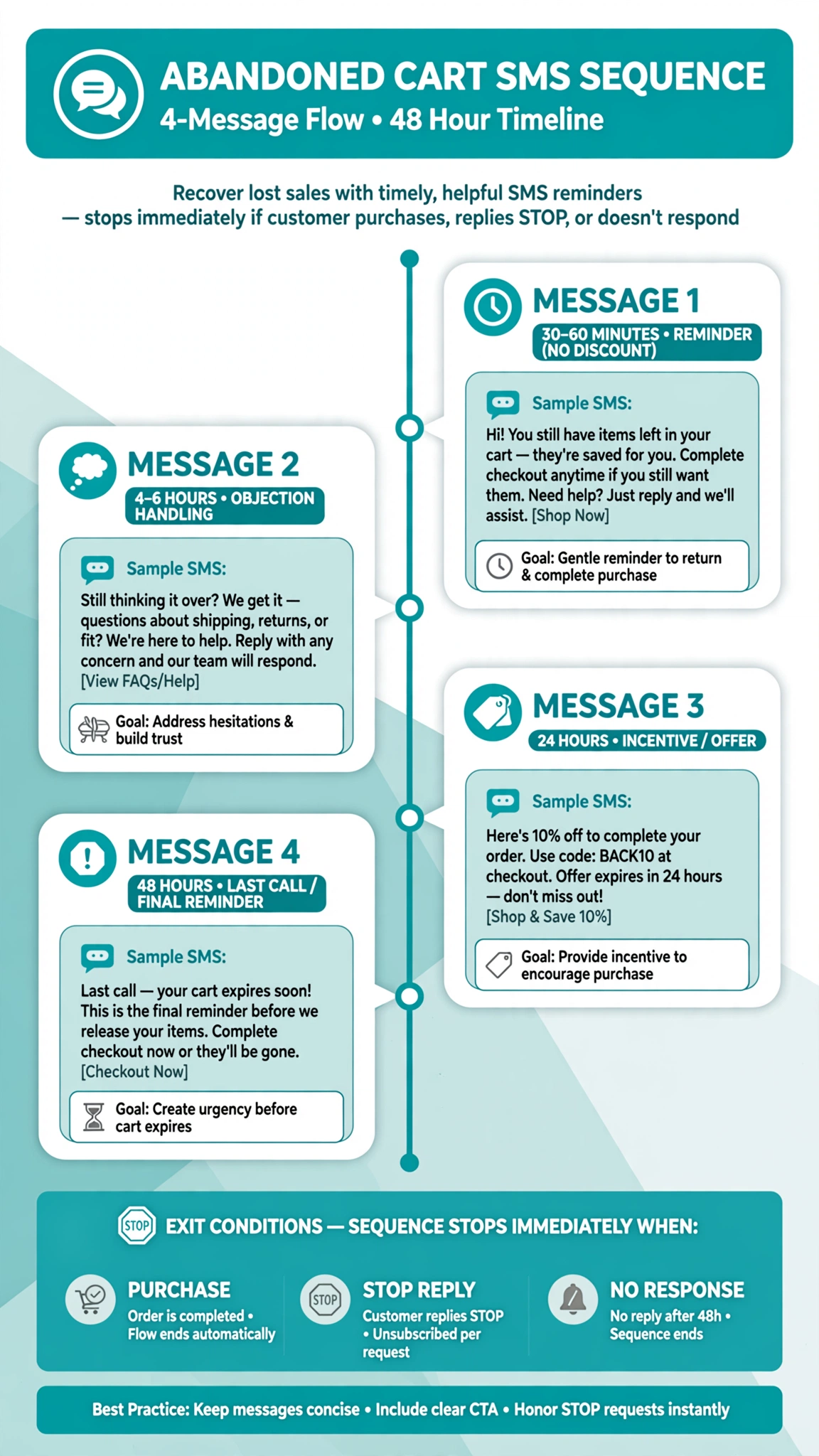
Timing is the backbone. Too early and you interrupt someone still shopping. Too late and intent has cooled. Most published playbooks land on three to four messages spread over about 48 hours.
Message 1: The Gentle Reminder (30 to 60 Minutes After Abandonment)
A nudge, not a sales pitch. Name the brand, name the product, and include the checkout link.
Hi Maya, this is Trail and Thread. You left the Ridgeview Rain Jacket in your cart. Your checkout is ready here: trailthread.co/c/8f2k. Reply STOP to opt out.
No discount here. Many abandoners come back at full price when reminded, and a coupon in the first message teaches shoppers to abandon on purpose.
Message 2: Objection Handling (4 to 6 Hours Later)
By now the distracted shoppers have mostly converted or gone quiet. The ones still on the fence usually have a question, so this message should invite it instead of repeating the reminder.
Still thinking about the Ridgeview Rain Jacket? Common questions: it runs true to size, ships in 2 days, and returns are free for 30 days. Ask me anything, I am here: trailthread.co/c/8f2k
This is where the chatbot earns its name: the message primes the shopper to reply, and the bot is ready for what comes back.
Message 3: The Incentive (24 Hours Later)
If the cart is still there after a day, price is the likely blocker. Now a discount is fair game: keep it modest, make the code single use, and give it a real expiry.
Maya, here is 10 percent off your cart to help you decide. Use code COMEBACK10 at checkout: trailthread.co/c/8f2k. The code expires tomorrow at midnight.
Only send this step for carts above a value threshold you set. Ten percent off a 12 dollar cart costs more in margin than it is worth.
Message 4: The Last Call (48 Hours Later, Optional)
One final message, short and direct. Remind them the incentive expires, then stop.
Last call: your 10 percent code COMEBACK10 expires tonight: trailthread.co/c/8f2k
Exit Conditions
Stop all messages the moment the shopper completes the purchase. Suppress the number entirely when they reply STOP. If there is no response after the final message, end the sequence and do not roll the number into another campaign.
Objection Handling by Reply: The Heart of the Chatbot
Most guides say “handle objections” without showing the actual thread. Here is a realistic recovery flow for a fictional outdoor store, where the bot answers questions and brings up a discount only when the shopper asks for a reason to decide.
Bot: Hi Maya, this is Trail and Thread. You left the Ridgeview Rain Jacket in your cart. Want me to hold your size while you decide? Here is your checkout link: trailthread.co/c/8f2k. Reply STOP to opt out.
Shopper: how much is shipping
Bot: Shipping is 6.95, and it is free over 75. Your cart is at 68, so you are 7 short. Want a suggestion to get you over the line?
Shopper: not sure about the size though
Bot: Fair question. The Ridgeview runs true to size, and most buyers around 5 foot 6 kept the Medium. Want the size chart link?
Shopper: ok send it
Bot: Here it is: trailthread.co/size-ridgeview. Take your time. I can also send a 10 percent code good for the next 24 hours.
Shopper: yes please
Bot: Here you go: COMEBACK10. It works at your checkout link above and expires tomorrow at midnight. Just reply if you need anything else.
Shopper: thanks, just ordered
Bot: Got it. Your confirmation is on its way by email.
Here the bot answers the shipping question with specifics, not a policy link. It handles the sizing doubt with concrete guidance. It offers the discount only after the shopper engages, which protects margin, and it closes the loop when the order comes through.
Build reply paths for the five objections you will see most: price (the only one where a discount is the right answer), shipping cost or speed (answer with actual numbers and the free shipping threshold), fit and sizing (a direct answer plus the size chart link), trust (state the return window plainly), and timing (do not argue; offer a reminder in a few days only if they say yes). Set handoff triggers too: route to a person when the shopper mentions a previous order problem, asks something the bot cannot answer twice, uses angry language, or asks to speak to someone directly.
Discount Logic: When and How Much to Offer
Discounts recover carts, and they also eat margin and train bad habits. Never discount the first message, or shoppers learn to abandon on purpose. Set a cart value floor so small carts get helpful follow-ups instead of coupons. Start small: five to ten percent or free shipping is enough for most hesitant buyers. Prefer single-use codes, since generic codes leak onto coupon sites. Cap incentive frequency per shopper so repeat abandoners cannot farm codes. And consider free shipping before percentage discounts: for carts just under your threshold, covering shipping often costs less than 10 percent off and feels more generous.
Watch the math on two-way costs. Conversational recovery sends more messages than a one-way blast, since every reply costs a segment. Run your expected volume through a bulk SMS cost calculator so recovered revenue is measured against real messaging cost.
Consent Safeguards
This is the part you cannot skip. Abandoned cart texts are marketing messages, and marketing texts require prior consent. A phone number typed into a checkout form is not consent. Consent has to be a clear, separate opt-in, such as an unchecked-by-default checkbox at checkout, and you should keep a record of when and how each number opted in.
Follow these safeguards: identify the brand in the first message; include “Reply STOP to opt out” and honor STOP replies immediately across all your messaging; keep consent records clean with one shared suppression list, which a phone list cleaner can help with; respect quiet hours and never text in the middle of the night in the shopper’s timezone, checking local rules with an SMS quiet hours checker when customers span states; and collect SMS marketing consent separately, since consent for email receipts or order updates does not cover it.
This is general guidance, not legal advice. Texting rules carry real penalties, so have a qualified attorney review your consent flow before you launch.
Setting It Up
Most ecommerce SMS platforms include cart abandonment triggers, and several add two-way replies on top. Connect the platform to your store, build the sequence with the purchase event as a global exit trigger, write the reply paths and handoff triggers, set the cart value floor, and generate single-use codes. Test the full flow with your own number first, then launch to a small segment, read the transcripts for a week, and fix the paths where the bot fumbled.
Mistakes That Kill Recovery Sequences
Discounting the first message trains shoppers to abandon on purpose. Sending more than four texts in 48 hours drives opt-outs. A “chatbot” that ignores replies is a broadcast with a fancier name. Generic copy with no product or brand name reads as spam. A 2 a.m. text generates a STOP, not a sale. And nothing burns trust like a discount text arriving after the shopper already bought at full price.
FAQ
Can a chatbot recover abandoned carts automatically?
Yes, once connected to your store. It detects the abandoned cart, sends the timed messages, answers common replies, offers the incentive at the right step, and stops when the purchase completes. You still need to review transcripts and refine the reply paths.
How long should I wait before sending the first abandoned cart SMS?
Thirty to sixty minutes after abandonment is the standard window: intent is still warm, and you are unlikely to interrupt someone mid-checkout. Some setups send email at one hour and hold the first SMS for the four-hour mark.
Should the first text include a discount?
No. Most recoveries at this stage happen at full price, and leading with a coupon trains shoppers to abandon deliberately. Save the incentive for the 24-hour message, and only for carts above your value threshold.
How many abandoned cart messages should I send?
Three to four texts over about 48 hours: reminder, objection handling, incentive, and an optional last call. Then stop, whether or not they replied.
Do I need consent to send abandoned cart texts?
Yes. A phone number entered at checkout is not consent for marketing texts. You need a separate, clear opt-in, and you must honor opt-outs immediately. This is general information, not legal advice.
Can customers reply to these texts?
That is the point of the chatbot version. Shoppers ask about shipping, sizing, returns, and delivery, and the bot answers from your store data. Someone on your team should still see the replies the bot cannot handle.
What is the difference between an abandoned cart chatbot and a regular reminder text?
A reminder is one-way: it goes out and the replies go nowhere. A chatbot is two-way: it reads replies, answers questions, handles objections, offers discounts selectively, and hands off to a human when needed. The reminder jogs memory. The chatbot resolves doubt.
What happens if a customer replies STOP?
Everything stops. The number is suppressed from the cart sequence and all your SMS marketing, immediately and permanently until they opt in again. Build this as a hard rule in your platform, not as something the bot decides.
Conclusion
An abandoned cart SMS chatbot is not a cleverer reminder. It is a salesperson that shows up by text at the moment of doubt, answers the actual question, and knows when a discount will help and when it will just cost margin. Get the timing right, prepare for the common objections, hold discounts until they are earned, and keep consent airtight.
Note: this article covers general strategy and compliance concepts only. It is not legal advice. Texting regulations vary by jurisdiction and carry significant penalties, so have a qualified attorney review your consent and messaging practices before launching.
Want this set up for you?
I build SMS chatbots and API integrations for businesses. If you would like what this guide describes, done for you, get in touch.