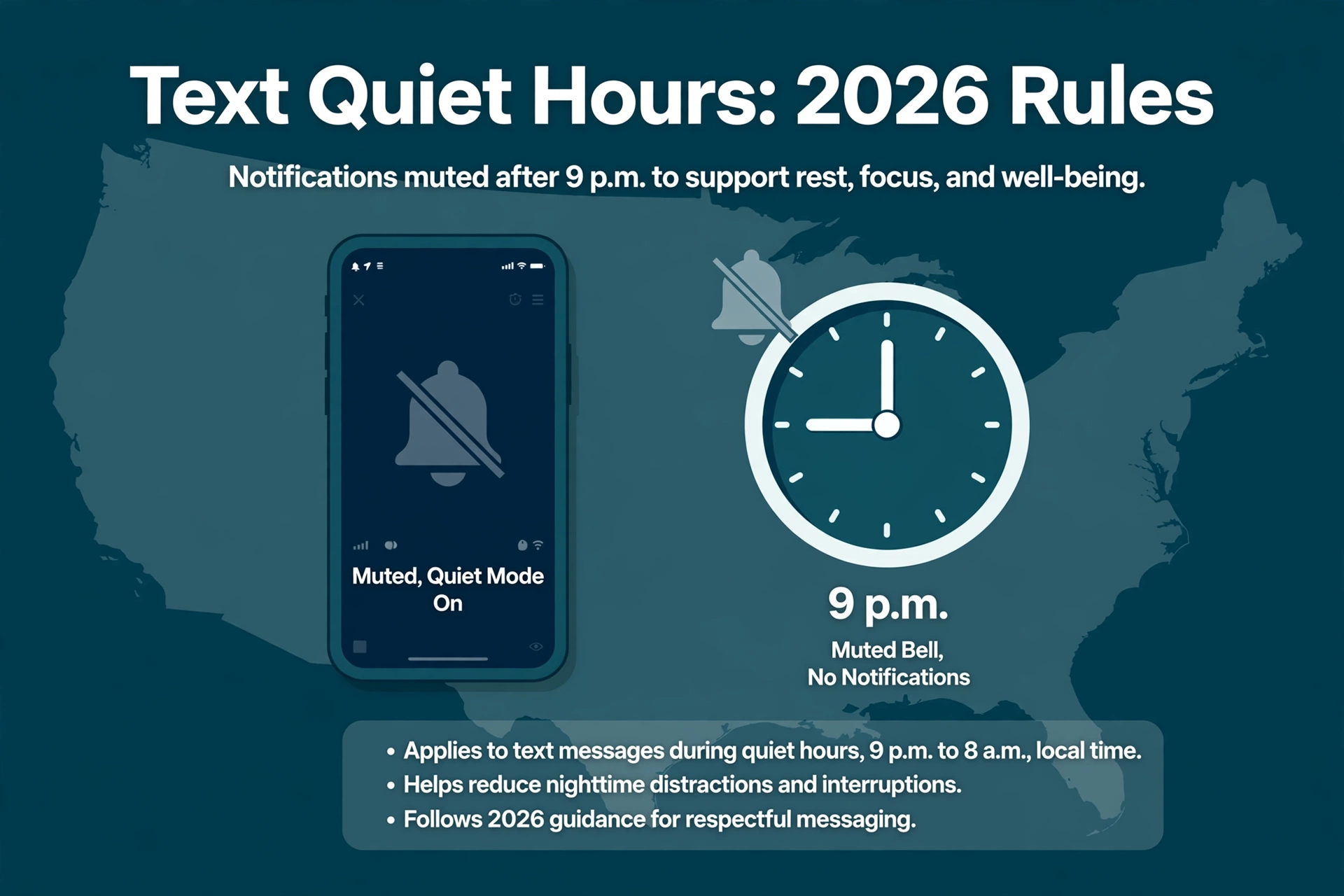
This guide is general information, not legal advice. Telemarketing law changes fast, and it varies by state. Talk to a qualified attorney before you build your sending rules.
One mistimed text can cost more than an entire ad campaign. Plaintiff firms actively run quiet-hour class-action investigations over early-morning marketing texts. Under the Telephone Consumer Protection Act’s quiet hours, each message can carry statutory damages of $500 to $1,500. For a chatbot that sends thousands of messages on autopilot, the math gets frightening quickly.
The federal baseline: 8 a.m. to 9 p.m., the recipient’s local time
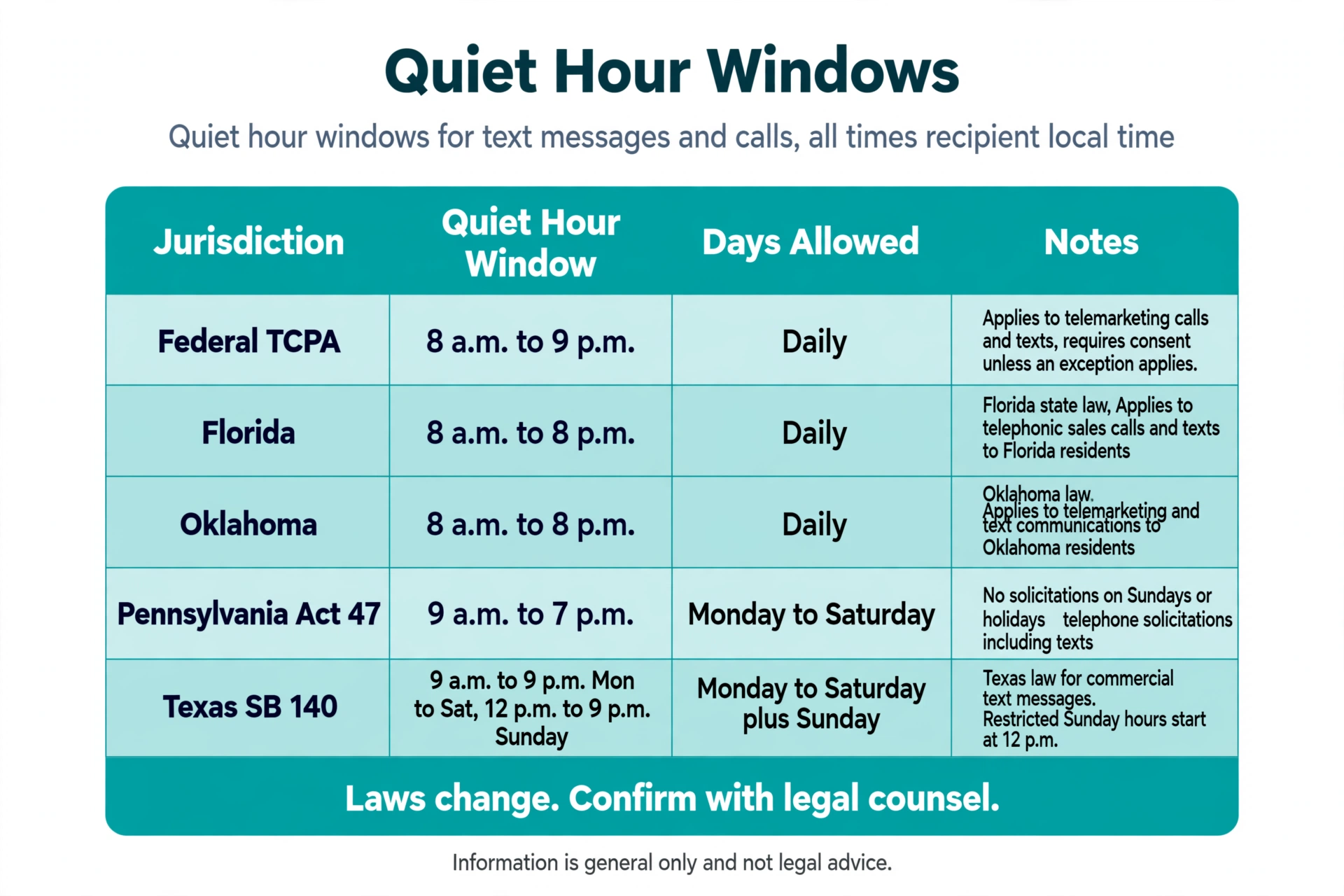
The federal rule is straightforward. The FCC’s TCPA regulation (47 C.F.R. sec. 64.1200(c)(1)) bars telephone solicitations before 8 a.m. or after 9 p.m. local time at the called party’s location. The FCC has long treated text messages as calls under the TCPA, so the same window applies to automated marketing texts.
- It is the recipient’s local time, not yours. A bot running on Eastern time that blasts at 8:30 a.m. is hitting California contacts at 5:30 a.m. That is a violation, not a technicality.
- Consent does not obviously cancel the window. There is active litigation over whether quiet hours apply to marketing texts the recipient consented to receive, and plaintiff firms are running quiet-hour class-action investigations right now. The safe position is simple: respect the window for every automated marketing message, consented or not.
- Damages are per message. Federal statutory damages run $500 per violation and can reach $1,500 for willful violations. One bad campaign blast at 6 a.m. can mean tens of thousands of messages, each one a separate count.
Also know the boundary of the rule. Transactional messages like order confirmations, shipping alerts, and appointment reminders are generally not telephone solicitations, so they sit under a lighter consent standard. But the line is thinner than it looks. A shipping confirmation with a coupon for your next order is routinely treated as marketing, and courts look at the actual content of the message, not what you named the campaign.
Why chatbots trip on quiet hours more than humans do
A human sending a text checks the clock instinctively. A bot sends whenever its trigger fires, and triggers do not care about time zones. The most common traps in automated flows:
- Missed-call textback. Someone calls your business at 11:40 p.m., and the bot helpfully texts back instantly. That 11:40 p.m. text is outside quiet hours if it is promotional.
- Away or after-hours auto-replies. These fire at exactly the wrong hours by definition.
- Scheduled drip sequences. A “day 3” message scheduled 72 hours after a 2 a.m. signup lands at 2 a.m.
- Server-time thinking. Your scheduler, your cron jobs, and your dashboard all run in one time zone. Your contacts do not.
The stricter states: Florida, Pennsylvania, Texas, Oklahoma
Federal law is the floor, not the ceiling. Several states run tighter windows, and your bot has to follow the strictest window that applies to each recipient.
Florida: 8 a.m. to 8 p.m.
Florida’s mini-TCPA (Fla. Stat. sec. 501.059, originally CS/SB 1120, effective July 2021) trims the federal window to 8 a.m. to 8 p.m. local time. That is a full hour shorter on the evening side, and evening is exactly when most e-commerce blasts go out.
Florida also deserves special handling for two reasons. The state spans two time zones, Eastern and Central, so a statewide campaign needs per-recipient zones even inside Florida. And penalties are $500 per violation, trebled to $1,500 for willful violations, with a private right of action and attorney’s fees, which is why Florida has produced a wave of mini-TCPA class actions.
Pennsylvania: 9 a.m. to 7 p.m., no Sundays, effective October 2026
The big 2026 development is Pennsylvania’s Act 47 of 2026 (Senate Bill 992, signed by Governor Shapiro on July 20, 2026), which overhauls the state’s decades-old Telemarketer Registration Act and takes effect in October 2026.
The new permitted window for telephone solicitations is 9 a.m. to 7 p.m., Monday through Saturday. Solicitations are banned entirely on Sundays and legal holidays. The law explicitly covers text messages, voicemails, and ringless voicemails, not just calls, and it applies to both landlines and wireless numbers.
A few details that matter for chatbot builders:
- Communications sent with the recipient’s prior express written consent are carved out of the “telephone solicitation” definition, so they generally fall outside the quiet-hour restrictions. But the exemption requires documented consent you can actually produce. No record, no exemption.
- Violations carry civil penalties of up to $1,000 per call or text, rising to $3,000 when the recipient is 60 or older, and private lawsuits are preserved.
- Opt-out keywords are spelled out in the statute: STOP, QUIT, END, REVOKE, OPT OUT, CANCEL, and UNSUBSCRIBE. Your bot’s opt-out handling should recognize all of them.
- Suppression must be keyed to the recipient’s location, not your operations center’s time zone.
If you text Pennsylvania numbers at all, your sending logic needs a Pennsylvania-specific window before October 2026.
Texas: 9 a.m. to 9 p.m., short Sunday window
Texas Senate Bill 140 took effect September 1, 2025, and rewrote the state’s mini-TCPA to explicitly include text, image, and graphic messages in the definition of telephone solicitation. The quiet-hour rule for covered sellers: 9 a.m. to 9 p.m. recipient local time Monday through Saturday, and only 12 p.m. to 9 p.m. on Sundays.
Texas also piles on obligations beyond timing. Covered sellers must register with the Texas Secretary of State, pay a $200 annual fee, and post a $10,000 bond, and violations carry $5,000 in statutory damages each under Bus. and Com. Code sec. 302, with a private right of action under the Texas Deceptive Trade Practices Act. One caveat: Texas officials have indicated that consent-based text programs may not require registration, but there is no binding precedent, so get counsel’s read on the registration question.
Oklahoma: 8 a.m. to 8 p.m.
Oklahoma’s mini-TCPA matches Florida’s 8 a.m. to 8 p.m. local-time window for calls and texts. Include Oklahoma in your stricter-window list, and confirm the statute directly before you ship.
These laws move, so treat any state list as a starting point and verify before you ship.
Implementing quiet hours in chatbot flows
This is the part most articles skip and the part that actually prevents violations. The rule for builders: no automated marketing message leaves your system without passing a per-recipient, per-state time check. Here is how to do it.
1. Capture the recipient’s time zone at opt-in
Ask for it, do not guess it. A ZIP code at signup is the simplest reliable input. Area codes are a weak fallback because people keep their numbers when they move. If you must infer, mark the record as inferred and re-verify at every meaningful touchpoint like a shipping ZIP.
2. Evaluate every send in recipient-local time
Your send path should look something like this before any message goes out:
recipient_time = now().in_timezone(contact.timezone)
window = quiet_hours_for(contact.state)   # e.g. FL: 8am-8pm, PA: 9am-7pm Mon-Sat
if message.is_marketing and not window.contains(recipient_time):
    queue_until(window.next_open(recipient_time))
else:
    send()
Key the window to the recipient’s state, not your office address or the area code.
3. Queue, do not drop or send anyway
When a message falls outside the window, hold it until the window opens. The two failure modes to avoid:
- Send anyway. Some platforms have a “send at exact time” toggle that overrides compliance checks. Turn that off for marketing campaigns.
- Drop silently. A queued appointment follow-up that never arrives is a customer experience problem and a consent-record problem. Queue with a timestamp, and if the message becomes stale (a flash sale that ended overnight), cancel it and log why.
4. Audit your triggers, not just your campaigns
Triggers rarely get compliance review. Walk through every automated path and ask what happens at 3 a.m.:
- Missed-call textback replies at the hour of the missed call. If the reply is promotional, an 11:40 p.m. text is a violation.
- After-hours auto-replies fire during quiet hours by definition. Keep them informational.
- Drip sequences and delayed follow-ups drift into night hours when the anchor event happened at night. Offset them to land inside the next day’s window.
- Keyword auto-replies deserve care too. A simple confirmation of an inbound message is fine, but promotional upsells inside it are not.
5. Handle the edge cases that produce violations
- Daylight saving changes. Timezone libraries handle this if you store a real timezone identifier (like America/Chicago), not a fixed UTC offset.
- Traveling recipients. You cannot reliably track where a phone physically is. In practice, senders use the number’s known location. Document your method.
- Sunday and holiday rules. Pennsylvania bans Sunday solicitations entirely, and Texas shrinks Sunday to a noon start. Your window logic needs day-of-week and holiday calendars, not just hours.
- Frequency caps. Florida limits repeated telephonic sales outreach per person per day. Track per-recipient send counts, not just per-campaign counts.
6. Keep the records that make consent real
Pennsylvania’s written-consent carve-out is only useful if you can produce the consent. Store the timestamp, the source (which form, which keyword), and the exact disclosure language the person saw. Keep opt-out records permanently and suppress stopped numbers across every campaign, not just the one they replied to.
Want this set up for you?
I build SMS chatbots and API integrations for businesses. If you would like what this guide describes, done for you, get in touch.
Frequently asked questions
What time can I send automated marketing texts?
Federally, between 8 a.m. and 9 p.m. in the recipient’s local time. Then check the recipient’s state: Florida and Oklahoma cut off at 8 p.m., Pennsylvania allows only 9 a.m. to 7 p.m. Monday through Saturday with no Sunday sends, and Texas runs 9 a.m. to 9 p.m. Monday through Saturday with a 12 p.m. to 9 p.m. Sunday window.
Whose time zone counts, mine or the recipient’s?
The recipient’s. The federal rule is written around local time at the called party’s location, and state laws like Pennsylvania’s say explicitly that suppression must be keyed to the recipient’s location rather than the sender’s operations center.
Do quiet hours apply to appointment reminders and order updates?
Purely transactional messages like confirmations and shipping alerts are generally not telephone solicitations, so they carry a lighter consent standard. But adding marketing content (a coupon, a cross-sell) to a transactional message can reclassify it as marketing, and then quiet hours apply. When in doubt, apply the higher standard.
Can my chatbot reply to someone who texts me at 2 a.m.?
A simple confirmation is fine, but anything promotional in that reply still needs to respect the window. Answer informationally at any hour, and queue offers until the window opens.
What counts as the recipient’s local time for a cell phone?
In practice, senders use the best location data they have: the timezone captured at opt-in, updated by shipping or billing addresses, with area code as a weak fallback. Document the method you use.
Do quiet hours apply if the customer already consented?
This is genuinely contested. Plaintiff firms are actively investigating quiet-hour claims, and the FCC’s historical statements cut both ways. For automated marketing messages, treat the window as binding regardless of consent. It costs you nothing to wait until morning and removes the entire argument.
The bottom line
Quiet hours are a per-message, per-recipient scheduling constraint with $500 to $1,500 in federal damages behind each violation, and states keep tightening the windows. Pennsylvania’s 2026 rewrite shows the trend: shorter hours, Sunday blackouts, and explicit text-message coverage.
Build it once into your send path: store a real timezone per contact, check the recipient’s state window before every automated marketing send, queue what falls outside, and keep consent and opt-out records you can actually produce. Do that, and quiet hours stop being a litigation risk and become what they should be, a boring solved problem.