A lead fills out your form at 11:40 pm. Nobody reads it until morning. By then the lead has contacted three competitors, and your rep is starting from zero.
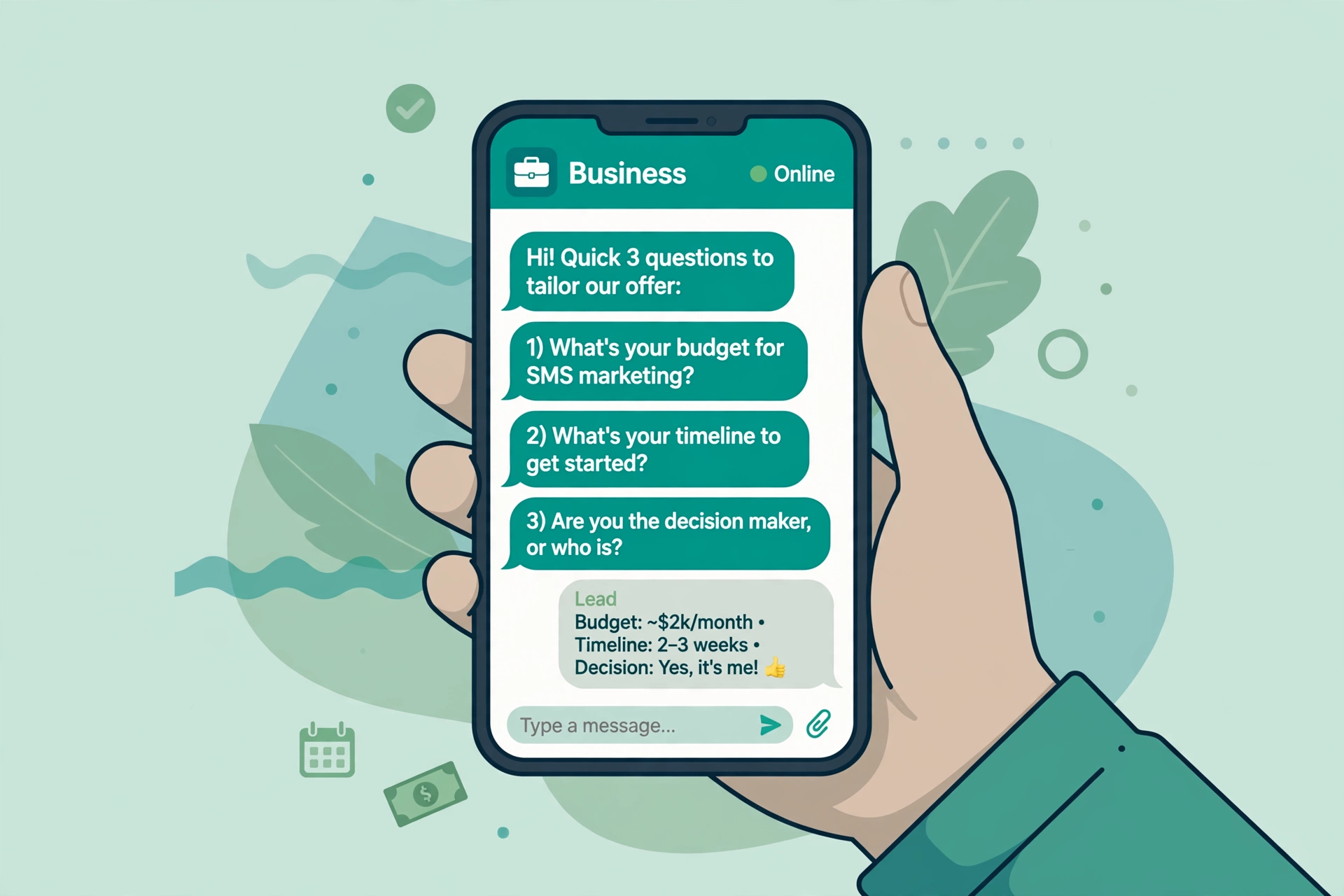
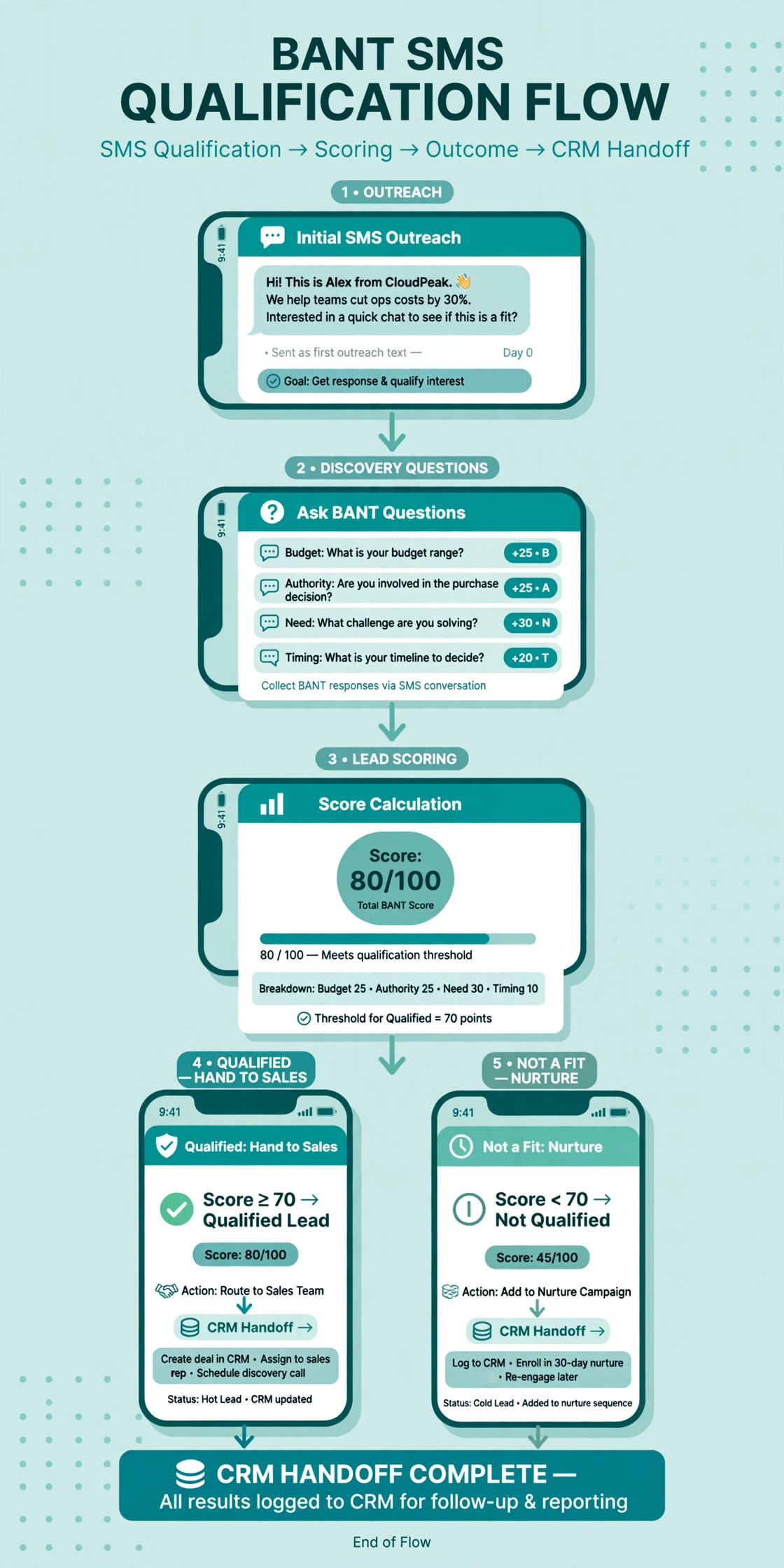
That is the problem SMS chatbot lead qualification solves. Instead of a rep calling days later, a text conversation starts within seconds. The bot introduces itself, asks three to five short questions, decides whether the lead is worth a human call, and hands a scored summary to your CRM.
This guide walks through how that works in practice: a BANT style flow mapped to actual text messages, a simple way to score answers, how the CRM handoff should look, and example scripts for common businesses.
What SMS chatbot lead qualification actually is
It is a two way text conversation triggered by a new lead, usually a form submission, a missed call, or an ad lead. The chatbot sends the first text right away, asks qualifying questions one at a time, and routes the lead based on the answers.
This is not a drip campaign. A drip campaign pushes messages on a schedule whether or not anyone replies. A qualification chatbot listens. It reads each reply and decides which question comes next.
The BANT flow, mapped to 3 to 5 texts
BANT stands for Budget, Authority, Need, and Timeline. Those four answers tell a salesperson almost everything they need to know before a first call. Collect them one question per text. Long multi question messages get skimmed or ignored. Short texts feel like talking to a person, and people answer people.
A standard flow looks like this:
Text 1: Introduce yourself, then ask about need. Name your business first since the lead may not recognize your number. Need is the easiest question because the lead already knows what they want.
Text 2: Ask about timeline. Someone buying next week gets different treatment than someone browsing for next year.
Text 3: Ask about budget. Make it multiple choice. Picking A, B, or C is easier than typing a number.
Text 4: Ask about authority. Find out if they are the decision maker before a rep pitches someone who cannot buy.
Text 5 (optional): The next step. Qualified leads get a booking link or a call offer. Everyone else gets a polite close and a nurture route.
Here is what that looks like for a fictional B2B software company selling scheduling software to dental clinics:
Bot: Hi Sarah, this is Dana from BrightBook, the scheduling tool you just looked at. Quick question so I point you to the right info: how many providers does your practice have?
Sarah: 4
Bot: Got it. And when are you hoping to have something in place? This month, or further out?
Sarah: This month ideally, we are losing bookings
Bot: Makes sense. Most of our plans run 99 to 249 a month depending on size. Is that in range for you? A, B, or C works: A under 99, B 99 to 249, C over 249
Sarah: B
Bot: Good. Last one: are you the person who would make the call on this, or is there a partner or office manager involved?
Sarah: That would be me
Bot: Perfect. You are exactly who we built this for. Want me to grab you a 15 minute walkthrough this week? I can send a booking link.
Four answers, no phone tag. The rep who takes the booking already knows the practice size, timeline, budget range, and that Sarah decides.
Scoring the answers
Raw answers are useful, but scores are what let you route leads automatically. A simple point system works fine. Assign points per answer based on what matters to your business. Here is a starting template:
| Signal | Hot answer | Warm answer | Cold answer |
|---|---|---|---|
| Timeline | This month or sooner | Next 2 to 3 months | Just researching |
| Budget | In your target range | Close or flexible | Well below range |
| Authority | Decision maker | Influencer with access | No influence |
| Need | Specific, described in their words | General but real | Vague or unclear |
Add the points up on a 0 to 100 scale and set routing thresholds. A common split is 80 and above for hot, 50 to 79 for warm, and below 50 for cold. Hot leads get an instant alert and a booking link. Warm leads go into a nurture sequence with a check back in a few days. Cold leads get a polite close and a light touch at most.
Tune the weights after your first 50 or so conversations. If your close rate on 80 plus leads is weak, your scoring is generous and the threshold should move up.
The CRM handoff
Qualification is only half the job. The other half is getting the result into your CRM in a shape your sales team will actually use. A good handoff writes at least four things to the contact record:
- The score and tier. Hot, warm, or cold, plus the number. Reps sort by this.
- The answers. Each qualifying answer as a field, not just a transcript. Fields can trigger automations; transcripts cannot.
- A one line summary. For example: “4 provider dental practice, buying this month, budget 99 to 249, decision maker.” Reps read this before they call.
- The conversation log. The full thread attached to the contact so the rep can see tone and exact wording.
For hot leads, add an instant alert: a Slack message, an email, or a text to the on call rep with the summary and a tap to call link. A hot lead that sits for two hours cools down.
Also tag the outcome clearly: qualified, nurture, unqualified with reason, or no response. Clean statuses are what make your reports honest later.
Example flows for two common businesses
Home services: the missed call follow up
Home service leads often arrive as missed calls. The bot texts within a minute and qualifies urgency, location, and job type.
Bot: Hi, this is Mike from Apex Plumbing. Sorry we missed your call. Are you dealing with something urgent right now, like a leak or no hot water?
Lead: Yeah my water heater is leaking
Bot: Got it, we will treat that as urgent. What is the service address zip code so I check you are in our area?
Lead: 78745
Bot: We cover that area. Is this your home or a rental property?
Lead: My home
Bot: Thanks. I am flagging this as urgent for our dispatcher. Can someone call you in the next 15 minutes at this number?
Urgent plus in area plus homeowner scores hot, so the dispatcher gets an alert with the zip and the problem already captured.
Real estate: buyer lead qualification
Bot: Hi James, this is Lena with Harbor Realty. Thanks for checking out the Maple Street listing. Quick one: are you looking to buy in the next couple of months, or just browsing for now?
James: Probably in the next 2 months
Bot: Nice. Have you talked to a lender yet, or is that still ahead of you?
James: Still ahead of me
Bot: No problem, we can connect you with one. Last question: are you already working with an agent, or would you like someone from our team to show you around?
James: Not working with anyone yet
Bot: Great. I will have an agent reach out today with a few times to see the Maple Street place. Does late afternoon work for you?
Timeline, financing status, and agent status give the agent everything needed for the first call, including a heads up to bring a lender contact.
Handling the messy middle
Real conversations wander. Your bot needs rules for the moments the happy path breaks.
No reply. Wait about 10 to 15 minutes, then send one short nudge that adds something, not just “bumping this.” If they still do not reply, one follow up the next day is reasonable. After that, stop texting and let nurture take over.
Off topic replies. Leads ask questions mid flow: pricing details, feature questions, “do you serve my area.” Answer briefly in one or two sentences, then steer back to the open question.
Angry or frustrated replies. Hand off to a human immediately. Flag the thread as needs human and alert a rep with the full context.
STOP, unsubscribe, or remove me. This one is non negotiable. Any opt out language must suppress the number instantly and no further message should be drafted, not even a confirmation text from the bot. Most SMS platforms handle the opt out automatically at the carrier level, but your bot logic should also catch it first so it never tries to continue the conversation. For more on staying inside allowed sending windows, see the SMS quiet hours checker.
A quick compliance note
You need permission before you text someone for marketing or sales purposes. A form submission with clear consent language or a keyword opt in are the usual paths. Every automated text should identify your business and include opt out instructions. This is general information, not legal advice. Texting rules carry real penalties, so check your situation with a qualified attorney before you launch.
Prefer to watch it built? This walkthrough shows an AI chatbot replying to a lead, qualifying them, and booking straight into a calendar:
Want this set up for you?
I build SMS chatbots and API integrations for businesses. If you would like what this guide describes, done for you, get in touch.
Frequently asked questions
How many questions should an SMS qualification bot ask?
Three to five. Fewer than three rarely gives you enough to score the lead, and more than five starts to feel like a survey. Qualify first and let the human rep collect the rest on the call.
What questions should the bot ask first?
Start with the easiest one, usually need or timeline. Budget and authority feel more personal, so they land better as the third or fourth text once the lead is already engaged.
How fast should the first text go out after a lead comes in?
Within a minute or two. Contact rates drop sharply after the first few minutes, and the whole point of automating this is that no lead waits for business hours.
What happens when a lead texts STOP?
The number must be suppressed immediately and the conversation must end. Do not let the bot draft any reply to the opt out message. Log the opt out in your CRM so the lead never gets re added to a texting list by mistake.
When should the bot hand a lead to a human?
Hand off when the lead is hot and ready for a call, when they ask something the bot cannot answer accurately, when sentiment turns negative, or when they request a person. A useful rule is that the bot qualifies and the human closes.
Can a chatbot qualify leads without a CRM?
It can hold the conversation, but you lose most of the value. Without a CRM there is no scoring history, no routing, no reporting, and no transcript for the rep. At minimum, push the score, the answers, and the conversation log somewhere your team works every day.
Wrapping up
SMS chatbot lead qualification works because it meets leads in their text inbox, seconds after they show interest. Keep the flow to three to five texts, ask one question at a time, score the answers with a simple system, and hand your CRM a clean record with a summary a rep can read in ten seconds.
If you are building out more of these flows, browse the free SMS tools for utilities like list cleaning and cost estimation that support the texting side of your operation.