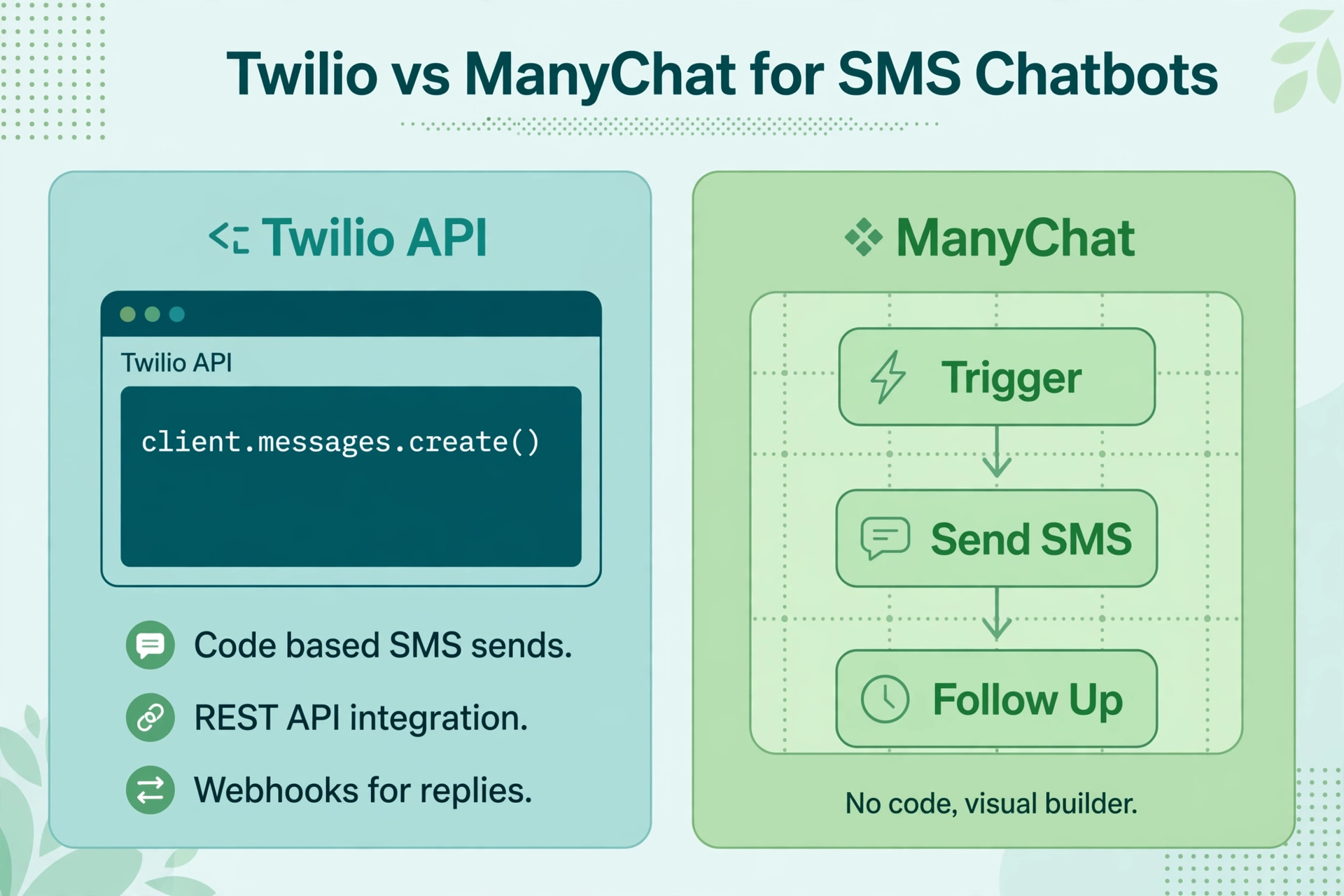
This is really a build versus buy decision wearing a product comparison costume. Twilio is infrastructure. ManyChat is an application. Comparing them feature by feature misses the point, because they are not trying to do the same job. The right question is: do you want to build your SMS chatbot, or do you want to buy one that is already assembled?
Let us walk through what each one actually gives you, what each one costs at real volumes, and which teams should pick which.
What Twilio actually is
Twilio is a communications API platform. You get programmable SMS, voice, WhatsApp, email through SendGrid, and verification APIs, all wired together with excellent documentation and SDKs in every major language. What you do not get is a user interface. There is no shared inbox, no drag-and-drop flow builder, no dashboard your marketing team can log into and run campaigns from. You build all of that yourself, or you buy a product built on top of Twilio.
That distinction matters more than any pricing table. A developer-led team sees Twilio as freedom: total control over conversation logic, memory, integrations, and data. A marketing team with no engineers sees Twilio as a pile of very good bricks with no house.
Twilio keeps shipping for the AI era too. Its Agent Connect SDK for building conversational agents went generally available in May 2026, and its documentation remains the best in the CPaaS category. If you are building a custom AI SMS agent with your own LLM orchestration, Twilio is the natural dial tone underneath it. Our SMS API guides hub covers the developer path in more depth.
What ManyChat actually is
ManyChat is a no-code visual builder for messaging automation. You get the flow canvas, triggers, conditions, keyword handling, broadcasts, a team inbox, and integrations with Shopify, Klaviyo, HubSpot, and Google Sheets. It covers Messenger, Instagram DMs, WhatsApp, SMS, email, Telegram, and TikTok comment automation from one dashboard.
What you do not get is per-message pricing on the messaging itself (you pay ManyChat’s plan plus per-message surcharges), and you do not get the kind of deep programmatic control an API gives you. Complex logic is possible through webhooks and API steps, but you are always working inside ManyChat’s model of contacts, flows, and channels.
ManyChat’s strength is marketer ownership. A marketing manager can build, launch, and iterate on an SMS chatbot without filing a ticket with engineering. For lead qualification flows, abandoned cart recovery, and appointment reminders, that speed is the whole value proposition. See our lead qualification and appointment reminder guides for the kinds of flows marketers typically build first.
The cost comparison
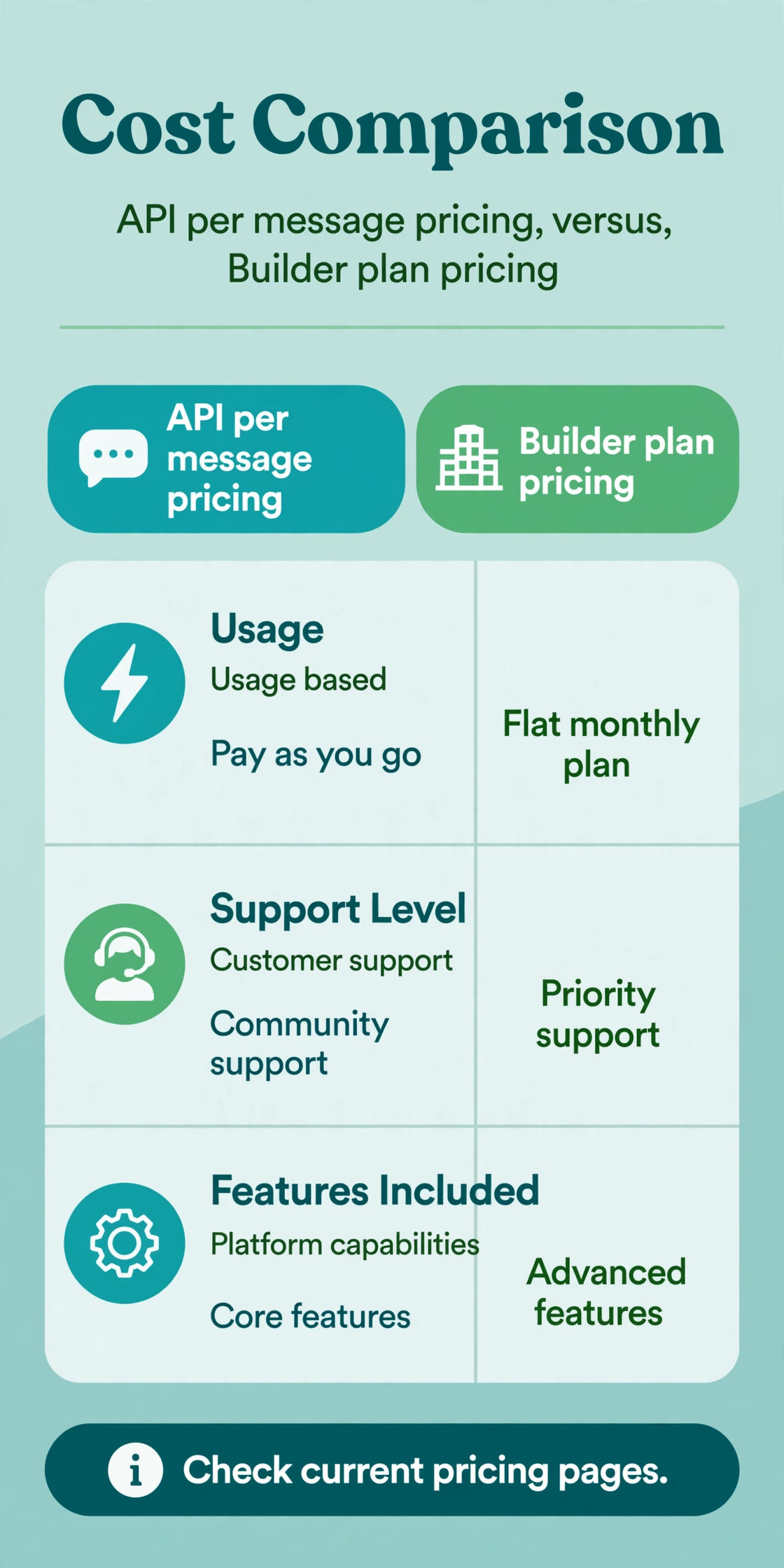
Here is where the build versus buy math gets concrete. All figures below are from 2026 sources and should be re-checked at publish time, since both vendors change pricing.
Twilio costs (pay as you go, no plan required):
Twilio bills per message segment, and a segment is 160 GSM characters or 70 Unicode characters. Longer messages bill as multiple segments, which surprises people the first time.
| Cost item | 2026 figure (US) |
|---|---|
| Outbound SMS per segment | About $0.0083 |
| Inbound SMS per segment | About $0.0083 |
| Carrier pass-through per message | About $0.0025 to $0.0045 depending on carrier |
| Long code phone number | $1.15 per month |
| Short code | About $1,000 to $1,500 per quarter plus setup |
| Trial credit | $15 free credit, roughly 1,900 SMS |
So a 10,000-message month on Twilio costs roughly $83 in message fees plus about $25 to $45 in carrier surcharges plus $1.15 for the number. Call it around $110 to $130 all in, before you count a single hour of engineering time.
ManyChat costs (plan plus usage):
ManyChat bills by active contacts per month, and SMS rides on top as a per-message surcharge.
| Cost item | 2026 figure |
|---|---|
| Free | $0, 25 active contacts |
| Essential | About $14 to $17 per month, 250 contacts |
| Pro | About $29 to $39 per month, 2,500 contacts |
| Business | About $69 to $99 per month, 7,500 contacts |
| Advanced | About $139 to $199 per month, 25,000 contacts |
| SMS per-message surcharge | Reported roughly $0.01 to $0.03 per message |
| AI add-on | Reported about $29 per month |
So a 10,000-message month on ManyChat might look like a $39 Pro plan plus $100 to $300 in SMS surcharges, or roughly $140 to $340, with zero engineering time.
The honest math: Twilio is cheaper per message, always. ManyChat can be cheaper overall once you price in the engineering time to build and maintain a Twilio-based bot. A developer spending even a few days a month maintaining a custom bot wipes out the per-message savings fast. But at very high volumes, say hundreds of thousands of messages a month, Twilio’s per-message advantage compounds and the custom build pays for itself.
Run your own numbers with our bulk SMS cost calculator before you decide. Model your real message volume, not your contact count, since segments and replies both bill.
Control versus speed
Cost is only half the story. The other half is what you can actually build.
With Twilio, you own everything. Conversation memory across sessions, custom NLP, calls into your internal APIs mid-conversation, escalation logic that matches your exact support process, data residency choices, your own analytics. If your SMS chatbot needs to check an order status in your warehouse system, apply a loyalty discount, and then hand off to a human with full context, you can build exactly that. The price is engineering time: building it, and maintaining it forever.
With ManyChat, you get speed and marketer ownership. The visual builder, keyword triggers, and ready integrations mean a campaign can go from idea to live in an afternoon. The tradeoff is the ceiling: unusual logic gets awkward, and you are subject to ManyChat’s pricing changes, feature gating, and platform risk. The March 2026 overhaul, which cut the free plan from 1,000 contacts to 25 and restructured every tier, is a reminder that you are renting.
There is also a middle path that a lot of teams end up on: Twilio for the messaging pipe, plus a bot framework like Botpress or a conversational AI platform on top. You get more control than ManyChat with less custom code than raw Twilio. It is still an engineering project, just a smaller one.
Compliance and deliverability
Both paths face the same US texting rules: 10DLC registration for application-to-person messaging, express consent before marketing texts, working opt-out handling, and quiet hours. Neither Twilio nor ManyChat exempts you.
The practical difference is tooling. Twilio gives you the primitives and expects you to implement compliance correctly: 10DLC campaign registration, STOP keyword handling, consent logging. ManyChat gives you builder blocks for consent capture and keyword triggers, which makes the basics easier but does not make you compliant by itself. Either way, read our 10DLC registration guide before you send your first campaign. This is general information, not legal advice.
One more consideration: deliverability and sender reputation behave differently. On Twilio you manage your own numbers, registration, and throughput. On ManyChat the SMS sending runs through their setup, so you inherit their deliverability practices, good and bad.
Which should you choose?
Choose Twilio if you have engineering resources, high message volume, unusual conversation logic, or strict requirements around data and integrations. It is the cheapest per message and the most flexible, and the flexibility is the point.
Choose ManyChat if marketers need to own the chatbot, you want to launch this week, your flows fit in a visual builder, and your volume is modest enough that per-message surcharges do not dominate. It is the fastest path from zero to a working SMS bot.
Choose the hybrid if you want Twilio-grade control with less custom code: Twilio plus a bot framework, accepting some engineering overhead for a higher ceiling.
FAQ
Is Twilio cheaper than ManyChat for SMS chatbots?
Per message, yes. Twilio runs about $0.0083 per US segment plus carrier fees, while ManyChat adds a plan fee plus reported per-message surcharges of roughly $0.01 to $0.03. But Twilio requires engineering time to build and maintain the bot, which often makes ManyChat cheaper overall at low to moderate volumes.
Can non-technical teams use Twilio?
Not really on its own. Twilio is an API with no built-in bot builder or marketer dashboard. Non-technical teams either need developers or should use a product built on Twilio, like ManyChat itself or a dedicated SMS platform.
Does ManyChat use Twilio for SMS?
ManyChat handles SMS delivery through its own setup and bills per-message surcharges on top of plans. You do not manage a separate Twilio account for ManyChat SMS.
How many messages can I send per month on each?
Twilio has no plan cap; you pay per segment and throughput depends on your number type and 10DLC registration. ManyChat’s plans are priced by active contacts, not messages, with SMS surcharges on top.
Which is better for AI chatbots specifically?
Twilio gives you the freedom to wire any LLM and any orchestration you want, which suits custom AI agents. ManyChat offers AI Steps, a Flow Builder Assistant, and a paid AI add-on, which suits marketers who want AI help inside a visual builder. For a truly custom AI SMS agent, Twilio plus your own stack wins on capability.
What about 10DLC registration?
Both paths need it for US application-to-person texting. On Twilio you register campaigns yourself through the console. With ManyChat, follow their SMS onboarding for registration. Either way, unregistered traffic gets filtered or surcharged.
The bottom line
Twilio is the buy-the-ingredients option: cheapest per message, total control, real engineering cost. ManyChat is the order-the-meal option: fast, marketer-friendly, pricier per message, with a ceiling on customization. Most teams should decide based on who will own the bot day to day and how weird the conversation logic needs to be, not on the per-message rate alone. If engineers own it and volume is serious, build on Twilio. If marketing owns it and speed matters, buy ManyChat.
Want this set up for you?
I build SMS chatbots and API integrations for businesses. If you would like what this guide describes, done for you, get in touch.