There is no single “best” SMS chatbot platform. A solo founder who has never written code needs something completely different from a developer team that wants raw API control, and both need something different from an enterprise that has to prove consent records to a legal team.
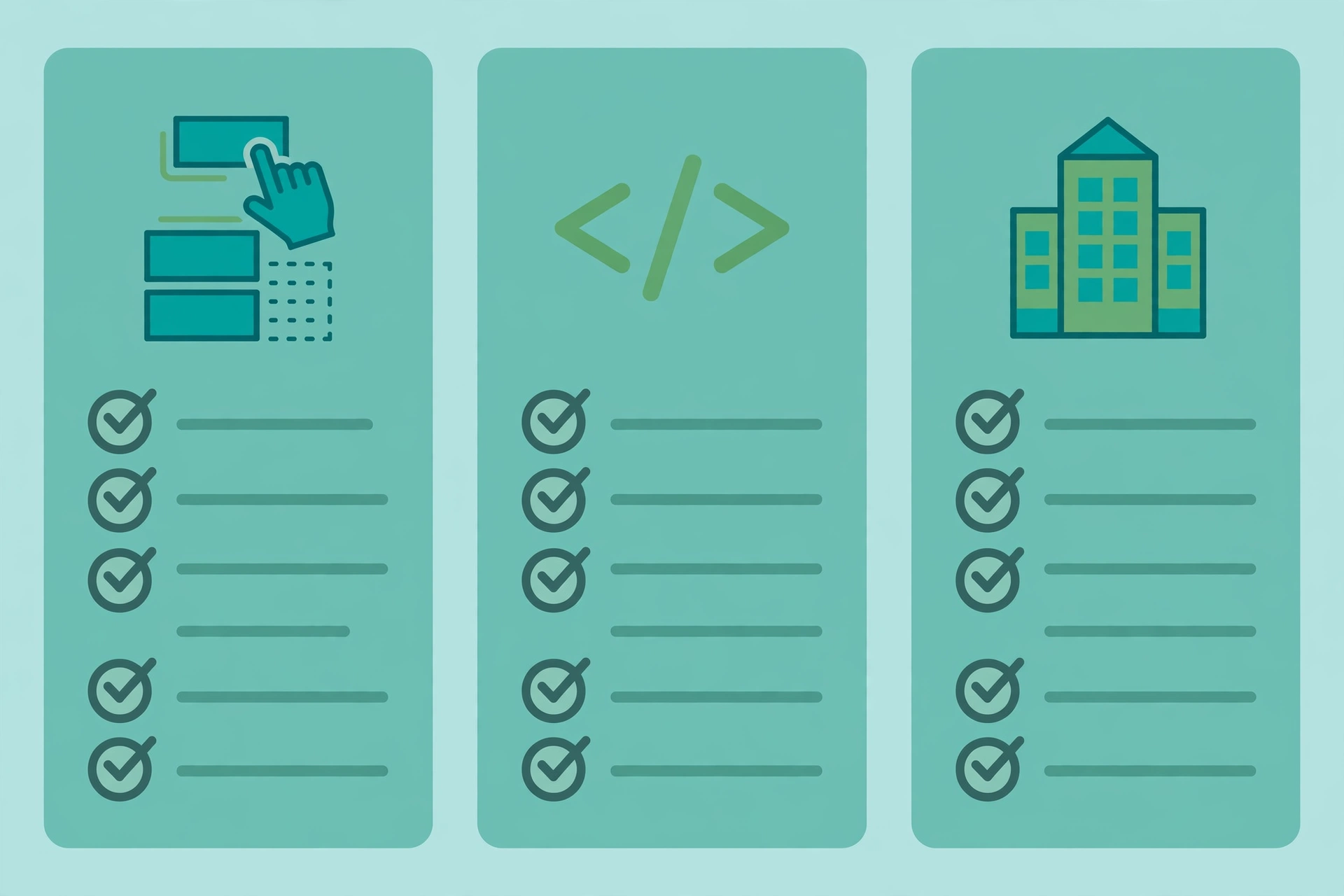
So this list is segmented by buyer, not ranked in one flat line. Three picks for no-code teams, three for developers, and three for enterprises. Every platform below was checked for one thing first: does it actually support real two-way SMS conversations right now.
One disclosure. Pricing and features in this space change fast. Everything below was checked on September 28, 2026. Treat every number as a snapshot and confirm it on the vendor’s site before you buy. No subscription covers carrier fees.
How we ranked these
We scored each platform on five things, weighted differently per segment:
- Real SMS support: native two-way texting with keyword triggers.
- Speed to first working bot: how fast a typical user gets live.
- AI quality: genuinely AI-driven replies versus dressed-up keyword matching.
- Compliance tooling: consent capture, opt-out handling, quiet hours, audit trails.
- Pricing transparency: published prices beat “talk to sales.”
The short version
| Segment | Pick | Starting price |
|---|---|---|
| No-code | ManyChat | Free, paid from $17/mo |
| No-code | BotPenguin | Free, paid from $29/mo |
| No-code | Textedly | Free account, paid from $29/mo |
| Developer | Twilio | Pay as you go, ~$0.0083/segment |
| Developer | Plivo | Pay as you go, ~$0.0055/SMS |
| Developer | Bird | Pay as you go, $0.0035/segment |
| Enterprise | Attentive | Custom quote |
| Enterprise | Sinch | Custom quote |
| Enterprise | Gupshup | Usage based, custom at scale |
Best for no-code teams
1. ManyChat
ManyChat rebuilt its pricing in March 2026 around five plans: Free ($0, 25 active contacts, 2 channels), Essential ($17/month or $14 billed annually), Pro ($39/month or $29 annually, 2,500 contacts, 3 channels including SMS plus ManyChat AI), Business ($99/month), and Advanced ($199/month). The key detail: SMS opens up at the Pro tier.
Its visual flow builder is one of the most polished in the category, and its comment-to-DM automation is what made the platform famous. AI replies on Pro and above handle open-ended questions instead of forcing conversations down rigid menu trees.
Watch the billing model. You pay per active contact (anyone who sends or receives a message that month), not per message, and SMS carrier fees sit on top at roughly $0.01 to $0.03 per message. For creators and small shops with engaged audiences it is an easy recommendation.
2. BotPenguin
BotPenguin’s own site describes a free-forever plan (around 1,000 messages a month), the Little plan at $29/month, and the King plan at $99/month. The standout: AI is included on every tier rather than gated behind expensive plans, which is rare.
For SMS, BotPenguin connects through your own Twilio number. You provision the number on Twilio’s side, build the bot in BotPenguin’s drag-and-drop builder, and your send costs follow Twilio’s rates. You get live chat handoff and CRM integrations (HubSpot, Salesforce, Zoho among 40+) without writing code, plus GDPR, HIPAA, and CCPA compliance claims with ISO certification and SOC 2 attestation.
3. Textedly
Textedly keeps things deliberately simple. There is a genuinely free account with 50 messages and one custom keyword, no credit card required and no time limit, making it one of the few places to test real SMS automation without paying. Paid plans start at $29/month for 500 messages.
Every plan includes drip campaigns and conversation triggers, and annual billing gets you 20 percent more messages instead of a discount. Two things to know: an $8 per month telecom surcharge applies on every plan, and the public API is still listed as coming soon.
Textedly is the pick when you want keyword opt-ins (text JOIN to a number) that trigger an automated sequence, running this afternoon. For branching lead qualification flows with CRM sync, it will feel thin.
Best for developers
4. Twilio
Twilio is the platform everything else gets compared against. US pricing sits at $0.0083 per SMS segment plus carrier pass-through fees, with local numbers renting for about $1.15 a month. The trial gives you free usage credit with no credit card, but trial accounts can only text verified numbers.
For chatbot building you get two paths. Studio is the visual flow builder. The Messages API plus webhooks is the full-control path: inbound texts hit your webhook, your code (or your LLM) decides the reply, and you send it back. In May 2026 Twilio’s Agent Connect SDK went generally available, giving a cleaner on-ramp for conversational AI agents.
The trade-off: Twilio gives you primitives, not policy. Consent management, quiet hours, and 10DLC registration are your job to build. US 10DLC registration is mandatory for production sending (roughly a $15 brand registration plus about $10 per month per campaign). Our 10DLC registration guide walks through the process.
5. Plivo
Plivo does roughly what Twilio does at a lower per-message price. Independent comparisons put US outbound SMS around $0.0055 per message on standard rates (about $0.0077 per segment on enterprise tiers), with local numbers from $0.50 a month. The trial is a small $0.10 credit with no credit card required.
You get a full SMS and voice API, SDKs in the major languages, and 190+ country coverage. Short codes, toll-free, and 10DLC are all supported.
Pick Plivo when your SMS chatbot is really a software project and you want Twilio-class capability at a lower unit cost. Pick Twilio when you need the deepest documentation or the biggest community.
6. Bird (formerly MessageBird)
Bird deserves attention for one reason above all: it publishes its rates openly, per channel and per country, with no login wall. As of early September 2026, US SMS on long code or toll-free was listed at $0.0035 per segment with carrier fees on top, and short code at $0.0070. The stated model is “priced by volume, not by seat,” with no platform fees.
On the chatbot side, Bird offers a visual Flow Builder for designing conversation flows, plus a CRM product starting around $45 a month for 3,000 contacts. As a Dutch company with GDPR-native data handling, it is a natural fit for European teams needing EU data residency.
The honest limitation: Bird’s AI agent positioning is more marketing than documented product right now. It is excellent messaging infrastructure with a solid flow builder.
Best for enterprises
7. Attentive
Attentive is the enterprise pick for brands that want SMS as a revenue channel with someone experienced driving it. It bundles SMS, RCS, and email with AI-powered send-time optimization, and its two-tap mobile signup units are genuinely good at growing lists.
Third-party transaction data puts smaller brands at roughly $1,000 to $3,000 a month, mid-market at $3,000 to $8,000, and high-volume enterprises at $10,000 a month and up, usually with quarterly minimums and 6 to 12 month contracts. Carrier fees stack on top.
What you get for that: built-in TCPA compliance management, 100+ integrations with Shopify, Salesforce, HubSpot and the rest, and a team that runs the program with you. If you are sending six-figure monthly volumes and want a managed partner, it is the category leader.
8. Sinch
Sinch is the pick when your legal and security teams get a vote. It is recognized as a Leader in the 2026 Gartner Magic Quadrant for CPaaS, carries GDPR, HIPAA, ISO 27001, PCI DSS, and SOC certifications, and offers 500+ integrations including Salesforce, SAP, HubSpot, and Adobe.
For conversational AI, Sinch offers Chatlayer alongside the Conversation API that unifies SMS, WhatsApp, RCS, and voice. Pricing for the API side is custom quote with no published rate card. (Its India-focused Converse product lists annual plans from ₹15,000, but that is a regional SMB product, not the enterprise platform.)
Choose Sinch for regulated industries like finance or healthcare, multi-country sending, or when the certification checklist has to be long. Choose Twilio or Bird when you want self-serve pricing and faster experimentation.
9. Gupshup
Gupshup handles over 6 billion messages a month across 30+ channels including SMS, WhatsApp, RCS, voice, and Instagram, with more than 36,000 bots on its platform. If your chatbot needs to live on SMS in one market and WhatsApp in another with shared logic, that breadth is the selling point.
Pricing is usage-based on a self-serve tier (Meta’s per-message rate plus a small platform markup, reported around $0.001 per message by third-party audits) with custom enterprise plans at volume. Two honest flags: the company has no public pricing page, and the exact free-tier limits for building and testing bots are not published.
Gupshup fits mid-market to enterprise teams running high volumes across multiple channels. It is not the pick for transparent self-serve pricing or a polished no-code builder.
Platforms we checked and left out
Three names you might expect here. Chatfuel pivoted in 2026 toward an AI operating system for healthcare and wellness businesses, covering Facebook, Instagram, and WhatsApp. It does not offer a native SMS channel. Landbot is a strong no-code builder, but it natively supports web and WhatsApp only; SMS works only through third-party integrations like Zapier. And the Microsoft Bot Framework SDK was archived by Microsoft with support ending December 31, 2025; new projects are pointed at the Microsoft 365 Agents SDK instead.
A quick word on compliance
Every platform above can send texts. None of them make your program compliant on its own. US rules require express consent before marketing texts, a clear way to opt out (honor STOP requests immediately), and respect for quiet hours. 10DLC registration is mandatory for application-to-person SMS in the US. Read our guides on TCPA consent and opt-out keywords before you launch. This is general information, not legal advice.
How to choose in five minutes
If you want a bot running today with no code, start with ManyChat or Textedly and upgrade when volume justifies it. If you are building the bot into your own product, start with Twilio’s trial or Plivo. If you are an enterprise with compliance requirements and a real budget, get quotes from Attentive, Sinch, and Gupshup and compare total cost of ownership.
Want this set up for you?
I build SMS chatbots and API integrations for businesses. If you would like what this guide describes, done for you, get in touch.
Frequently asked questions
What is the best SMS chatbot platform overall?
There is no single winner. ManyChat is the best default for no-code teams and creators, Twilio for developers, and Attentive for large DTC brands.
How much does an SMS chatbot platform cost?
From free (Textedly’s free account, BotPenguin’s free plan, ManyChat’s free tier) to $25 to $40 a month for small business tools, to thousands a month for enterprise platforms. On top of every subscription, budget for carrier pass-through fees and, in the US, 10DLC registration.
Do I need to know how to code to build an SMS chatbot?
No. ManyChat, BotPenguin, Textedly, and Bird’s Flow Builder all let you build conversational flows visually. You need code only for custom logic, deep CRM integration, or AI behavior the no-code builders do not offer.
Which platform handles TCPA compliance for me?
None make you compliant by themselves, but Attentive and Sinch have the deepest built-in compliance tooling (consent capture, suppression lists, audit trails). Whatever you choose, you still own consent collection and opt-out handling.
Can I try these platforms for free before committing?
Most of them. Textedly and BotPenguin have genuinely free plans, ManyChat has a free tier, and Twilio, Plivo, EZ Texting, and SimpleTexting offer free trials with usage credit. Attentive and Sinch are demo and quote based.
Why is Chatfuel not on this list?
Chatfuel does not currently offer a native SMS channel. After its 2026 pivot it focuses on Facebook, Instagram, and WhatsApp automation for healthcare and wellness businesses.