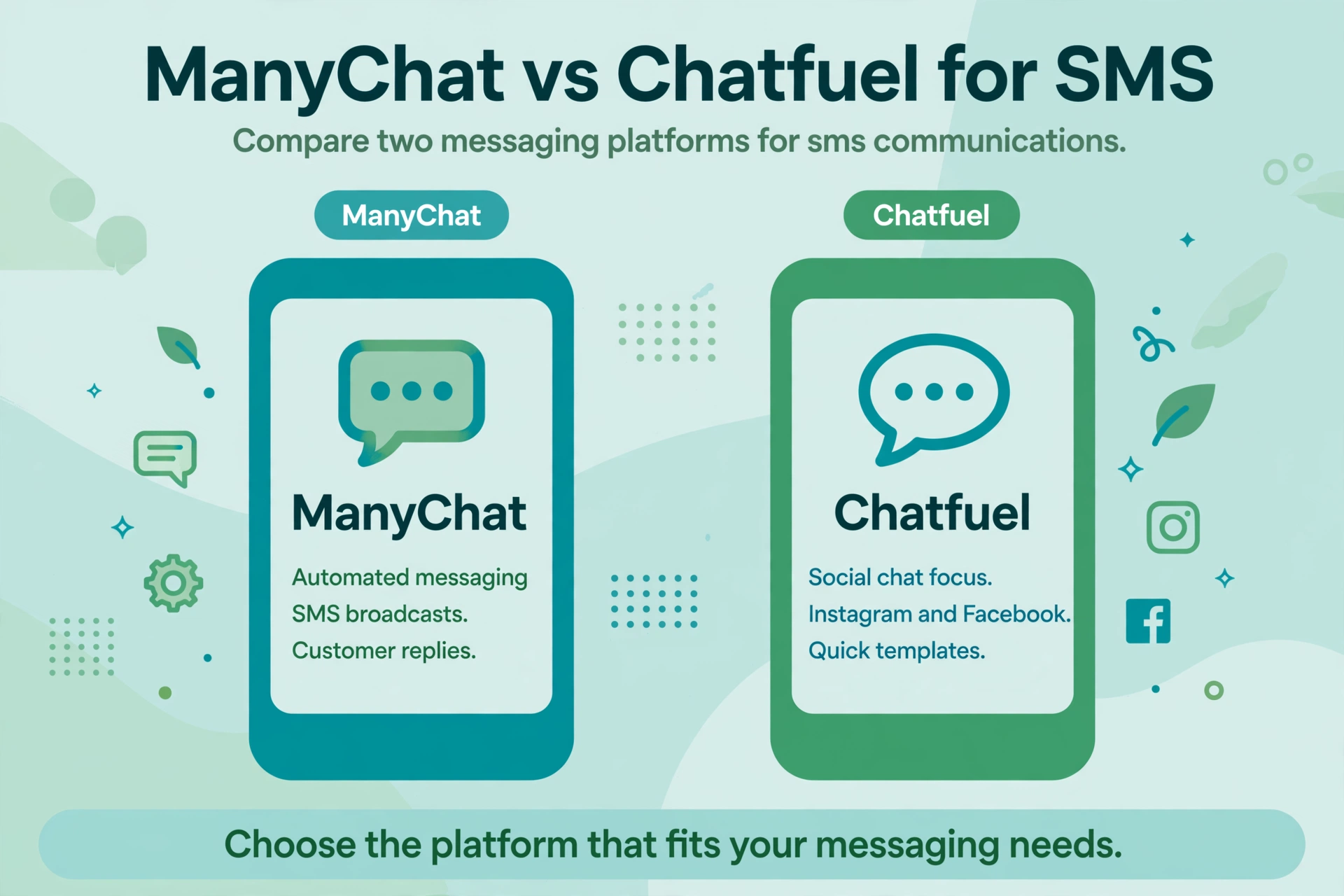
Let me save you some time up front. If SMS is the channel you actually care about, this comparison has a very short answer. ManyChat has a native SMS channel. Chatfuel does not. Everything after that is about what you give up, what you gain, and what the workarounds look like.
That said, it is worth understanding exactly what each platform does and does not do, because the “winner” depends on what your business actually runs on. A lot of ecommerce brands live on WhatsApp and Instagram DMs and barely touch SMS. If that is you, the answer gets more interesting.
Quick legal note before we dig in: this article talks about texting rules like consent and opt-outs in general terms. It is not legal advice. TCPA rules and carrier rules change, and your situation may differ, so check with qualified counsel before you start sending marketing texts.
The short version
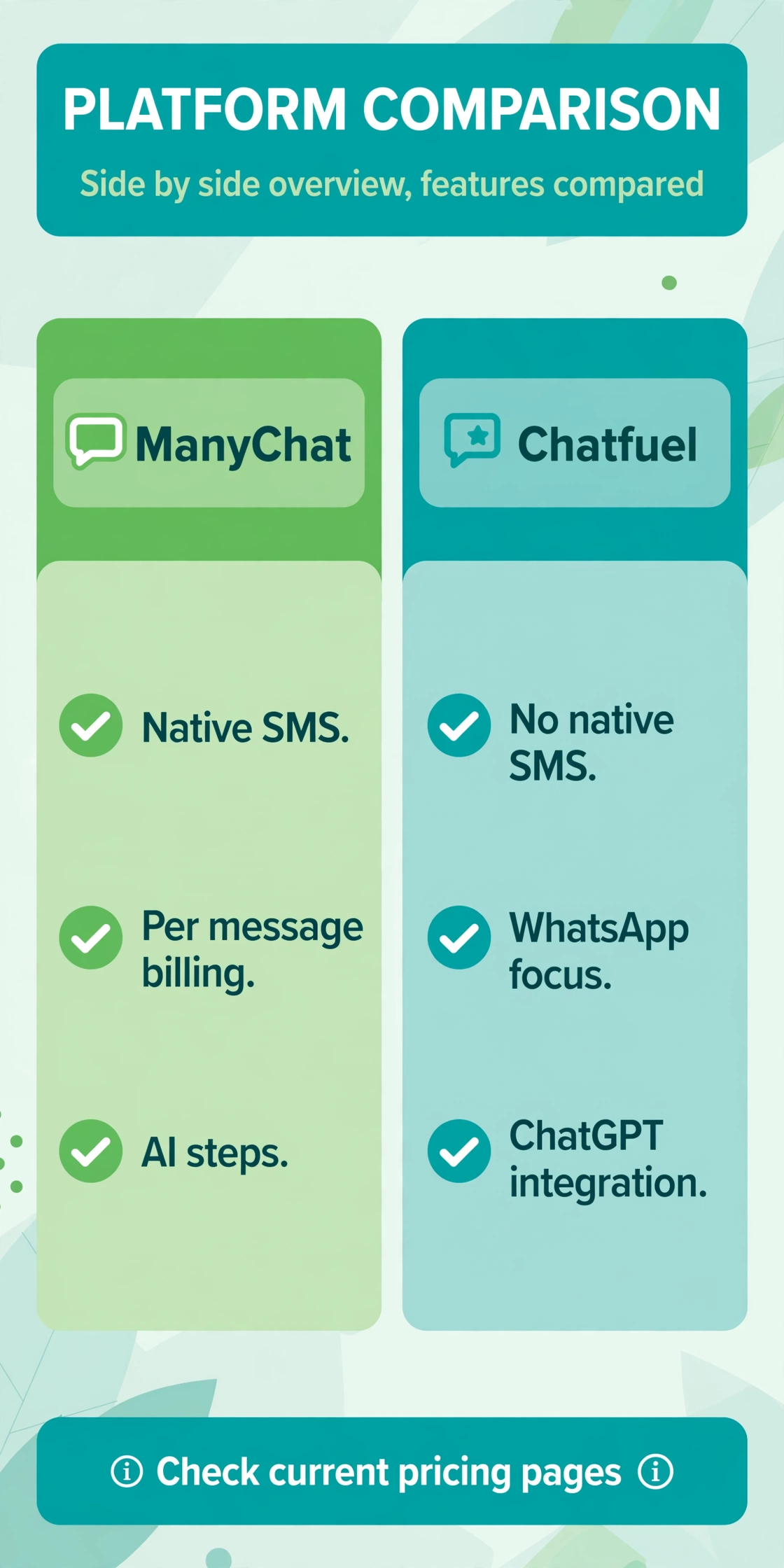
ManyChat is the broader multichannel builder. It supports Messenger, Instagram DMs, WhatsApp, SMS, email, Telegram, and TikTok comment automation. SMS is available on paid tiers, and each message carries a per-message surcharge on top of your plan.
Chatfuel is the focused one. It runs on Messenger, Instagram, and WhatsApp, with a website widget in beta. It has no native SMS or email. If your whole strategy is social messaging, especially WhatsApp commerce, Chatfuel goes deep there. If you need a text message channel, you are building a workaround.
SMS channel support: the deciding factor
This is the whole game, so let us be precise.
ManyChat supports SMS as a first-class channel inside its flow builder. You can capture a phone number in a conversation, ask for consent, and then send SMS messages, run SMS sequences, and build keyword triggers from the same visual builder you use for DMs. ManyChat also handles email from the same place, which matters if you want a lead that arrives on Instagram to be followed up by both email and text.
Chatfuel does not do native SMS. Multiple 2026 reviews and comparisons confirm this, including Tidio’s Chatfuel review and the typebot.io comparison: Chatfuel lacks native email and SMS. Its channels are Messenger, Instagram, WhatsApp, and a website chat widget that is still in beta.
Does that mean Chatfuel can never touch a text message? Not quite. Chatfuel integrates with Zapier and Make, which means you can wire a Chatfuel conversation to an SMS provider like Twilio through automation. It works, but it is a different thing from native support. You now have two bills, two dashboards, and a Zap sitting between your bot and your customer’s phone. For a small drip sequence that is fine. For a real SMS program with thousands of messages, it gets fragile.
Pricing and what SMS actually costs
Both platforms meter differently, so compare carefully.
ManyChat bills primarily by active contacts per month. The 2026 plan lineup, after the March 2026 overhaul, looks roughly like this: a free plan capped at 25 active contacts, Essential around $14 to $17 per month for 250 contacts, Pro around $29 to $39 for 2,500 contacts, Business around $69 to $99 for 7,500, and Advanced around $139 to $199 for 25,000 contacts. Annual billing runs cheaper than monthly. Note that ManyChat has been migrating accounts between plan structures, so the numbers you see on manychat.com may differ slightly from what older reviews quote.
SMS is not included in any of that. It is billed per message on top. Third-party 2026 breakdowns put the surcharge at roughly $0.01 to $0.03 per message, with one source citing about $0.015 for US SMS and about $0.04 for MMS. Treat those as reported figures from review sites, not official ManyChat rates, and check the current pricing page before you budget. WhatsApp also carries Meta’s per-conversation fees on top.
One more wrinkle: sources do not fully agree on which tier unlocks SMS. A July 2026 pricing breakdown says Pro adds WhatsApp, SMS, and email. A 2026 cost analysis says SMS is available on Business and Advanced plans. That kind of disagreement usually means a rollout in progress. If SMS is the reason you are buying, confirm the tier with ManyChat directly before you commit.
Chatfuel prices by channel and by conversation volume, which is a different kind of math. The Facebook and Instagram plan starts around $23.99 per month for up to 1,000 conversations. The WhatsApp plan starts around $34.49 per month for the same volume. Enterprise plans start around $300 per month with an account manager and bot-building hours. Instead of a free tier, new users get a 50-conversation trial. Exceed your conversation limit and overage fees apply, so businesses with spiky volume need to watch this.
For an SMS-first program, ManyChat’s total cost is the plan plus per-message SMS fees. For Chatfuel, there is no SMS plan at all, so your “SMS cost” is whatever your Zapier plus SMS provider stack costs, plus the maintenance headache.
AI and conversation quality
Both platforms have moved toward AI, but they took different paths.
Chatfuel leans AI-first. It has built-in ChatGPT integration and offers AI agents for lead qualification, product recommendations, and scheduling. The vibe is generative: the bot handles unscripted questions more naturally instead of forcing every reply down a button branch. This is one of the main reasons brands choose Chatfuel for WhatsApp commerce, where customers ask messy, real questions about products.
ManyChat is flow-first with AI layered on. The visual flow builder is the star, with triggers, conditions, and actions you build by hand. It offers AI Steps to build conversational logic and a Flow Builder Assistant that helps structure automations faster. There is also a paid AI add-on, reported at around $29 per month on Pro and Business, for fuller AI chatbot behavior. ManyChat’s strength is predictability: if the path is scriptable, the flow builder handles it beautifully. The moment a customer types something off-script, you feel the difference versus a generative bot.
For SMS specifically, this matters more than people expect. SMS is a plain-text channel. There are no buttons, no carousels, no quick replies. A bot on SMS lives or dies on natural language understanding. A generative AI layer helps a lot here, which is a point in Chatfuel’s favor conceptually, except Chatfuel does not do SMS natively. On ManyChat, SMS flows tend to be more scripted, with keyword triggers doing the heavy lifting. That works well for things like appointment reminders, order updates, and simple keyword campaigns, where the conversation paths are narrow.
Who each platform is really for
Pick ManyChat if SMS is part of the plan. The native channel, keyword triggers, and the ability to run Instagram, WhatsApp, SMS, and email from one builder make it the obvious choice for multichannel marketing. It is also the better pick for creators running comment-to-DM funnels who want to follow up by text. Just budget for the per-message fees and confirm which tier unlocks SMS right now.
Pick Chatfuel if your business lives on WhatsApp and Instagram and you do not need SMS at all. Its GPT-powered conversations are genuinely stronger for commerce use cases like product questions and recommendations, and its WhatsApp tooling is deep. Mid-market ecommerce brands running ad-driven WhatsApp campaigns are its sweet spot. Just go in knowing that SMS is off the table natively, and the Zapier workaround is a workaround, not a strategy.
Compliance: the part nobody can skip
Whichever platform you choose, the texting rules are the same. In the US, marketing texts generally need prior express written consent, every message program needs working STOP and HELP handling, and you need to respect quiet hours and state laws. ManyChat gives you the building blocks (consent capture steps, keyword triggers, scheduling controls), but the legal responsibility is yours. If you use the Chatfuel plus Zapier plus Twilio route, make sure consent records and opt-out handling are wired correctly across all three systems, because a gap in the chain is where violations happen. Our guides on TCPA consent for SMS chatbots and STOP and HELP keywords walk through the requirements in plain language.
What about the alternatives?
If you want native SMS plus AI without the per-contact pricing model, look at the CPaaS route: Twilio or Plivo for the messaging layer plus a bot framework on top. It is more engineering work but cheaper per message at scale. If you want SMS-first autoresponders with keyword depth and do not need a bot builder at all, SimpleTexting or SlickText are purpose-built for that and simpler to run. And if your support use case matters more than marketing, a support platform with native SMS like Zendesk or Freshchat may fit better than either marketing builder.
A missed-call text-back flow, for example, is a classic native-SMS job that ManyChat handles well and Chatfuel simply cannot do on its own. See our missed-call text-back guide for how that flow works.
FAQ
Does Chatfuel support SMS?
No. Chatfuel has no native SMS channel. It supports Messenger, Instagram, WhatsApp, and a website widget in beta. You can send texts through a Chatfuel bot only by connecting an SMS provider through Zapier or Make, which adds cost and complexity.
Which ManyChat plan includes SMS?
SMS sits behind paid tiers, but sources disagree on exactly which one. A July 2026 pricing breakdown lists SMS under Pro, while a 2026 cost analysis says Business and Advanced. Confirm the current tier on ManyChat’s pricing page before you buy, since the lineup has been changing.
How much does SMS cost on ManyChat?
On top of your plan, third-party 2026 sources report roughly $0.01 to $0.03 per message, with one citing about $0.015 for US SMS and $0.04 for MMS. These are reported figures, not official rates. Check ManyChat’s current pricing for the exact surcharge.
Can I use Chatfuel for SMS keyword campaigns like text JOIN to 12345?
Not natively. Keyword campaigns need an SMS provider. You could route keywords through a Twilio number into Chatfuel via Zapier, but at that point you are really running a Twilio SMS program with Chatfuel attached, not a Chatfuel SMS program.
Is ManyChat or Chatfuel better for WhatsApp?
Chatfuel is the deeper WhatsApp tool for AI-driven commerce conversations, thanks to its GPT integration. ManyChat also supports WhatsApp on paid tiers and wins on multichannel breadth, since one flow can span WhatsApp, SMS, Instagram, and email.
Which is cheaper overall?
It depends on your volume and channels. Chatfuel’s entry pricing is higher per channel but it bundles AI more deeply. ManyChat’s contact-based pricing can get expensive as your list grows, and SMS fees stack on top. Price your actual contact count and message volume on both current pricing pages before deciding.
The bottom line
For SMS, ManyChat wins by default because it actually does SMS and Chatfuel does not. That is the honest headline. The real decision is whether you need SMS at all. If your customers live on WhatsApp and Instagram, Chatfuel’s AI-first approach to those channels is legitimately strong, and you should not pay for an SMS channel you will never use. If text messaging is anywhere in your strategy, ManyChat is the pick, with the caveat that you should verify the current SMS tier and per-message rates before you sign up, because both have shifted in 2026.
For more on what SMS chatbots can do once the channel is in place, browse the SMS chatbots hub or our guide to SMS chatbots for customer support.
Want this set up for you?
I build SMS chatbots and API integrations for businesses. If you would like what this guide describes, done for you, get in touch.