
You are under a sink with a wrench in your hand when your phone buzzes in your back pocket. By the time you wipe your hands and check it, the call is gone. No voicemail. That caller is now dialing the next name on the list, and there is a good chance they never call you back.
A missed call text back auto responder exists for exactly this moment. The instant a call goes unanswered, it texts the caller from your business number. Something like: sorry we missed you, how can we help? The caller is usually still holding their phone. Instead of a dead end, they get a live thread.
This guide covers how the whole thing works, the honest difference between a simple instant auto-reply and an AI conversational follow-up, the three realistic ways to set one up, and message templates you can copy today.
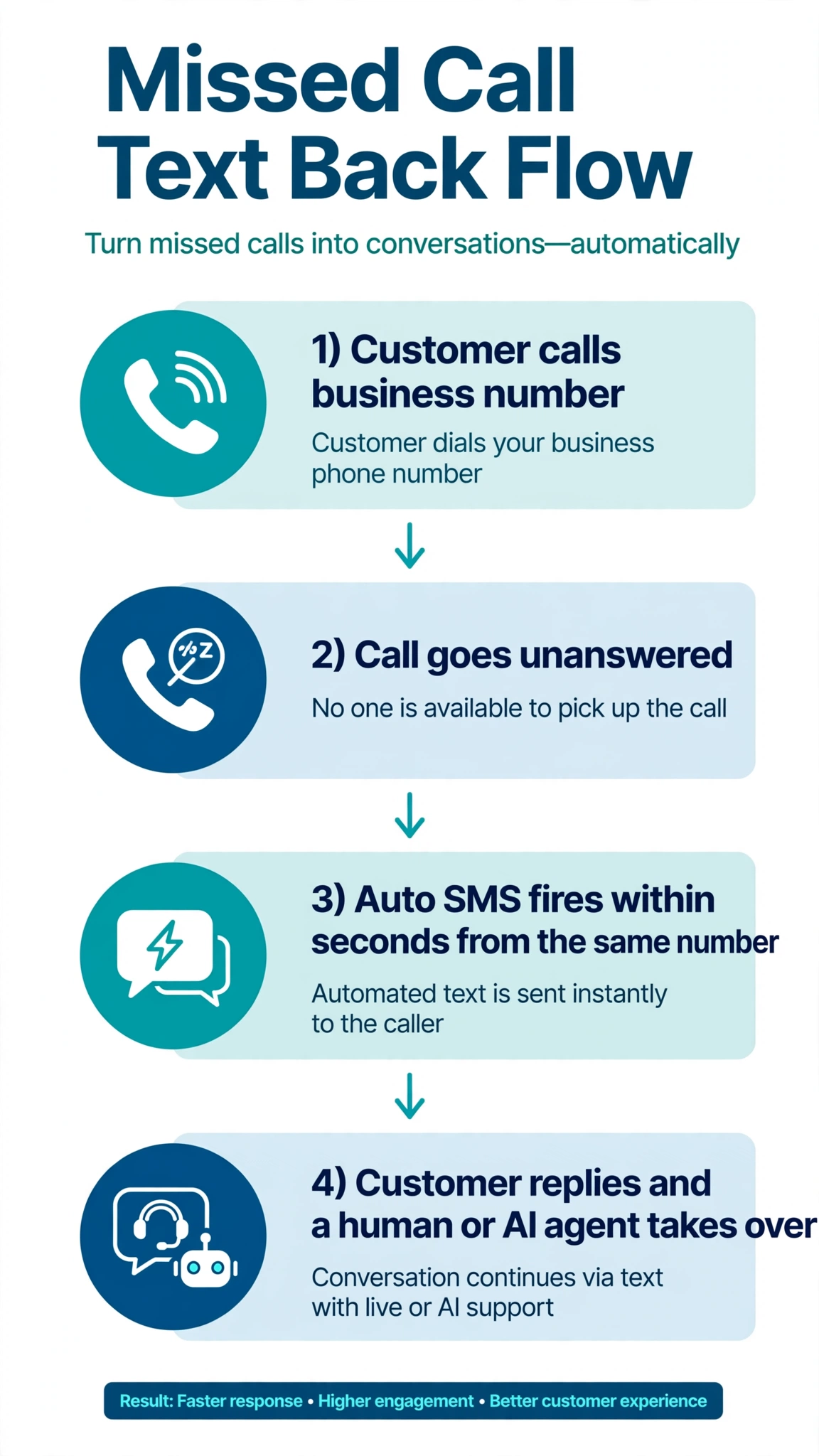
How a missed call text back actually works
The mechanic is simple. Your business number rings. Nobody picks up, so the call ends as missed. That missed call event triggers an automatic SMS to the caller’s number, usually within seconds. The text goes out from the same number they just dialed, which matters because people ignore texts from unknown numbers.
If the caller replies, the conversation lands in an inbox where you or your team can pick it up. No app to install and no portal to log into. That is the whole system.
Two flavors: instant auto-reply vs AI conversational follow-up
Most products in this space fall into one of two camps. They look similar from the outside, but they behave very differently once the caller replies.
The instant auto-reply
This is the classic version. You write one fixed message, and every missed caller gets it. “Hi, this is Mike at Apex Plumbing. Sorry I missed your call, I am on a job right now. Reply here with what you need and I will get back to you within the hour.”
It fires fast. It says exactly what you told it to say, and it costs almost nothing to run.
The weakness is what happens next. If the caller asks a question, nobody answers until you look at your phone. A static text buys you time. It does not win the job on its own. For a solo operator who checks messages between jobs, that is often enough.
The AI conversational follow-up
This is the newer version. After the first text goes out, an AI agent carries the conversation. It can answer common questions, ask what the caller needs, collect a name and address, and in some setups book an appointment straight into your calendar.
It works at 2am, during the lunch rush, and while you are on a ladder.
The trade-offs are real. AI replies cost more per message than a static text. The agent can misunderstand a caller or answer a question wrong, so you need guardrails on what it may say and what it must hand to a human. And someone still has to review bookings and conversations, especially in the first week. An AI agent that books a job for the wrong day is worse than no agent at all.
Which one fits your business
If your calls are mostly simple questions, the instant auto-reply plus a fast human callback is hard to beat. It is cheap, predictable, and honest.
If you miss a lot of calls or take them outside business hours, the AI version can pay for itself. But read a week of transcripts before you trust it, and never let it quote prices or promise arrival times.
One more honest note. Neither version helps if nobody reads the replies. The automation starts the conversation. A person still closes it.
Where it earns its keep: four concrete examples
The plumber. A homeowner calls about a leak while you are under someone else’s sink. Your text goes out: “Hi, this is Dave at Apex Plumbing. I am on a job right now. Is this urgent, a leak or no hot water? Or can I call you back within the hour?”
The salon. A client calls to move her Saturday appointment while your stylists are all with clients. Your text includes your booking link: “Hi! Sorry we missed your call. Reschedule here: [link]. Or reply with a day and time and we will move it for you.”
The medical office. The front desk steps out for lunch and three calls go to voicemail. Your text: “Hi, this is Riverside Dental. We missed your call. Reply to request an appointment or a callback.” Keep these texts to scheduling only. Never discuss diagnoses or test results over automated SMS.
The auto shop. A driver calls about a grinding noise while your bays are full. Your text: “Hi, this is Tony at City Auto. Sorry we missed you. Tell me the year and model and what you are hearing, and I will get you an estimate window today.”
Three setup paths, from simplest to most capable
Path 1: your phone’s built-in features. Both iPhone and Android can send a quick text when you decline a call, and iPhones can auto-reply while Driving Focus is on. Fine for personal use, but short for a business. It only covers your own cell phone, it cannot run different messages for open and closed hours, and replies do not land anywhere your team can see them. Treat this as a stopgap, not a system.
Path 2: a business phone platform with auto-reply built in. Most cloud business phone services include a missed-call auto-reply setting. Connect or port your business number so texts come from the number customers already call. Write your message, choose when it fires, then call the number yourself and let it ring out to confirm the text arrives. This covers most small businesses and takes under an hour.
Path 3: an SMS platform or CRM workflow with AI on the reply. The missed call triggers a workflow: send the first text, log the call to your CRM, and let an AI agent handle the back and forth. Some setups add a follow-up text if the caller never replies, plus a daily summary of missed leads. This is the most capable option and the most work to set up. It fits when call volume is high enough that missed calls are clearly costing you jobs.
Whichever path you choose, five rules apply. Text from the number they called. Name your business in the first message. Set different messages for open and closed hours. Test it with your own phone before it goes live. And assign one person to own the replies, because an inbox nobody watches is just voicemail with extra steps.
Copy-ready templates for common scenarios
Keep every first text under 160 characters if you can. Name your business, acknowledge the call, and give the caller one clear next step. Add “Reply STOP to opt out” on the first message.
During business hours:
Hi, this is [Name] at [Business]. Sorry I missed your call, I am with a customer. What can I help you with? I will reply here shortly.
After hours:
Hi, this is [Business]. We are closed until [time] tomorrow. Reply here with what you need and we will call you first thing. Reply STOP to opt out.
Weekend or holiday:
Hi, this is [Business]. We are closed for the weekend and back [day] at [time]. Send us a message here and you will be first in line Monday. Reply STOP to opt out.
One rule for all of these. The first text answers the call they made. The moment a follow-up starts pitching offers or dripping messages over several days, you have crossed into marketing, and that needs real consent.
The part everyone skips: what to do when the caller replies
Here is the gap almost nobody talks about. Businesses install the auto-responder, the texts go out, callers reply, and then nothing happens for three hours because nobody was watching the inbox. The automation did its job. The business did not.
Fix it with four habits. Send reply notifications to a real person’s phone, not just an email digest. Set a response target of fifteen minutes during business hours. Use a shared inbox so the reply is visible to the whole team. And plan for after hours: either the AI agent handles it, or the morning routine starts with the overnight replies instead of voicemail. If you run the AI version, read its conversations for the first week so you can catch where it needs better instructions.
Compliance basics for auto-reply texts
This is general information, not legal advice. Texting rules are a genuine litigation area, so talk to your own counsel if anything here feels uncertain.
Replying to someone who just called you is the safest ground in business texting. They contacted you first, and a single responsive text that names your business and asks how you can help is generally treated as answering their call, not as marketing.
Stay on the right side of the line with a few practices. One responsive text per missed call, tied to the call they made. No offers or drip sequences on message one. Include opt-out language and honor STOP replies immediately. Never add these callers to a marketing list just because they called you once. And respect quiet hours in the caller’s timezone. Our quiet hours checker can help you confirm the allowed texting window by state.
FAQ
Do I need a new phone number?
No. Most setups text from the number the caller dialed. Some services use call forwarding so they can watch for missed calls behind your existing number. Either way, the customer only ever sees your real number.
How fast does the text go out?
Within seconds is the standard. Aim for under thirty seconds. A text that arrives five minutes later finds a caller who has already moved on.
Can I set this up on my iPhone or Android directly?
Partly. You can send a quick text when you decline a call, and iPhones can auto-reply while driving. But phone-level features cannot run different business messages around the clock or share replies with a team. For a real business setup, use a business number on a platform with auto-reply.
How much does it cost?
A do-it-yourself build on a cloud phone number can run a few dollars a month plus a small per-message fee. Managed services charge a monthly subscription. Our bulk SMS cost calculator can help you estimate message costs at different volumes.
Will it work with my CRM?
Many business phone and SMS platforms log calls, texts, and replies to popular CRMs automatically. Check the integration list before you buy, and confirm the missed-call event itself syncs, not just the text thread.
What if the caller is on a landline?
They will never get the text. Keep your voicemail greeting current as the fallback for those callers, and check voicemail on a schedule.
Is an after-hours text okay at 2am?
The text is a reply to their call, so it is generally fine, but keep it short and honest about when you will respond. Check your local quiet hours rules if you plan any follow-up texts.
Watch how this works in practice. This walkthrough covers the setup step by step:
The bottom line
A missed call text back auto responder is one of the simplest automations a local business can run. Start with a plain instant auto-reply and honest reply habits. Add AI conversational follow-up when your call volume justifies it. Either way, the technology is the easy part. Watching the inbox is the job.
Want to see where this fits in a bigger messaging setup? Browse the free tools hub for the quiet hours checker and other utilities that pair well with automated texting.
Want this set up for you?
I build SMS chatbots and API integrations for businesses. If you would like what this guide describes, done for you, get in touch.