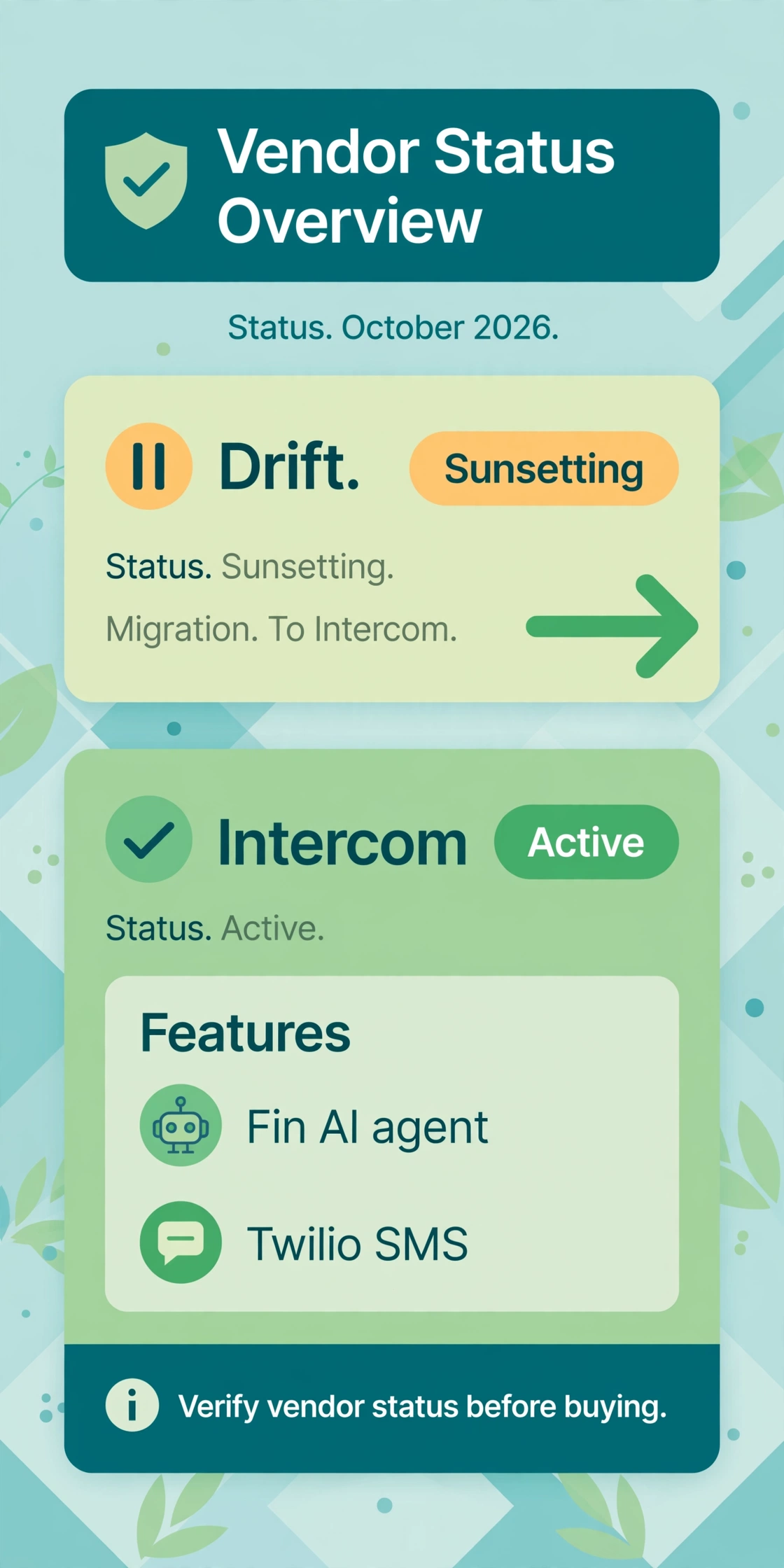
I need to be straight with you before this comparison starts: Drift is being sunset. In March 2026, its owner Salesloft announced that Drift is winding down as an independent product, naming 1mind as its successor, and existing customers are migrating. Multiple 2026 sources confirm it, including alternative-vendor pages tracking the migration wave.
So this is not a normal “which should I buy” article. Nobody should buy Drift today. This is a “what happened, what it means for your conversational marketing, and where Intercom fits” article. If you are a Drift customer planning a migration, or a team that used to shortlist Drift, here is the honest picture.
What Drift was
Drift defined conversational marketing for B2B: playbooks that engaged website visitors in real time, qualified them with chatbots, routed hot leads to sales reps, and booked meetings inside the conversation. At its peak it was the default choice for B2B SaaS companies running inbound pipeline through chat.
Two things about Drift matter for this comparison. First, its channel was the website. Drift’s playbooks lived on your site; it did not do SMS, WhatsApp, or messaging apps as native channels. Second, it was expensive and heavy: third-party sources cite entry pricing around $2,500 per month with implementations measured in weeks, aimed squarely at B2B enterprise sales teams.
That website-only footprint is why “Drift versus Intercom for SMS” was always an odd matchup. Drift never really did SMS. If your conversational marketing is moving to texting, you were already going to outgrow Drift’s channel model.
Your migration checklist
If you are on Drift today, here is a practical order of operations for the next 90 days.
First, get the facts from Salesloft in writing: the sunset timeline, what happens to your data, export formats and deadlines, and what 1mind actually covers versus what it does not. Do not rely on announcement blog posts for planning.
Second, audit your playbooks. List every Drift playbook, its conversion rate, and its owner. You will find that a handful of playbooks drive most of the pipeline. Those are the ones to rebuild first, and they are the candidates for SMS redesign.
Third, pick the new platform by piloting, not by slideware. Rebuild your top two playbooks on Intercom and on one other contender, run them on live traffic, and compare meeting-book rates and speed-to-lead. A migration forced by a sunset is still a buying decision, so make vendors earn it.
Fourth, use the move to fix consent. Drift’s web chat never needed SMS consent infrastructure. Your replacement will. Build the consent capture, preference center, and opt-out handling as part of the migration, not as an afterthought bolted on later.
What the sunset means practically
If you are on Drift today, the practical questions are about timeline, data, and playbook migration, not about features.
Timeline: Salesloft named 1mind as the successor, but successor products rarely replicate every playbook, integration, and workflow on day one. Get your migration timeline in writing from your account team, including when support and security updates end.
Data: your conversation history, playbook performance data, and lead routing rules are assets. Confirm what exports are available and in what format before the migration window closes.
Playbooks: Drift playbooks were website chat experiences. If you are rebuilding on a new platform anyway, this is the moment to ask whether those playbooks should become SMS conversations instead of just being re-created as web chat. SMS open and response rates crush web chat engagement for follow-up, and a migration is the cheapest time to redesign the channel mix.
Intercom: the active alternative
Intercom is the natural comparison because it is the other big conversational platform, and unlike Drift, it is actively developed and very much alive. Intercom positions as an AI-first customer service platform with the Fin AI agent, and it is used by tens of thousands of organizations.
For conversational marketing extended to SMS, Intercom’s story has three parts. First, the messaging core: Intercom’s Messenger, chat, and email handle the real-time engagement playbooks that Drift customers recognize. Second, Fin: the LLM-based AI agent that answers from your knowledge base, qualifies, and hands off to humans, which is the modern version of Drift’s chatbot qualification. Third, SMS reach: Intercom extends to SMS through Twilio integration and approved third-party apps, so the conversation that starts on your website can continue by text when the visitor leaves.
That third part is the strategic difference. Drift’s playbook ended when the visitor closed the tab. Intercom’s can follow up by SMS, which is where conversational marketing is heading: capture the conversation on the web, continue it on the channel the buyer actually reads.
Head-to-head, honestly framed
Since Drift is sunsetting, a feature grid would be misleading. Here is the comparison that actually helps:
Product status: Drift is sunsetting with migration to 1mind underway. Intercom is active and shipping, with Fin as its AI centerpiece. This alone decides the purchase question.
Channels: Drift was website-only. Intercom covers web chat, Messenger, email, WhatsApp via integrations, and SMS via Twilio bridging. For an SMS-inclusive strategy, Intercom’s channel model is the only viable one of the two.
AI approach: Drift’s later era had AI chatbots trained on company content for qualification. Intercom’s Fin is LLM-native, generating answers from help docs in real time. Fin represents the newer generation of the same idea.
Pricing shape: Drift was enterprise-priced with long implementations. Intercom uses seat-based pricing plus AI resolution usage. Neither is cheap; model your volume on current Intercom pricing.
Migration path: Drift customers need a new home regardless. Intercom is one candidate, but the field includes Qualified (Salesforce-only), and newer conversational platforms. Evaluate on your CRM, your channels, and whether you want the AI agent to also handle support.
Moving conversational marketing to SMS
Whether you land on Intercom or another platform, the migration moment is the time to redesign for SMS. The classic Drift playbook, qualify on the website and book the meeting, maps well to texting with a few adjustments:
Why migrations are the best time to rethink channels
There is a temptation in any forced migration to rebuild exactly what you had, just on new software. Resist it. You are already paying the switching cost: retraining the team, rebuilding integrations, revalidating reporting. The marginal cost of redesigning the channel mix at the same time is small, and the upside is large.
Web chat playbooks were designed around a visitor who is already on your site, already engaged, already seconds away from a form. SMS playbooks are designed around a buyer living their life, reachable in the moments between. The qualification questions change, the timing changes, and the consent model changes completely. A team that rebuilds Drift playbooks one-to-one in a new web chat tool gets continuity. A team that rebuilds the best ones as SMS conversations gets a growth lever.
Speed to lead becomes the killer metric. Our speed-to-lead guide covers why responding by text within minutes changes conversion. An AI agent that texts the visitor seconds after they leave your pricing page is the SMS-native version of the Drift playbook.
Nurture becomes conversational. Instead of email drip sequences, the agent continues the qualification conversation by text over days. See our lead nurturing automation and lead qualification guides for the flow patterns.
Consent becomes mandatory infrastructure. Web chat visitors implicitly opted into a conversation; SMS recipients must give express consent first. Build consent capture into the handoff from web to text, and keep the records. Our TCPA consent guide covers the requirements. General information, not legal advice.
FAQ
Is Drift still available?
Drift is being sunset by Salesloft following a March 2026 announcement, with 1mind named as successor. Existing customers are migrating. Do not start a new deployment on Drift.
Did Drift support SMS?
No. Drift was a website conversational marketing platform. It did not offer SMS as a native channel.
Does Intercom support SMS?
Intercom reaches SMS through Twilio integration and approved third-party apps that bridge texting into the Intercom inbox, where Fin and your team can work the conversations.
What should Drift customers migrate to?
It depends on your stack. Intercom is the closest active equivalent with broader channels including SMS. Salesforce-centric teams also evaluate Qualified. Get your Drift data exports and timeline in writing first, then pilot alternatives on your actual playbooks.
Can I move Drift playbooks to SMS?
Yes, and a migration is the ideal time. Redesign website qualification playbooks as SMS conversations with proper consent capture, and measure speed-to-lead and meeting-book rates against the old web chat baselines.
Is 1mind a full Drift replacement?
That is the question to ask Salesloft directly, with your specific playbooks and integrations listed. Successor products often cover the core use cases first and the edge cases later. Verify against your requirements, not the announcement.
The bottom line
Drift versus Intercom for SMS is not a buying decision anymore. Drift is sunsetting, it never did SMS natively, and its customers are migrating. Intercom is the active platform with an AI agent in Fin and an SMS path through Twilio. If you are leaving Drift, treat the migration as a strategy upgrade: rebuild your best playbooks as SMS-first conversations with proper consent, and measure them against the web chat numbers you are leaving behind.
Want this set up for you?
I build SMS chatbots and API integrations for businesses. If you would like what this guide describes, done for you, get in touch.