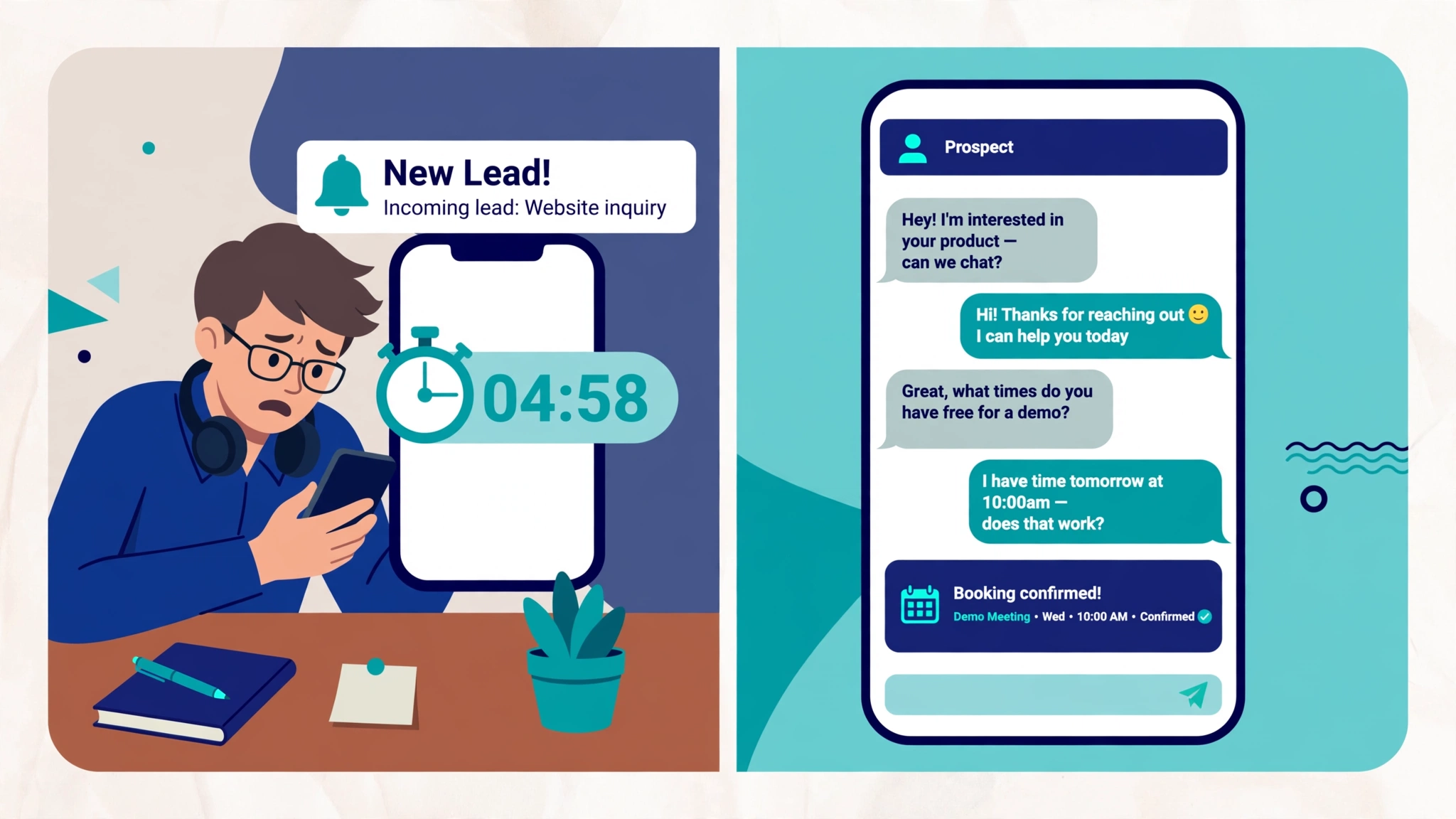
A prospect fills out your demo form at 7:45 in the evening. Your team is offline. By morning that same prospect has filled out forms on two competitor sites. Whoever starts a real conversation first usually wins the deal.
Most teams lose this race before they know they are running it. A 2026 benchmark cited by Aktify puts the average business response time at about 42 hours, with only around 7 percent of companies replying within five minutes. Your leads are talking to whoever shows up first.
Two way SMS paired with an AI first touch is the most practical fix available. Not a one way blast. A real conversation that starts within a minute of the form submit, qualifies the lead, books the meeting, and hands a warm prospect to your rep. This article covers why the five minute window matters, scripts that get replies, how to measure response time honestly, and how to design the handoff so the AI knows when to step aside.
Why Sub Five Minute Text Follow Up Wins
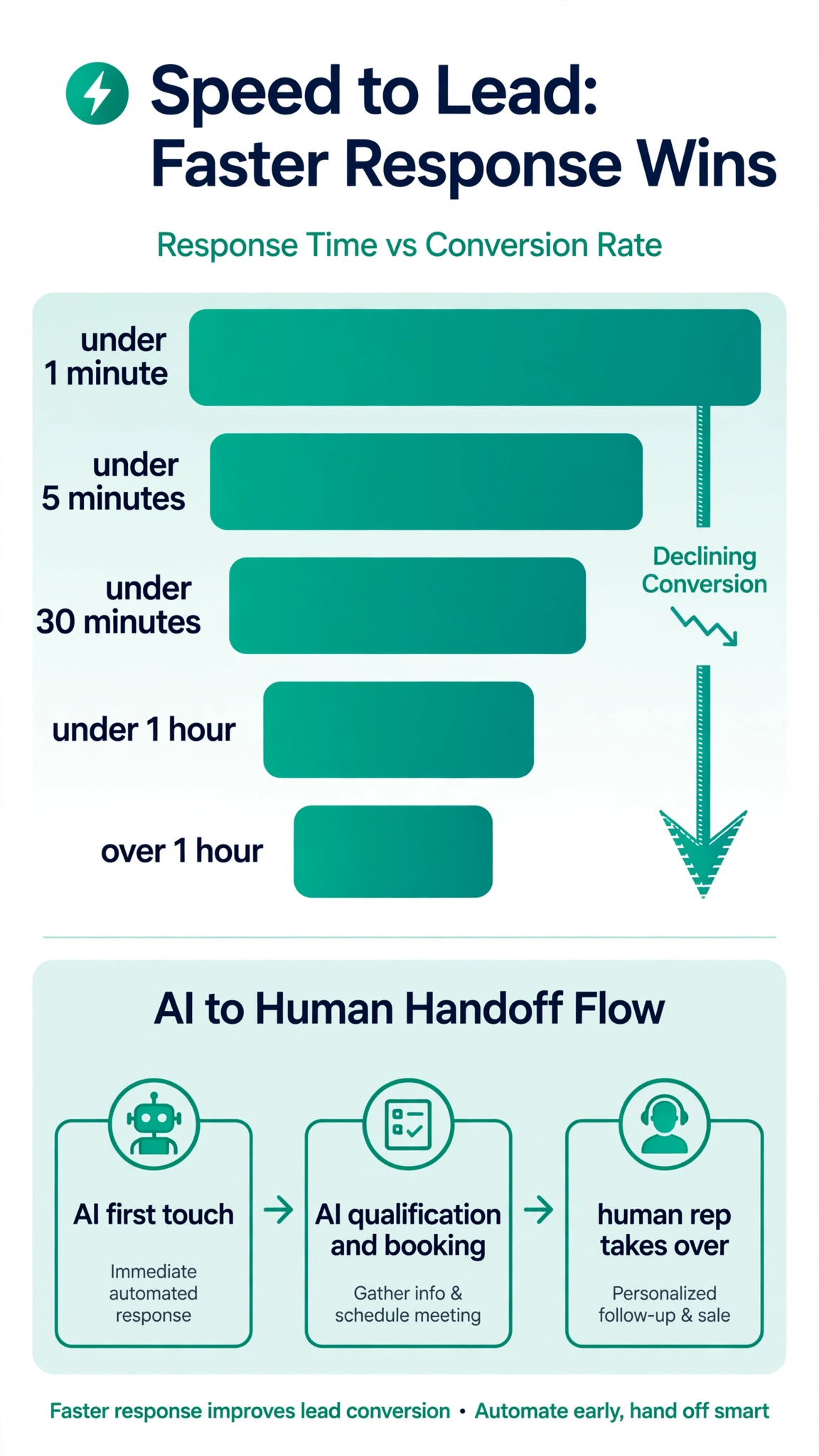
Speed to lead has one of the most researched claims in sales. Dr. James Oldroyd’s landmark study with MIT and InsideSales.com analyzed more than 15,000 leads across six companies. Leads contacted within five minutes were 21 times more likely to qualify than leads contacted after 30 minutes, and roughly 100 times more likely to make contact at all. The study is from 2007, so treat it as a landmark rather than fresh data, but no newer research has contradicted the direction of the finding.
Why does text beat phone and email for that first touch? Calls go to voicemail, email sits unread for hours, and a text lands on the lock screen and gets read in minutes. That timing advantage is the whole game.
But there is a catch that Aktify put well in a recent post: with broadcast texting, delivery is the finish line. With two way texting, delivery is just the start. A one way “thanks for your interest” text does not capture intent. A two way message that asks a question starts a conversation, and conversations are where qualification happens.
The practical target: a real exchange inside five minutes, not just a sent message inside five minutes. An automated confirmation text followed by silence is barely better than nothing. What wins is a reply, then a back and forth, then a booked meeting, before your competitor’s rep has finished their coffee.
AI First Touch Message Scripts That Get Replies
The AI follows a simple structure: acknowledge, ask one question, move toward booking. Here are working scripts for the three moments that matter.
Initial outreach: the first text after a form submit
The first message has one job. Name your business, reference what the lead just did, and ask one easy question. Keep it under 160 characters so it arrives as a single segment, and include opt out language on the first touch of any new thread.
Hi Maya, this is Dan from Northwind CRM. Saw you just requested a demo. Quick question: is this for your sales team or support team? Reply STOP to opt out.
An after hours version keeps the same shape but sets the expectation that a human follows up in the morning. What these do not do: pitch, include a link, or ask for a call right away. Carriers filter aggressively. The only goal is a reply.
Qualification: one question per text
Once the lead replies, the AI works through qualification one question at a time. A five question survey in a single message kills the conversation. The pattern from the best performing setups is to use what the lead already told you and ask only what is missing: team size, then current solution, then timeline, one message each. Each answer becomes structured data in the CRM, so the rep inherits context instead of starting cold. Stop at three or four questions. If the conversation passes four or five exchanges without a clear next step, that is a handoff signal, not a cue to keep chatting.
Booking: moving from chat to calendar
The AI should book the meeting inside the text thread, not redirect the lead to a scheduling page and hope they complete it. Offer two concrete options:
I can get you 20 minutes with our team. Does Thursday at 2 PM or Friday at 11 AM work better?
When the lead picks a time, confirm with specifics so the no show rate stays low: who they are meeting, what the meeting covers, and a reminder the day before. Once the lead starts negotiating, pushes back on price, or asks something the knowledge base cannot answer confidently, the AI hands over.
Use Cases: Where This Actually Works
Inbound demo and trial requests. A SaaS company wires its demo form to an AI texting agent. Every submission gets a text within 60 seconds, around the clock. The AI qualifies with two or three questions and books directly to rep calendars. Reps arrive in the morning to meetings the AI already booked, plus full transcripts in the CRM.
After hours and weekend coverage. A plumbing company gets a quote request at 11 PM. The AI texts back immediately, asks what the issue is and whether it is urgent, then books the morning slot or flags the on call tech for emergencies. If your business takes inquiries outside office hours, check your quiet hours rules before you automate anything, since timing restrictions still apply.
Missed call text back. A prospect calls, nobody picks up, and within a minute the system texts: “Sorry we missed your call, this is Brightline Solar. What can I help you with?” This single automation recovers conversations that used to die in voicemail.
Paid ad lead follow up. Leads from paid social and search ads are expensive and cool fast. The AI texts the moment the ad platform posts the lead, references the specific offer from the ad, and qualifies.
How to Measure Speed to Lead
The core metric. Speed to lead is the time between the moment a lead expresses interest and your first outreach attempt. Calculate it per lead, then aggregate: total response time divided by the number of leads contacted. Track the median alongside the average, since one lead that sat untouched all weekend will drag your average into meaninglessness.
The metrics that surround it. Speed alone can mislead. Track time to first reply (this measures message quality), response rate by channel, qualification rate, time to meeting booked, and follow up consistency. A team can be fast and useless, so the surrounding numbers keep the headline honest.
Tracking it in practice. At low volume a shared sheet works. Log five fields per lead: inquiry timestamp, channel, first response timestamp, outcome, and reason lost. Review weekly and look for patterns, like web forms that always lag or after hours inquiries that never get touched. When you cost out the texting side of this program, run the numbers through a bulk SMS cost calculator before committing to a volume tier.
Set targets by lead type. A demo request and a whitepaper download are not the same lead. An example SLA framework used by RevOps teams: demo requests and pricing page visits get a response in under five minutes, paid ad leads in under three minutes, partner referrals in under 30 minutes, organic inbound in under ten minutes, and content downloads go to nurture rather than instant outreach. Treat this as a starting template and tune it to your volume and staffing.
The Handoff to Human Reps
The AI starts the conversation. It does not close the deal. Designing the handoff is what separates a system that books meetings from a system that annoys prospects.
Handoff triggers: when the AI steps aside. Program explicit rules. The AI hands over when the lead asks to talk to a person, when pricing negotiation begins, when the lead asks something the knowledge base cannot answer with confidence, when the lead sounds frustrated, or when the conversation stalls after four or five exchanges. Opt out requests must be honored immediately and automatically. “Stop” means stop, however it is spelled or phrased.
Handoff mechanics: how the transfer works. A good handoff has three elements. The AI tells the lead what is happening: “Let me bring in Alex from our team, he handles pricing questions and can give you an exact quote.” The rep gets the full transcript plus the structured qualification data, not just a name and number. And the rep follows up within minutes during business hours, because a handoff that sits for two hours kills the momentum the AI built.
SLA design: the human side of the contract. Write it down and make it visible. AI first touch within 60 seconds of lead creation, 24 hours a day. Human pickup after an AI handoff within 15 minutes during business hours, first thing in the morning for overnight handoffs. A human reviews every thread the AI could not book or qualify within 24 hours. Review handoff transcripts weekly at first. Every question the AI fumbles is either a knowledge base gap to fix or a new handoff trigger to add.
FAQ
What is speed to lead?
The time between a prospect expressing interest, usually by submitting a form, and your team’s first response. It is measured in minutes and hours, not days.
What is a good speed to lead response time?
Under five minutes for high intent leads like demo requests, based on the landmark MIT and InsideSales.com research. Under one minute is better if you can manage it.
How do you measure speed to lead?
Subtract the inquiry timestamp from the first outreach timestamp for each lead, then average the results. Track the median too, since outliers skew averages.
When should an AI texting agent hand off to a human?
When the lead asks for a person, starts negotiating price, asks something the AI cannot answer confidently, shows frustration, or stalls after four or five exchanges. Opt out requests are handled automatically and immediately.
Is it legal to text sales leads automatically?
Sales texts generally require prior express written consent, and AI generated messages get no special exemption. Collect consent on your forms with clear language, keep records of it, and never cold text purchased lists. This is not legal advice. Texting rules carry significant per message penalties, so have counsel review your program before you scale it.
What is the difference between one way and two way SMS for sales?
One way SMS delivers information like reminders and confirmations. The conversation ends at delivery. Two way SMS starts an exchange where the lead can reply and get answers in real time. For speed to lead, two way is the whole point, because qualification happens inside the conversation.
Conclusion
Speed to lead is not a technology problem. It is a math problem. Intent decays in minutes, your competitors are one tab away, and no human team can watch every form around the clock. Two way SMS has the fastest read times, and an AI first touch starts a real conversation inside a minute, every time.
Start small. Pick your highest intent lead source, write three honest first touch scripts, set a five minute target, and measure your actual response time for two weeks. Then add qualification, booking, and the handoff rules. The teams that win are not the ones with the fanciest AI. They are the ones that answer first, ask one good question, and get a human into the conversation at exactly the right moment.
Compliance note: this article is for informational purposes and is not legal advice. Sales texting in the US generally requires prior express written consent, and regulations like the TCPA carry significant penalties per message. Consult qualified counsel before launching or scaling an automated texting program.
Want this set up for you?
I build SMS chatbots and API integrations for businesses. If you would like what this guide describes, done for you, get in touch.