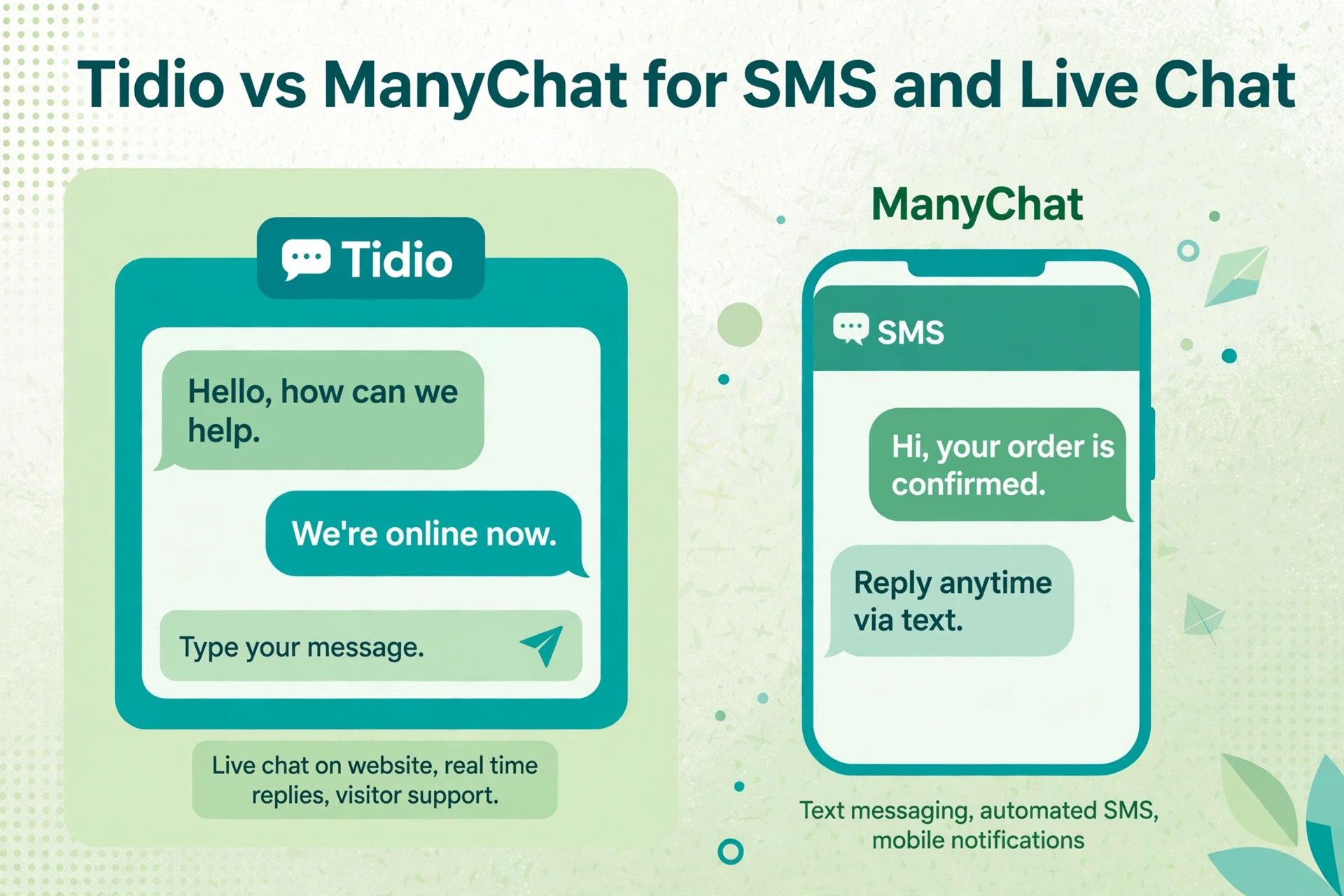
Here is the thing most comparison articles bury: Tidio and ManyChat are not really competing for the same job. Tidio is a live chat platform for websites that grew a chatbot and an AI agent. ManyChat is a messaging automation platform that happens to include SMS. If you need both live chat on your site and SMS in your marketing, you are choosing which half matters more, because neither product is best at both.
Let us be honest about what each one does, starting with the headline fact.
The SMS headline: only one of them does it
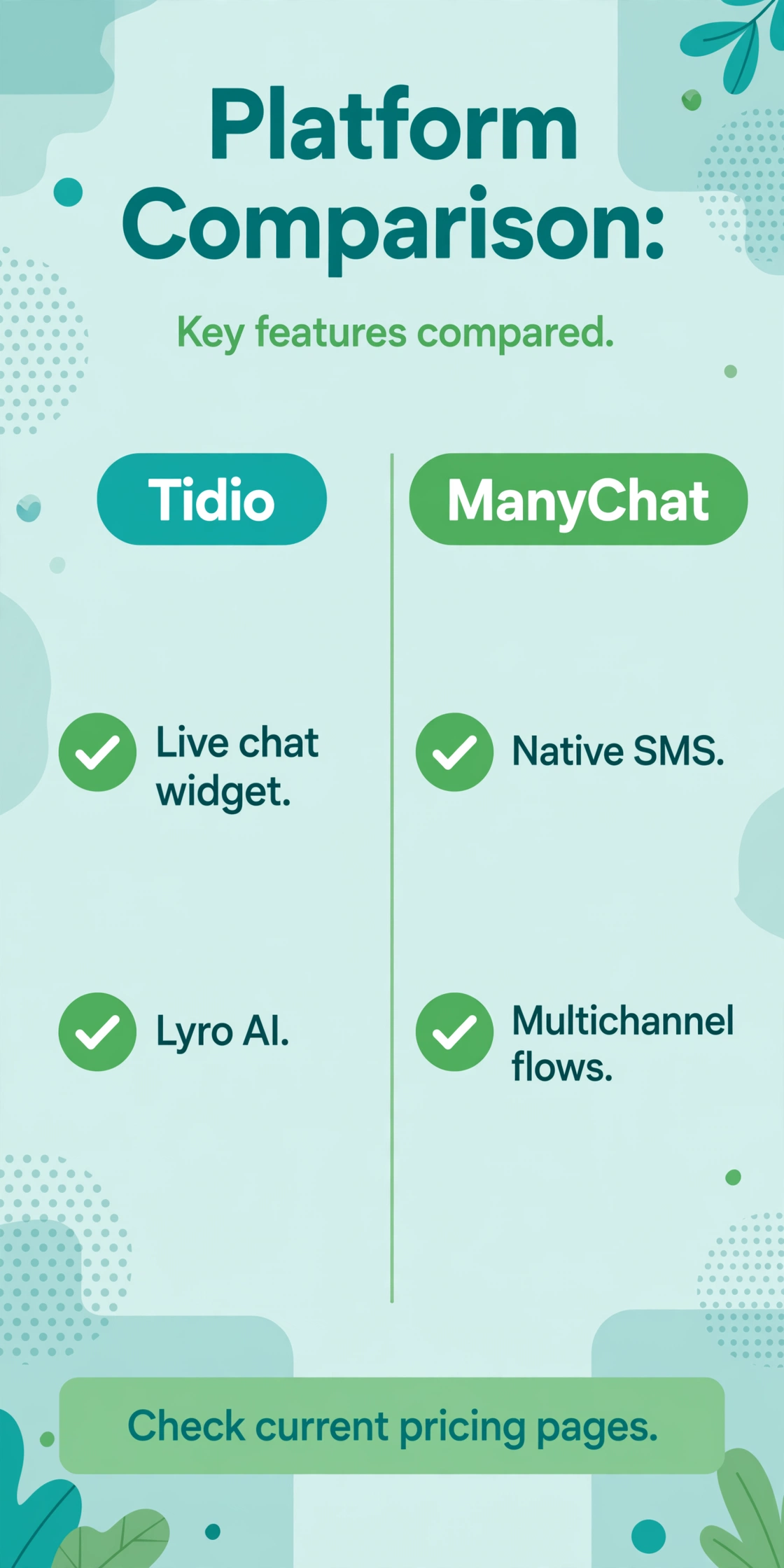
ManyChat has native SMS on paid tiers. You build SMS steps directly in the flow builder, capture phone numbers with consent, run keyword triggers, and send broadcasts, all inside one dashboard. Per-message surcharges apply on top of your plan, reported around $0.01 to $0.03 per message by third-party 2026 sources.
Tidio does not have native SMS. Its channels are the website live chat widget, email, Messenger, and Instagram, plus the Lyro AI agent that works across them. If you want a text message to go out from a Tidio workflow, the documented path is Zapier: connect Tidio to an “SMS by Zapier” action, which sends the text through a separate SMS provider. It works for notifications like pinging the owner when a key chat happens, but it is not an SMS marketing channel. You cannot run keyword campaigns, drip sequences, or broadcasts to a text list from inside Tidio.
So if SMS is a requirement rather than a nice-to-have, ManyChat wins this comparison before it starts. The rest of the article is for everyone whose needs are more mixed.
Live chat: Tidio’s home turf
This is where Tidio earns its keep. The product was built around the website visitor: a polished live chat widget, real-time visitor tracking with typing preview, a shared team inbox, ticketing tools, and chatbot flows for lead capture and FAQs. For a small ecommerce store or service business, Tidio replaces several tools at once: the chat widget, the FAQ bot, and a basic helpdesk.
Lyro, Tidio’s conversational AI agent, handles routine questions from your knowledge base and hands off to humans with context. Third-party descriptions credit it with resolving a solid share of inquiries, and it works in dozens of languages with automatic detection. For a team drowning in “where is my order” and “what are your hours” chats, Lyro plus the widget is a genuine workload reducer.
ManyChat does have a team inbox and live chat handoff, but it is not a website live chat product in the same sense. ManyChat’s world is messaging channels: someone comments on your Instagram post, the flow captures them, the inbox lets your team jump in. If your primary conversation surface is your website, Tidio’s widget, visitor tracking, and ticketing are meaningfully better.
Ecommerce depth
Both platforms court online stores, but differently.
Tidio’s ecommerce play is on-site conversion and support: engage the visitor while they are on the product page, answer questions with Lyro, recover the hesitant buyer in the chat, and follow up by email or Messenger. Its Shopify integration is native and the whole product is tuned for stores doing live support on a budget. Our restaurant chatbot guide and abandoned cart guide show the kinds of flows local and ecommerce businesses run.
ManyChat’s ecommerce play is off-site reach: comment-to-DM automation that turns social engagement into subscribers, then nurtures them across Instagram, WhatsApp, SMS, and email. Its Shopify integration supports abandoned cart recovery and order notifications across those channels. If your traffic comes from social content, ManyChat’s funnel thinking fits. If your traffic lands on your website, Tidio’s on-site thinking fits.
The strongest ecommerce setups often use both patterns, which is why this comparison frustrates people. You want Tidio’s widget and ManyChat’s SMS. Running both is legitimate if the budget allows, but most small teams should pick the channel where their customers actually are.
AI comparison: Lyro versus ManyChat’s AI
Lyro is included in Tidio’s product as its conversational AI agent: trained on your content, answering in the chat widget and messaging channels, escalating with context. It is positioned as a core feature, not an add-on.
ManyChat’s AI is more layered. The flow builder has AI Steps and a Flow Builder Assistant, and there is a paid AI add-on reported around $29 per month for fuller chatbot behavior. ManyChat’s AI story is improving, but the product’s soul is still the visual flow builder: deterministic, branch-based automation you design by hand.
For freeform customer questions, Lyro’s included AI is the simpler story. For structured marketing funnels with precise control over every branch, ManyChat’s builder is the stronger tool. SMS sharpens this difference: SMS is plain text with no buttons, so generative AI helps more there, which is ironic given Tidio does not do SMS natively.
Pricing shape
Tidio prices around conversations and seats with a free tier to start; check tidio.com for current plans since packaging changes. ManyChat prices by active contacts per month: free at 25 contacts, then roughly $14 to $17, $29 to $39, $69 to $99, and $139 to $199 tiers, plus per-message SMS surcharges and a possible AI add-on.
The pricing models punish different growth patterns. Tidio gets expensive as conversation volume and seats grow. ManyChat gets expensive as your contact list grows, even if those contacts rarely engage. A business with a huge quiet list and modest messaging might find ManyChat’s contact billing painful; a business with intense live chat volume might find Tidio’s conversation billing painful. Price your actual usage pattern, not the headline tier.
Also watch the add-on creep. ManyChat’s AI features and extra inbox seats can stack on top of the base plan, while Tidio’s higher tiers gate the AI agent and advanced automation. The plan you start on is rarely the plan you end on, so ask both vendors what the next tier up costs before you commit to the entry one.
The SMS workaround question
Can you fake SMS with Tidio plus Zapier? For narrow jobs, yes. Owner alerts when a VIP chats, a text to the on-call tech when a bot flags an issue, an SMS confirmation after a chat-collected booking. These are notification use cases, and Zapier handles them fine.
What you cannot fake is an SMS program: keyword opt-ins, list growth, drip sequences, broadcasts, two-way SMS conversations with customers. That needs a native SMS platform, whether ManyChat, a dedicated SMS tool like SimpleTexting, or a CPaaS build on Twilio. Do not let a Zapier integration talk you into thinking you have an SMS channel. You have a notification pipe.
Who should pick which
Pick Tidio if your website is your main conversation surface, you need live chat plus ticketing plus a chatbot in one affordable product, and SMS is at most a notification need. It is the better live chat product, full stop.
Pick ManyChat if SMS is a real channel in your strategy, your audience lives on Instagram and social messaging, and you want one builder across SMS, WhatsApp, Messenger, and email. Verify which current tier unlocks SMS before you commit, since sources disagree on the exact tier.
Pick both only if you have the budget and a clear split: Tidio owning the website, ManyChat owning messaging and SMS. For most small teams, that is overkill. Pick the surface your customers use most.
FAQ
Does Tidio support SMS?
No native SMS. Tidio’s channels are website live chat, email, Messenger, and Instagram. You can send texts through Zapier integrations with an SMS provider, but that is a notification workaround, not an SMS marketing channel.
Does ManyChat support live chat?
ManyChat has a team inbox with live agent handoff inside its messaging channels, but it is not a website live chat widget product like Tidio. Its strength is automated flows across messaging channels, not on-site visitor chat.
Which is better for ecommerce?
Tidio is better for on-site conversion and support chat. ManyChat is better for social-driven funnels and multichannel follow-up including SMS. Choose based on where your traffic comes from.
Can I use Tidio for SMS keyword campaigns?
No. Keyword campaigns need a native SMS platform. Tidio plus Zapier can send one-off notification texts, not run a keyword program.
Which is cheaper?
They meter differently: Tidio around conversations and seats, ManyChat by active contacts plus SMS surcharges. Price your actual volume on both current pricing pages. Small lists with heavy chat favor ManyChat; big quiet lists with light chat favor Tidio.
Do I need both?
Rarely. Most small teams should pick the platform matching their primary conversation surface. Both is justifiable when the website chat operation and the SMS marketing program are both serious and separately owned.
The bottom line
Tidio versus ManyChat for SMS plus live chat is really a question about which half you need. Need live chat on your website? Tidio, easily. Need SMS as a marketing and automation channel? ManyChat, because Tidio does not do SMS natively. Be honest about where your customers talk to you, price your real usage, and do not mistake a Zapier notification pipe for an SMS strategy.
Want this set up for you?
I build SMS chatbots and API integrations for businesses. If you would like what this guide describes, done for you, get in touch.