If you are a developer building an SMS chatbot, your first real decision is the pipe: whose API carries the messages. Twilio and Plivo are the two names in every shortlist, and the comparison looks deceptively simple. Twilio is the famous one with the best docs. Plivo is the cheaper one with a solid API. But the details, number rental, carrier fees, support tiers, compliance tooling, decide the real total cost and the real developer experience.
Let us compare them the way an engineer choosing infrastructure should: pricing line by line, webhook and DX ergonomics, and the compliance machinery you will live with.
Per-segment pricing: the headline numbers
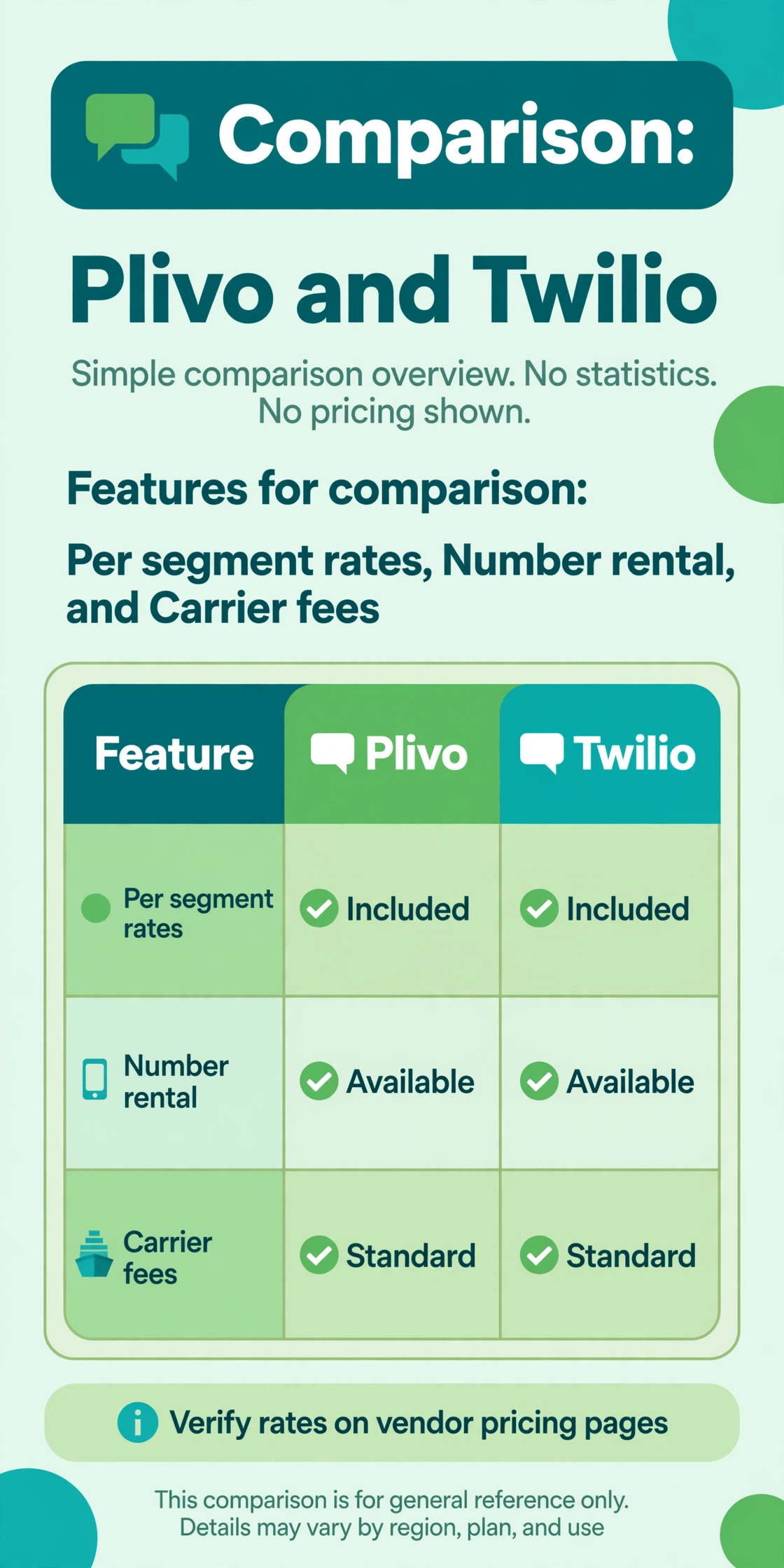
Both providers bill per message segment, where a segment is 160 GSM characters or 70 Unicode characters. Long messages bill as multiple segments, and carrier pass-through fees apply on top at both providers.
| Cost item (US) | Twilio | Plivo |
|---|---|---|
| Outbound SMS per segment | About $0.0083 | About $0.0077 |
| Inbound SMS per segment | About $0.0083 | Reported free on US long codes (single source, verify) |
| Carrier pass-through per message | About $0.0025 to $0.0045 | About $0.0035 to $0.0050 |
| Long code number per month | $1.15 | About $0.50 |
| Trial credit | $15 (roughly 1,900 SMS) | Check current offers |
Plivo’s headline rate is about 7% cheaper per segment, and its number rental is less than half Twilio’s. At 200,000 US messages a month, third-party modeling puts Plivo around $1,540 in base message costs versus Twilio around $1,660, with roughly $800 in carrier surcharges on either side. The gap is real but not dramatic: a few hundred dollars a month at serious volume.
Two caveats before you budget. First, one comparison notes that Plivo’s best messaging rates sit behind an Enterprise arrangement with a $1,000 per month commitment, so verify which rate applies to your account type on plivo.com. Second, carrier fees are pass-throughs set by the carriers, not the providers, so they are nearly identical everywhere and nobody can discount them. Anyone comparing headline rates without carrier fees is hiding the second-biggest line on the invoice.
Older sources cite Twilio at $0.0079 per segment; the $0.0083 figure is the more current 2026 number across multiple sources. Rates move, so re-check both pricing pages at publish time.
One more line item for international programs: both providers price SMS per destination country, and international rates vary widely. Twilio publishes per-country rates reaching roughly $0.29 per message for expensive destinations, while Plivo’s international rates are generally competitive but also destination-dependent. If your chatbot texts customers outside the US, price your actual destination mix on both rate cards. US-only comparisons can be misleading for global programs.
Webhook and developer ergonomics
This is where Twilio earns its premium. Its documentation is the best in the category: every API has guides, every SDK is maintained, the helper libraries cover all major languages, and the error messages actually help. Twilio’s 2026 developer story includes the Agent Connect SDK for conversational agents (generally available since May 2026) and a hosted MCP server in public beta that lets AI coding tools read the full API reference. If your chatbot is built by developers who value their time, Twilio’s DX shortens every task: first SMS sent, webhook signature validation, delivery receipts, number provisioning.
Plivo’s DX is genuinely good, just smaller. The REST API is clean and Twilio-compatible in many endpoints (which eases migration), SDKs cover the major languages, and the docs are solid. What you lose is the ecosystem depth: fewer Stack Overflow answers, fewer community tutorials, fewer third-party integrations that assume Twilio. For a competent team, this is a minor tax. For a team learning as they go, it is a real cost in hours.
Webhook ergonomics are comparable: both deliver inbound messages and status callbacks to your HTTPS endpoints, both support signature validation, both handle MMS media. Neither will surprise a developer who has built on the other.
Compliance tooling: 10DLC and trust
US application-to-person texting runs on 10DLC registration: brands and campaigns registered with The Campaign Registry, with vetting, throughput limits, and carrier-specific rules. Both providers support the full registration flow, and both will hold your hand to roughly the same degree.
Be honest with yourself about the timeline. Registration review is an industry-wide bottleneck, not a provider-specific one. 2026 reports describe campaigns taking weeks and multiple rejections on either platform. Twilio sells a paid Fast Track option for teams stuck in review; factor the possibility of delay into your launch plan regardless of provider.
Beyond 10DLC, compare the trust tooling: Twilio’s TrustHub centralizes compliance artifacts, and its Verify API offers managed OTP at $0.05 per successful verification for teams that need authentication without building it. Plivo offers its own Verify API for 2FA flows. If your chatbot handles authentication codes, compare the managed verification products directly rather than building OTP on raw SMS.
Also note the quiet regulatory background: carrier fees changed in 2026 (AT&T raised rates in April, Verizon scheduled an increase for October), which flows through both providers identically. Your per-message economics should assume fees keep drifting upward.
Reliability and support
Both providers run carrier-grade infrastructure with strong deliverability. At normal volumes, you will not be able to tell them apart on delivery rates.
Support is where the price difference sometimes shows. Twilio’s included support is self-serve heavy; SLAs and faster response sit behind paid support plans (one comparison cites 4% of spend for SLA support). Plivo includes support with a reputation that varies: some operators report slower escalation than Twilio. If your chatbot is business-critical, price the support tier you actually need on both sides instead of comparing the free tiers.
Which should you choose?
Choose Twilio if developer velocity is the priority: best documentation, deepest SDK and community ecosystem, the Agent Connect SDK for conversational builds, and managed products like Verify when you need them. You pay a modest per-message premium for the ecosystem. For most teams building their first SMS chatbot, this is the default recommendation, and the premium is small relative to engineering salaries.
Choose Plivo if cost at scale is the priority and your team is self-sufficient: lower per-segment rates, cheaper number rental, a clean API, and Twilio-compatible endpoints that keep migration easy. Verify the rate tier your account qualifies for, since the best published rates may sit behind volume commitments.
Choose both if you are serious about resilience: many teams route primary traffic through one provider and fail over to the other, or split message types across providers. Multi-provider routing is more engineering work, but it is the standard answer for cannot-fail messaging.
Building the chatbot layer
Whichever pipe you choose, the chatbot itself is a separate decision. Raw provider APIs give you send and receive; the conversation logic, memory, LLM orchestration, and escalation are yours to build, or you layer a framework on top. Options include Botpress or Voiceflow for visual agent building over either provider’s SMS, or a fully custom stack with your own LLM calls. Our SMS API guides hub covers the developer path, and our bulk SMS cost calculator models the per-segment math.
Before you send at scale, clean the list. Our phone list cleaner catches malformed numbers that would otherwise burn segments and hurt deliverability. And read our 10DLC registration guide early, because registration lead time is the most common launch delay in this category.
FAQ
Is Plivo cheaper than Twilio?
On headline rates, yes: about $0.0077 versus $0.0083 per US segment, with cheaper number rental ($0.50 versus $1.15 per month). Carrier fees are nearly identical on both. Verify which Plivo rate tier your account qualifies for, since best rates may require volume commitments.
Which has better documentation?
Twilio, by consensus. Its docs, SDKs, and community are the deepest in the category. Plivo’s docs and API are solid but the ecosystem is smaller.
Do I need 10DLC registration with both?
Yes. Both providers support brand and campaign registration, and review timelines are an industry-wide bottleneck. Start registration early regardless of provider.
Can I switch from Twilio to Plivo later?
Plivo’s API is Twilio-compatible on many endpoints, which eases migration. Number porting and 10DLC re-registration still take planning, so it is not free, but it is very doable.
Which is better for OTP and verification?
Both offer managed verification APIs: Twilio Verify at $0.05 per successful verification, Plivo Verify for 2FA flows. Compare them directly if authentication is part of your chatbot.
Should I use both providers?
For business-critical messaging, multi-provider routing with failover is standard practice. It costs engineering effort but removes single-provider risk.
The bottom line
Plivo versus Twilio for SMS chatbots is a price-versus-ecosystem trade. Plivo wins on per-message cost and number rental for self-sufficient teams at volume. Twilio wins on developer experience, documentation depth, and managed products, at a modest per-message premium. Most teams building their first SMS chatbot should default to Twilio and revisit Plivo when volume makes the savings material. Whichever you choose, start 10DLC registration early, model carrier fees honestly, and remember the pipe is only half the build: the chatbot’s brain is a separate decision.
Want this set up for you?
I build SMS chatbots and API integrations for businesses. If you would like what this guide describes, done for you, get in touch.