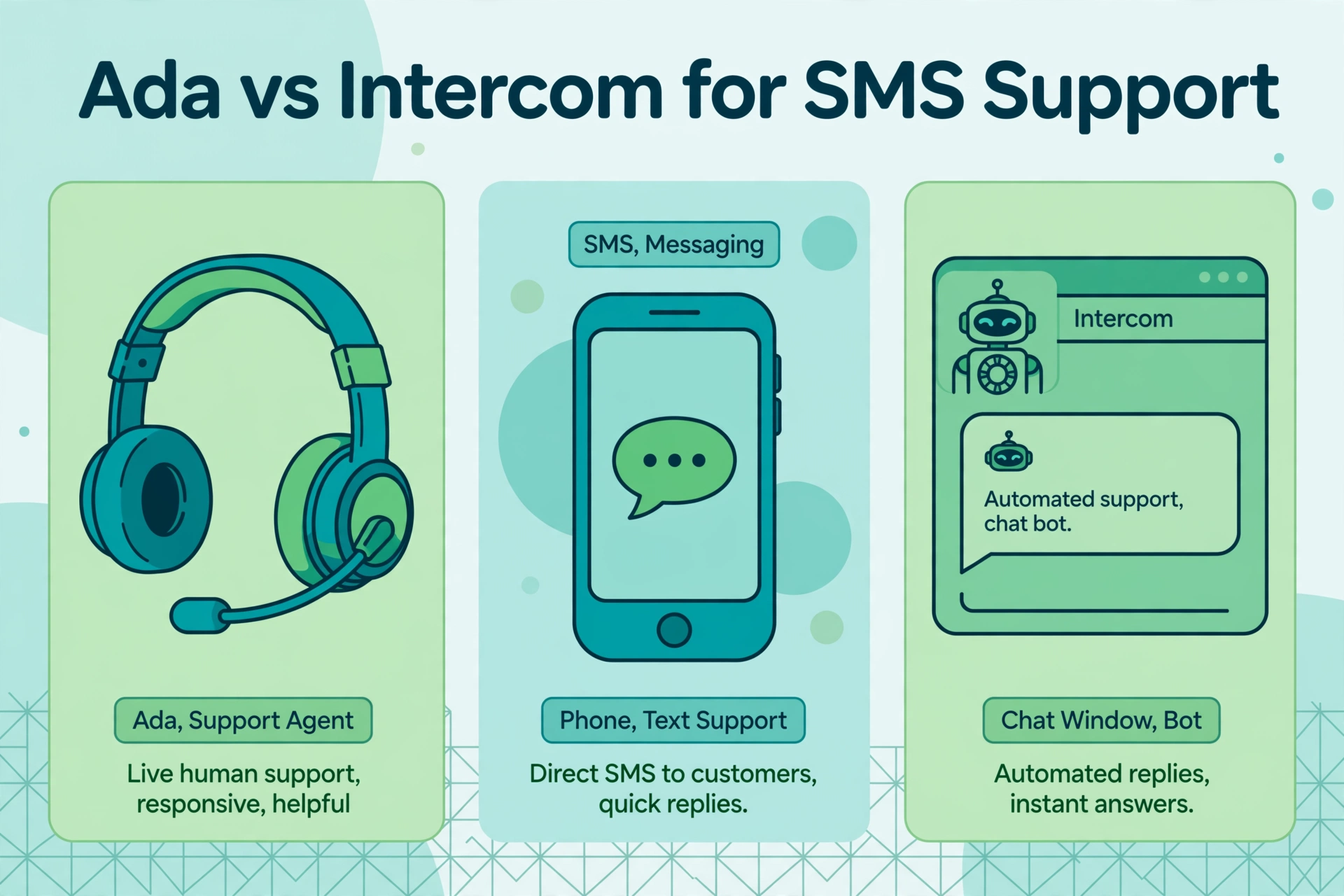
Ada and Intercom both promise the same dream: an AI that resolves support conversations on its own, across every channel, with humans stepping in only when judgment is needed. They approach it from opposite directions. Ada was built as an automation layer that sits across your channels. Intercom was built as a messaging platform that grew an AI brain called Fin.
If your customers text you for support, the question is how each one gets AI onto the SMS channel, how honest the deflection numbers are, and which operating model fits your team. Let us compare on those terms.
How each one reaches SMS
This is the first thing to get straight, because neither product is “an SMS app.”
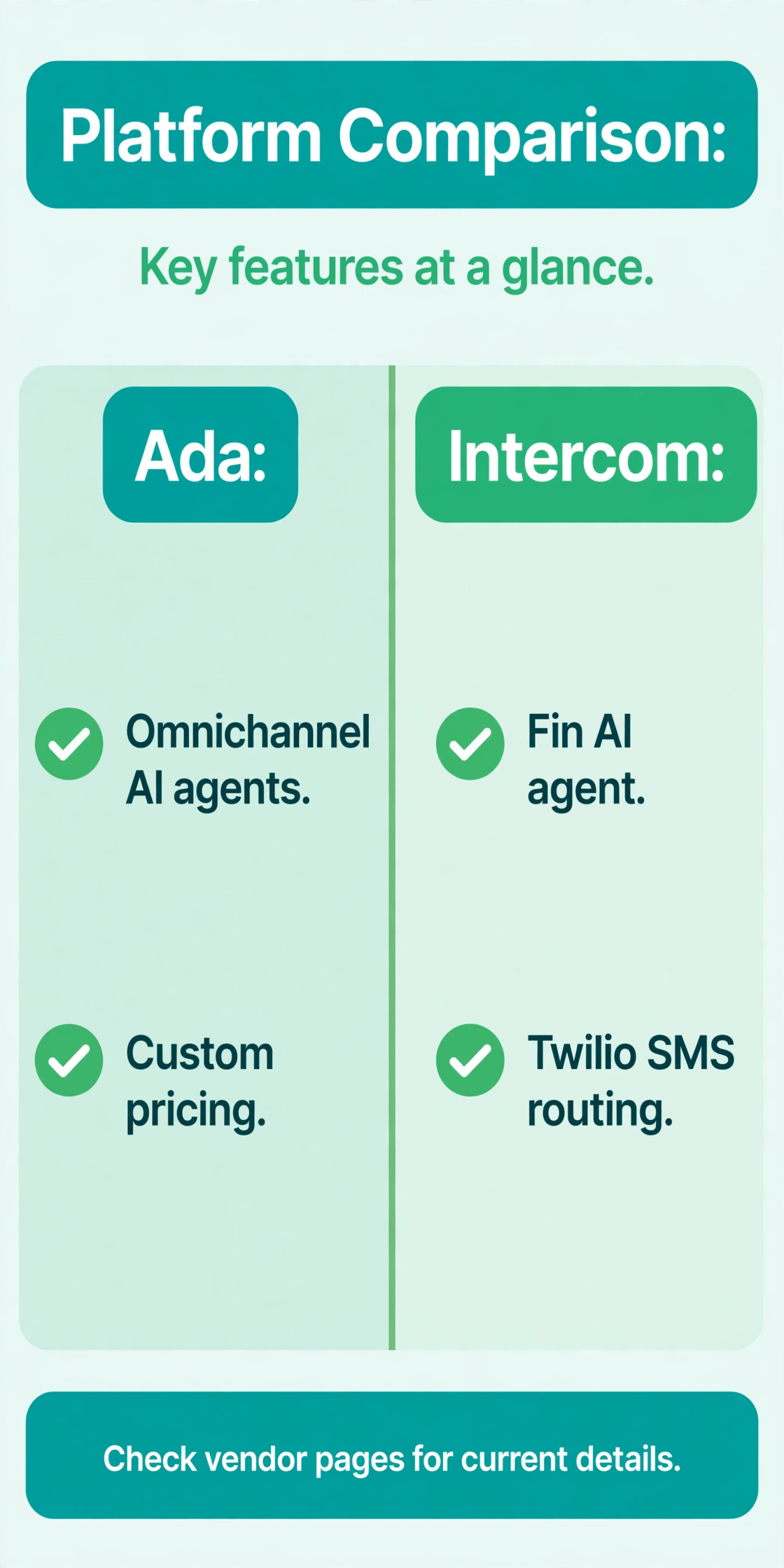
Ada is omnichannel by design. Its AI agents work across voice, messaging, and email, and SMS is one of the messaging channels in that model. You build the agent once, train it on your knowledge and backend systems, and deploy it to the channels your customers use. The pitch is consistency: the same agent, the same training, the same guardrails, whether the customer is on your website, on WhatsApp, or texting your support number.
Intercom reaches SMS through Twilio. Intercom’s native world is its own Messenger, email, and chat, and SMS arrives via Twilio integration or through approved third-party apps that bridge SMS into the Intercom inbox. Fin, the AI agent, then works on those conversations like any other. This is a meaningful architectural difference: with Ada, SMS is a channel the platform owns; with Intercom, SMS is a channel the platform borrows.
In practice, both can run an SMS support bot. The difference shows up in edge cases: message threading over long SMS conversations, MMS handling, carrier-specific quirks, and how cleanly SMS conversations merge with the customer’s other channel history. If SMS is a primary support channel rather than a side channel, Ada’s native model has a structural edge. If SMS is one of several channels and your team already lives in Intercom, the Twilio bridge is usually good enough.
The AI: automation layer versus Fin
Ada’s AI is built for action. The platform is designed to connect to backend systems, CRMs, order management, billing, so the agent can do things, not just say things: look up an order, process a return, update account details. It uses Playbooks for training and improves through automated learning from conversations. It is particularly established in regulated industries like financial services and telecom, where the bot has to operate inside strict compliance constraints and still resolve the issue.
Intercom’s Fin is built for answers. It is an AI agent built directly on large language models that reads your help documentation and knowledge base in real time and generates responses, rather than selecting from pre-written scripts. It handles multi-step queries conversationally and hands off to a human when it hits the edge of its knowledge. For companies whose support load is mostly “how do I…” questions answered by docs, Fin is a natural fit, and it lives inside the Intercom workspace your agents already use.
The philosophical split: Ada automates processes, Intercom answers questions. Most support organizations need both, which is why the real comparison is about which half dominates your ticket mix.
Deflection numbers: read the fine print
Both vendors publish impressive resolution figures, and you should treat all of them as ceilings, not promises.
Ada’s materials talk about resolving up to 83% of inquiries and published containment rates in the 70 to 85% range for enterprise deployments in telecom and fintech. Intercom’s ecosystem reports Fin resolving 40 to 70% of incoming volume in enterprise deployments. Third-party analysis consistently notes that real-world results land lower and depend heavily on knowledge base quality, ticket mix, and how aggressively escalation is configured.
Here is the honest way to read these numbers: the platform matters less than the implementation. A well-trained Ada agent on clean backend integrations will beat a poorly configured Fin, and vice versa. When vendors quote deflection, ask for the definition. Does “resolved” mean the customer confirmed resolution, or just that the bot ended the conversation without escalation? Those are very different numbers.
For SMS specifically, deflection tends to run lower than on web chat. SMS conversations are slower, customers multitask, and context gets lost across hours-long threads. Budget your expectations accordingly, and pilot with your real SMS ticket mix before committing to a vendor’s headline figure.
Pricing and packaging
Ada uses custom pricing. There is no public price list; you talk to sales, scope your volume and channels, and get a quote. That is standard for enterprise automation platforms, but it means you cannot budget from a blog post.
Intercom’s pricing is public but layered: seat-based pricing plus usage-based charges for AI resolutions. Published entry figures vary across sources, which tells you the packaging has been evolving. Fin resolutions are typically billed per resolution on top of seats, so your AI cost scales with the very success you are buying. Model this carefully: a high deflection rate on per-resolution pricing can still be far cheaper than the agent hours it replaces, but you need your own ticket economics to prove it.
The cost question to ask both vendors is the same: what is my all-in cost per resolved conversation at my volume, including seats, AI usage, SMS delivery, and any Twilio or telephony pass-through? Get it in writing.
One more pricing trap to watch: per-resolution AI pricing rewards high deflection, which is good, but it also means your AI bill grows with the success metric. Negotiate volume tiers or caps if your deflection rate climbs, so a great quarter for automation does not become a surprising invoice.
Who should pick which
Pick Ada if SMS is a primary support channel, your agents need to take actions in backend systems (not just answer questions), you operate in a regulated industry with strict controls, or you want one automation layer across voice, messaging, and email with centralized training. Ada’s no-code builder plus deep integrations suit enterprises that want business teams to own the automation.
Pick Intercom if your team already runs support in Intercom, your ticket mix is dominated by questions your help docs can answer, you want the AI agent and the agent workspace in one product, or SMS is a secondary channel where Twilio-based bridging is sufficient. Fin’s LLM-native answering is genuinely strong for knowledge-driven support.
If you are choosing a first support platform rather than adding AI to an existing one, the decision often comes down to where your team already works. Migrating a support operation is expensive and disruptive; the AI is rarely worth a platform migration on its own unless your current tooling is truly broken.
Compliance notes for support texting
Support texts have their own compliance wrinkles. Even service messages need proper consent practices, opt-out handling must work instantly (a customer who texts STOP mid-conversation must be opted out, not argued with by the bot), and conversation logs become records you may need later. Both platforms offer enterprise security postures, but your consent capture, quiet hours observance, and state law compliance are your responsibility. Our guides on TCPA consent and opt-out keywords cover the essentials. This is general information, not legal advice.
FAQ
Does Ada support SMS?
Yes. Ada is an omnichannel platform and SMS is one of its messaging channels, with the same AI agent deployed across voice, messaging, and email.
Does Intercom support SMS?
Intercom reaches SMS through Twilio integration and approved third-party apps that bridge SMS into the Intercom inbox. It is not a native Intercom-owned channel the way its Messenger is.
Which has better deflection, Ada or Intercom?
Vendor-reported figures favor Ada (up to 83% claimed) over typical Fin deployments (40 to 70%), but third-party analysis says real results depend on implementation quality more than platform choice. Pilot both on your actual ticket mix.
Can either bot take actions like processing a return?
Ada is the stronger action platform by design, with deep backend integrations for lookups, returns, and account updates. Fin can take actions through Intercom’s workflows and integrations, but its heritage is knowledge-based answering.
How is Intercom’s Fin priced?
Fin typically bills per AI resolution on top of seat-based platform pricing. Model your cost per resolved conversation at your volume rather than comparing headline seat prices.
Which is better for regulated industries?
Ada has deeper established presence in regulated verticals like financial services and telecom, with HIPAA, SOC 2, and GDPR-aligned controls. Either way, run your own security review and confirm SMS-specific consent handling.
The bottom line
Ada is the automation-layer choice: native omnichannel SMS, action-oriented AI, custom enterprise pricing, strongest where bots need to do things in backend systems. Intercom is the workspace choice: Fin’s LLM-native answering inside the inbox your team already uses, with SMS arriving via Twilio bridging. If SMS support is the mission, Ada’s native channel model is structurally cleaner. If Intercom is already home, Fin plus a Twilio SMS bridge is the pragmatic path. Either way, pilot on real SMS tickets and measure cost per resolved conversation, not vendor headline rates.
Want this set up for you?
I build SMS chatbots and API integrations for businesses. If you would like what this guide describes, done for you, get in touch.