
A quick note before we start: this article is practical guidance for chatbot builders, not legal advice. The Florida Telephone Solicitation Act carries real penalties, courts keep refining how it applies, and the legislature has already amended it once. Treat everything here as a starting point, then have a qualified telecom attorney review your flows before you send to real customers. Laws and interpretations change, so confirm the current rules when you read this.
Why Florida is the state chatbot builders worry about
Most SMS chatbot projects learn about the federal TCPA early. Consent, opt-outs, quiet hours. Then someone asks about Florida, and the room gets quieter than usual.
Florida has its own telemarketing statute, the Florida Telephone Solicitation Act (FTSA), at Fla. Stat. sec. 501.059. People call it Florida’s mini-TCPA, and the nickname undersells it. The 2021 rewrite was designed to be tougher than the federal baseline. It gives consumers a direct right to sue, and it attaches per-message damages that scale fast for a chatbot sending thousands of texts on autopilot.
If your chatbot sends marketing texts to Florida numbers, the FTSA is the law you build around.
What the FTSA is, in plain language
In 2021, Florida passed CS/SB 1120, rewriting the state’s telephone solicitation rules effective July 1, 2021. The key move was definitional. A “telephonic sales call” under the law is not just a phone call. It covers a telephone call, a text message, or a voicemail transmission to a consumer for the purpose of soliciting a sale of consumer goods or services, soliciting an extension of credit, or obtaining information that will or may be used for direct solicitation.
That definition is broader than most builders expect. Promotional blasts and lead-nurture drips are in scope, and even appointment reminders can drift into scope if they start carrying offers. Courts look at message content, not campaign names.
The law reaches beyond Florida’s borders. It covers businesses soliciting Florida consumers from anywhere, so if your chatbot texts Florida residents, assume the FTSA applies.
The area-code presumption survived the 2023 amendments: texts to Florida area codes are presumed covered (a rebuttable presumption, not an absolute rule). If your list has area codes like 305, 786, or 407, treat those recipients as Florida unless you have evidence otherwise.
One mix-up worth clearing: this is not Florida’s texting-while-driving ban. That is a separate statute, Fla. Stat. sec. 316.305. The FTSA governs businesses that text consumers.
Why the FTSA hits harder than the federal TCPA
The FTSA leans on private enforcement, and that is what makes it dangerous for chatbot operators.
Consumers can sue you directly. The law creates a private right of action for injunctive relief and damages. After the 2021 rewrite, hundreds of suits followed. A chatbot that misfires at scale is exactly the kind of defendant that draws attention.
Damages are per message. A successful plaintiff can recover the greater of $500 per violation or actual damages, trebled up to $1,500 per violation for willful and knowing violations.
The winner’s lawyers get paid. Prevailing parties may recover attorney’s fees and costs. That fee-shifting makes even modest cases worth a plaintiff’s attorney’s time.
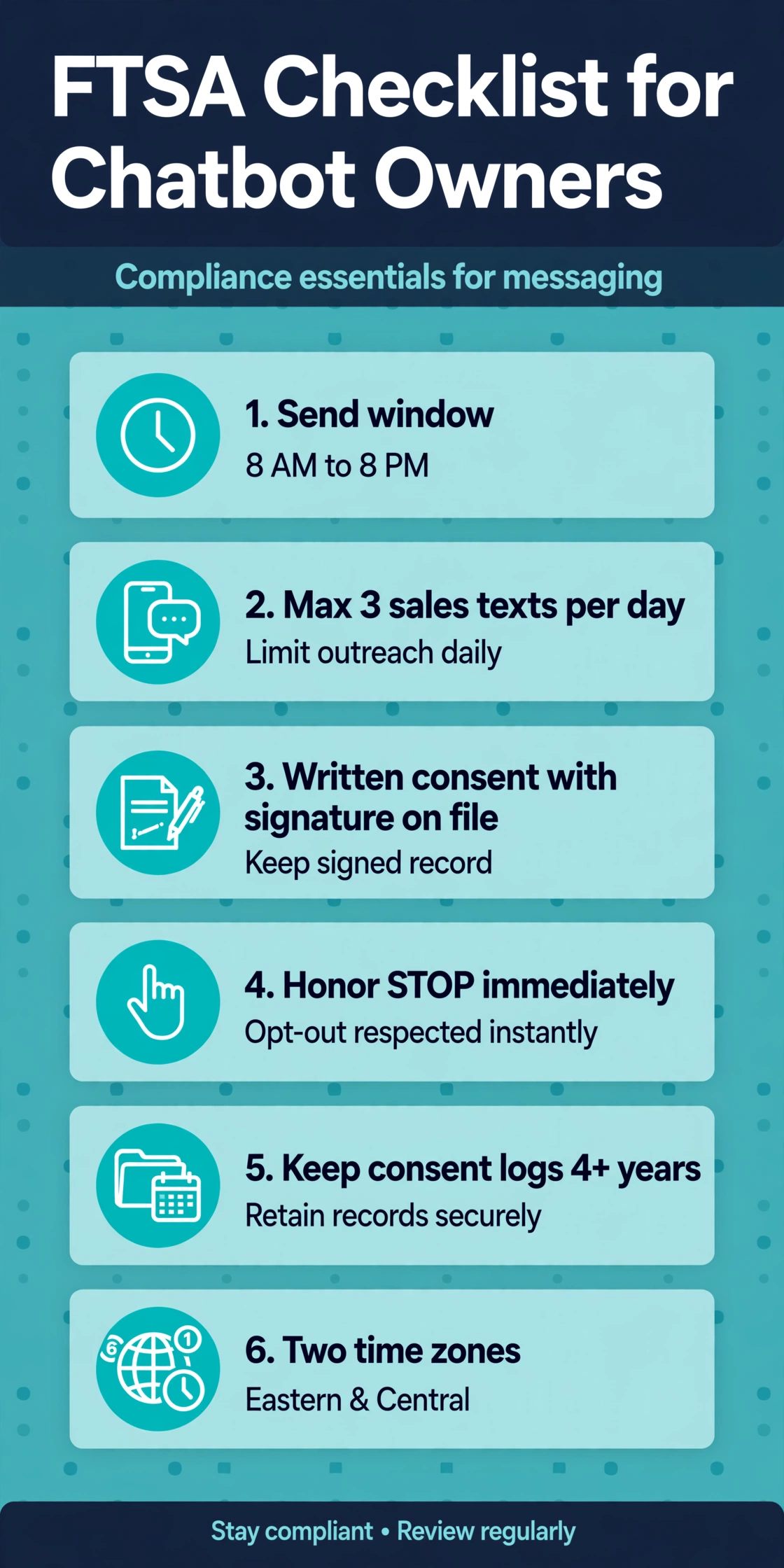
The defaults are stricter. The TCPA’s quiet hours run 8 a.m. to 9 p.m. Florida gives you 8 a.m. to 8 p.m. There is no federal equivalent of the three-texts-per-day cap. If you built your send logic for the TCPA and assumed it covers every state, Florida is where that assumption breaks.
The three rules that shape your send logic
Rule 1: The 8 a.m. to 8 p.m. window
No sales texts before 8 a.m. or after 8 p.m., measured in the consumer’s time zone. Not your server’s time zone, and not Eastern time because your company sits in New York. The recipient’s local time.
Florida matches the federal 8 a.m. start but ends an hour earlier at 8 p.m., and that single hour quietly breaks the most campaigns. A drip firing at 8:30 p.m. Eastern is fine under the TCPA and a violation under the FTSA for every Florida recipient.
Florida also spans two time zones. Most of the state is Eastern, but the Panhandle is Central. Resolve each recipient’s timezone at opt-in from the area code or subscriber-provided location, store it on the contact record, and gate every send behind a window check. To sanity-check a send time, the site’s quiet-hours checker exists for exactly that. For the broader state-by-state picture, see our quiet-hours guide.
Rule 2: No more than three sales texts on the same subject per recipient per 24 hours
Florida caps you at three telephonic sales contacts about the same subject matter per recipient in a 24-hour period, regardless of which sending number you use. Rotating numbers or short codes does not work.
Build a rolling 24-hour counter per recipient, not a midnight reset. Increment it on every outbound sales text, block the fourth, and log the block.
Count anything promotional. Purely transactional messages like order confirmations sit outside the solicitation definition, but a shipping confirmation ending with a coupon is marketing in a court’s eyes. When in doubt, count it.
Rule 3: Documented prior express written consent
For automated sales texts, Florida requires prior express written consent with a specific documentation standard. Per the Florida Bar’s analysis, valid consent must include the signature of the called party, a clear authorization to receive automated calls or texts from you, the telephone number covered, and a disclosure that signing is not a condition of doing business. The 2023 amendments made “signature” practical for modern flows: it now includes acts like checking a box or affirmatively replying to a text invitation.
But the consent is only as good as your proof. Store the phone number, the timestamp, the opt-in source, the exact disclosure wording, and the signature artifact. The FTSA carries a four-year statute of limitations, and the standard recommendation is to keep records for five years. Our TCPA consent guide covers the federal consent tiers underneath this state layer.
What the 2023 amendments changed, and what they did not
In May 2023, Governor DeSantis signed CS/CS/HB 761, effective immediately on May 25, 2023. The amendments softened the FTSA in real ways. Here is what got softer and what stayed sharp.
The autodialer trigger narrowed. The 2021 law covered “an automated system for the selection or dialing of telephone numbers.” One word changed: it is now “selection and dialing,” so both functions are required. This moved Florida’s definition closer to the federal standard from the Supreme Court’s Facebook v. Duguid decision, and a bot working through a stored list of opted-in subscribers looks less like the statute’s target than it did in 2021. Do not read that as a green light. The definition is still not limited to random or sequential number generators the way the federal one is, so a campaign platform that loads a list and fires texts automatically still sits close to the line. Consent and documentation remain the safe path.
Only unsolicited calls are banned. The amended law limits the automated-system prohibition to unsolicited telephonic sales calls. Solicited messages backed by proper prior express written consent are the intended use case.
A 15-day notice-and-cure rule now gates text-message lawsuits. Before suing over text solicitations, the consumer must reply STOP, and the sender then has 15 days to stop. A lawsuit is only available if texting continues past that mark. In a 2024 federal case, a judge threw out both individual and class claims because the plaintiff never alleged replying STOP.
The critical nuance: those 15 days are a litigation shield, not a compliance target. They describe when a plaintiff can sue, not how long you may keep texting someone who asked you to stop. Federal rules require honoring opt-outs within 10 business days, and the industry expectation is same-day suppression. Honor every STOP immediately, send at most one confirmation text, and suppress the number across all campaigns.
The changes reached back into pending cases. The amendments apply to suits filed after the effective date and to putative class actions not certified by that date, which wiped out a large share of pending FTSA text-message class actions.
What stayed sharp: the 8 a.m. to 8 p.m. window, the three-per-day cap, the $500 to $1,500 damages, the attorney’s fees, the private right of action, and the area-code presumption.
Turning the FTSA into chatbot logic
Hand this section to your developer.
Timezone-aware throttling on every send. Put the window check in the send path itself, not just the campaign scheduler. Schedules drift, retries fire late, queued messages slip. The check is simple: is the recipient’s local time right now between 8:00 a.m. and 8:00 p.m.? If not, queue the message for 8 a.m. recipient time instead of dropping it.
Per-recipient rolling send counters. Cap outbound sales texts at three per rolling 24 hours per recipient, across all sending numbers. Block the fourth attempt and log the block with a timestamp.
Consent records that survive scrutiny. For every Florida subscriber, store the phone number, the consent timestamp, the source, the exact disclosure text shown, and the signature artifact. Keep these records for at least four years, and five to match the standard recommendation. Our double opt-in guide walks through the confirmation pattern that produces the cleanest consent artifacts.
Opt-out handling faster than the law requires. Listen for STOP and the other standard keywords, plus natural-language opt-outs like “please stop texting me.” A keyword-only listener is not enough for a conversational bot. On detection, suppress the number immediately across every campaign, send no more than one confirmation text, and log the revocation with a timestamp.
Want this set up for you?
I build SMS chatbots and API integrations for businesses. If you would like what this guide describes, done for you, get in touch.
Frequently asked questions
Does the FTSA apply to text messages?
Yes. The definition of “telephonic sales call” expressly includes text messages and voicemail transmissions sent to solicit sales or gather information for solicitation.
What are Florida’s quiet hours for marketing texts?
Between 8 a.m. and 8 p.m. in the recipient’s local time zone, stricter than the federal 8 a.m. to 9 p.m. window.
How many marketing texts can I send per day in Florida?
No more than three about the same subject matter per recipient in a 24-hour period, regardless of which sending number you use.
What are the penalties?
The greater of $500 per violation or actual damages, trebled up to $1,500 per violation for willful and knowing violations. Prevailing parties can also recover attorney’s fees and costs.
My business is not in Florida. Does the FTSA still apply?
Yes, if you text Florida consumers. The law covers out-of-state businesses soliciting Florida residents, and texts to Florida area codes are treated as covered.
Do my chatbot’s automated replies count as automated texts?
They can, if they are sales solicitations sent by automated means. A genuine answer to a customer’s inbound question is not a solicitation, but promotional content pushed by the bot is.
What happens when someone replies STOP?
Under the amended law, a consumer must reply STOP and give the sender 15 days to stop before suing over text solicitations. Honor opt-outs immediately anyway. The 15 days is a defense against lawsuits, not a grace period.
Is this the same as Florida’s texting-while-driving law?
No. That is Fla. Stat. sec. 316.305 and applies to drivers. The FTSA is Fla. Stat. sec. 501.059 and applies to businesses sending solicitation calls and texts.
The bottom line
Florida is one of the toughest states for chatbot texting, and it punishes exactly what chatbots do at scale: automated sends, high frequency, and thin consent records. The posture that survives is mechanical. Enforce the 8 a.m. to 8 p.m. window per recipient timezone, cap same-subject sales texts at three per rolling 24 hours, capture real consent with real records, and honor opt-outs the moment they arrive.
None of that replaces legal review. The FTSA has already been amended once, courts are still shaping its edges, and your flows will have facts this article cannot see. Build the system described here, then have a telecom attorney review it before it touches real customers.