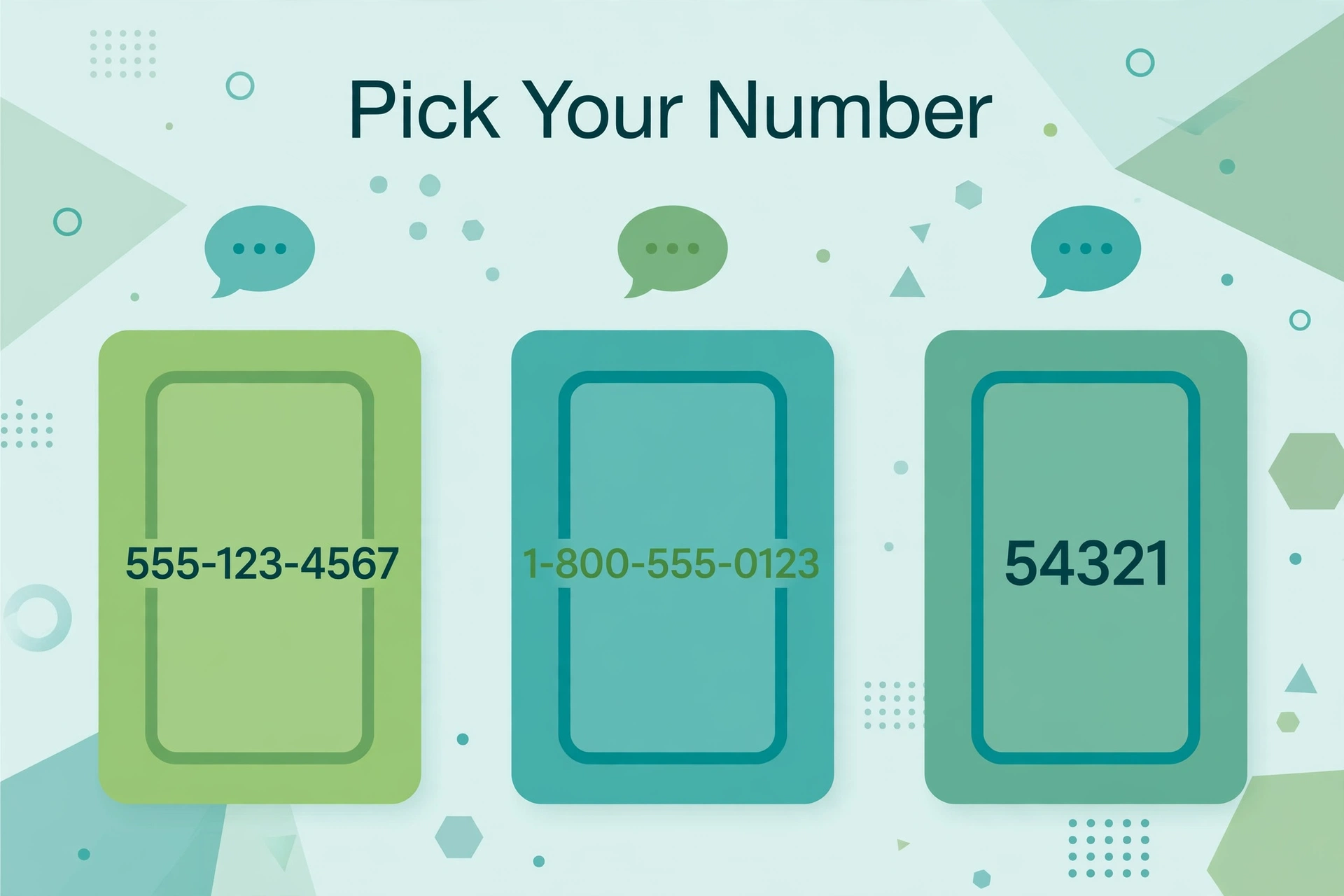
If you are setting up business text messaging in the US, one of the first decisions you face is what kind of number to send from. The three options are 10DLC (a regular-looking 10-digit long code), toll-free numbers (the 800 and 888 style numbers), and short codes (the 5 or 6 digit numbers like the ones big brands use). Each comes with different costs, speeds, registration requirements, and best use cases, and picking the wrong one means either overpaying or watching your messages crawl out at a trickle.
Quick note before we start: this is general information about how these number types work, not legal advice. Messaging rules involve the FCC, the CTIA guidelines, and carrier policies that change over time. When in doubt, check with your provider or a qualified professional.
What each number type actually is
10DLC stands for 10-digit long code. It is a standard-looking US phone number with a local area code, registered for application-to-person messaging through The Campaign Registry. It supports two-way texting, voice calls, and MMS. Because the number looks local, it feels personal, which is why small and mid-size businesses love it for customer conversations.
Toll-free numbers are the familiar 800, 888, 877, 866, 855, 844, and 833 numbers. They can send SMS and MMS, support voice, and work well for national businesses that want one recognizable number. Toll-free SMS requires its own verification process before you can send.
Short codes are the 5 or 6 digit numbers (think 12345) leased specifically for high-volume messaging. They cannot make voice calls, but they are the workhorses of mass texting: marketing blasts, alerts to huge audiences, and two-factor authentication at scale. They are also the most expensive and slowest to set up.
Registration: the part nobody can skip
Every one of these number types requires registration before carriers will deliver your messages reliably. Unregistered business texting gets filtered, throttled, or blocked outright. Here is what each path looks like.
10DLC registration goes through The Campaign Registry (TCR). You register your brand (your business identity) and then register each campaign (your use case, with sample messages and a description of how you collect opt-ins). Carriers assign your brand a trust score, and that score determines your throughput. Registration typically takes days to a couple of weeks. If your campaign gets rejected, it is usually for a fixable reason, and our guide to 10DLC campaign rejection reasons covers the most common ones.
Toll-free verification is a separate process coordinated through the toll-free messaging program. You submit your business information, use case description, sample messages, and opt-in details. Approval generally takes days to a few weeks. Until verification completes, your toll-free number cannot send SMS to the US.
Short code provisioning is the heavyweight process. You apply for the code, carriers review your use case, and provisioning takes weeks to months. The review is thorough because short codes get the highest throughput and the most trust from carriers.
If you are writing your first campaign descriptions, our 10DLC sample campaign descriptions show what compliant submissions look like.
Throughput: how fast your messages go out
Throughput is measured in messages per second, and the differences here are dramatic.
Short codes are the fastest, typically handling around 100 messages per second by default, with higher rates available. That is why they are the choice for time-sensitive blasts to massive lists. When a retailer texts a million people about a flash sale, that is a short code doing the work.
10DLC throughput varies with your trust score. A fully vetted brand with a high trust score can reach high throughput, while a low score or unregistered traffic crawls. In practice, registered 10DLC works well for conversational messaging, notifications, and marketing to small and mid-size lists. It is not built for blasting millions of messages in minutes.
Toll-free sits in the middle to low end, around a few messages per second by default, with increases available. It is a solid fit for customer service conversations, notifications, and moderate-volume outreach, but it will not keep up with a short code for mass blasts.
The practical takeaway: match the number to your volume. Conversational and local-feeling traffic belongs on 10DLC. National customer service and moderate campaigns fit toll-free. True mass blasting needs a short code.
Cost comparison
Costs break down into setup, monthly, and per-message, and the ranking is consistent across all three: 10DLC is the cheapest, toll-free is in the middle, and short codes are by far the most expensive.
10DLC has modest registration fees and low per-message costs plus carrier surcharges. For a small business, it is the most economical compliant option.
Toll-free has moderate monthly number costs and per-message rates slightly above 10DLC. No campaign registry fees, but the verification process has its own requirements.
Short codes carry a significant monthly leasing fee per code plus setup costs, on top of per-message charges. The total easily runs into thousands per year before you send a single message. That is why short codes only make financial sense at serious volume.
I am deliberately not quoting exact fee amounts here because carrier surcharges and registry fees change. Check your provider’s current pricing page before budgeting.
Which one should you choose?
Here is a simple decision framework.
Choose 10DLC if you are a small or mid-size business doing conversational messaging, appointment reminders, local marketing, or customer support. You want a local presence, two-way texting, and the lowest cost. This covers most businesses.
Choose toll-free if you are a national business that wants one recognizable number for customer service, notifications, and moderate marketing. Toll-free numbers feel established and work well when customers might also call the same number.
Choose short code if you send very high volumes on a schedule, like weekly blasts to hundreds of thousands of subscribers, or you need maximum throughput for time-sensitive alerts. You should also have the budget and the lead time, since provisioning takes weeks to months.
Consider using more than one. Many larger operations run short codes for mass marketing blasts and 10DLC numbers for conversational follow-up. The number types are tools, not identities, and mixing them is normal.
Compliance applies to all three
Whichever number type you pick, the compliance fundamentals are the same: get proper consent before texting, honor opt-outs immediately, identify your business in messages, and respect quiet hours. The CTIA messaging principles and FCC rules apply regardless of whether your number is 10 digits or 5. Registration gets your messages delivered; compliance keeps you out of trouble. Our SMS API guides hub has deeper dives into 10DLC tutorials and troubleshooting if you are building on these rails.
Frequently Asked Questions
Can I just use my personal cell number for business texting?
Not for any real volume. Carriers distinguish person-to-person traffic from application-to-person traffic, and business messaging from a personal number gets filtered. Register a proper 10DLC, toll-free, or short code number instead.
How long does 10DLC registration take?
Typically days to a couple of weeks for brand and campaign approval, depending on your business type and whether vetting is needed. Toll-free verification runs on a similar timeline. Short codes take the longest, often weeks to months.
Is toll-free SMS really free for the recipient?
Toll-free refers to the number type, and recipients generally are not charged for texts to or from toll-free numbers the way they might be for standard messages, though carrier specifics vary. For the sender, toll-free SMS is definitely not free: you pay monthly number fees and per-message rates.
Do I need consent even if my number is registered?
Yes. Registration and consent are separate requirements. Registration tells carriers who you are; consent is your legal basis for texting each person. You need both, along with working opt-outs and proper sender identification.