Vonage vs Sinch is the enterprise global-messaging comparison. Both are carrier-backed in the serious sense: Vonage is owned by Ericsson, the telecom infrastructure giant, and Sinch owns carrier infrastructure outright in many countries, built partly through acquisitions like MessageMedia and Inteliquent. Both sell to enterprises with global footprints, negotiated contracts, and compliance requirements. Neither is trying to be the cheapest self-serve API.
This article compares Ericsson-backed Vonage against Sinch’s acquired carrier infrastructure on the dimensions global buyers care about: EU and APAC delivery posture, Verify pricing for OTP, API design, SDKs, pricing structure, and the enterprise buying experience.
Two kinds of carrier backing
Vonage’s carrier backing is corporate: Ericsson bought Vonage in 2022, which gives Vonage telecom credibility, enterprise sales muscle, and a parent company that literally builds the networks. The backing shows up in procurement conversations and in Vonage’s carrier relationships, particularly in Europe.
Sinch’s carrier backing is operational: the company owns and operates messaging infrastructure in many countries, including US assets from the Inteliquent acquisition. The backing shows up in the network path itself, with fewer intermediaries on routes where Sinch owns the infrastructure.
In practice, both claims matter most for international traffic. For US 10DLC traffic, both are full CSPs with The Campaign Registry and the differences are modest. For EU and APAC traffic, the infrastructure story is the whole game, and it is where you should focus your evaluation.
Pricing structure
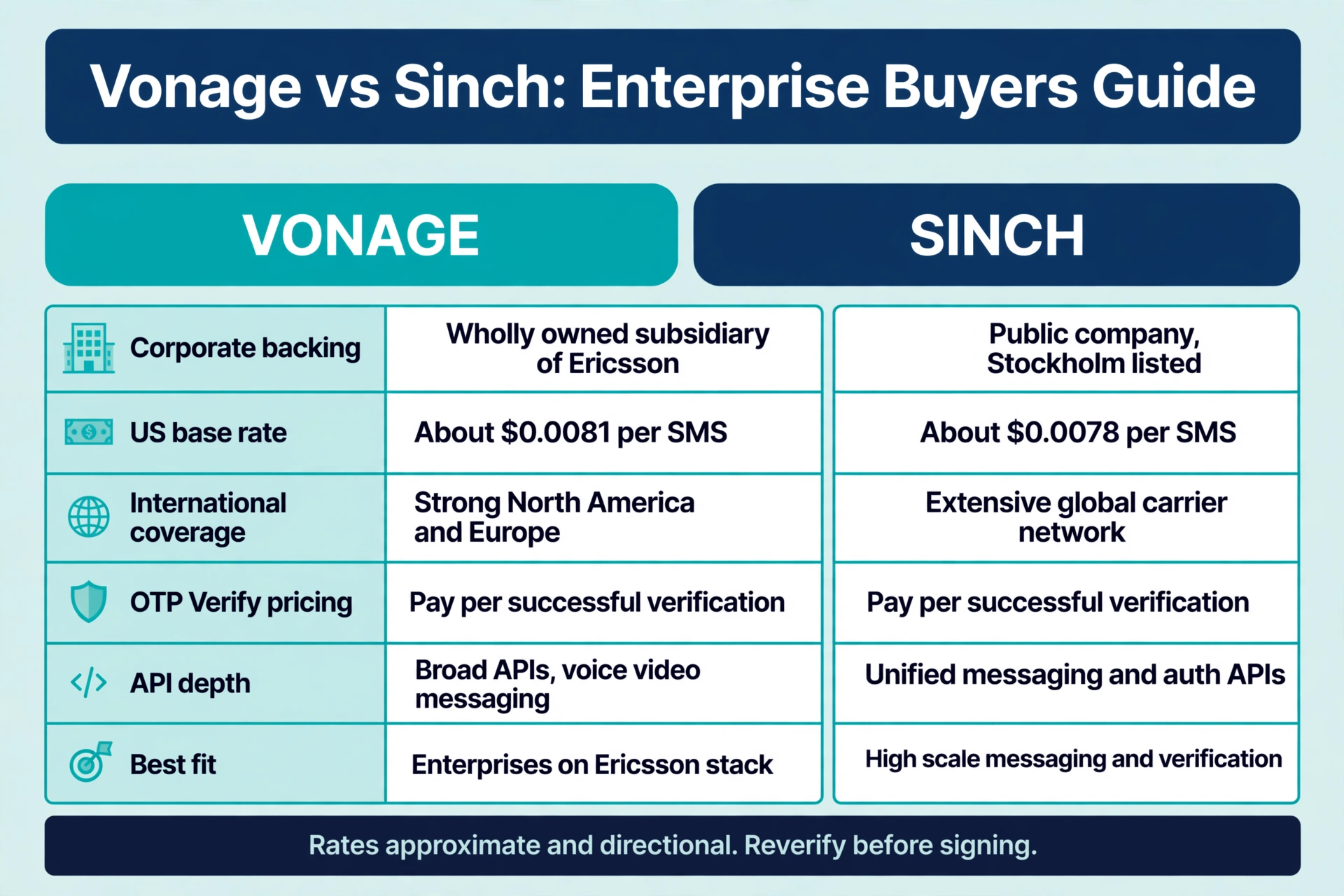
Both are quote-led at enterprise scale, with published or semi-published rates for self-serve evaluation. At the time of writing, third-party snapshots put US list-style rates close together:
- Vonage: roughly $0.0081 per US SMS.
- Sinch: roughly $0.0078 per US SMS.
Neither competes primarily on US list price. Both discount at volume through negotiated contracts, and both price international routes according to their infrastructure costs on each corridor. The honest way to compare them is to hand both vendors your actual destination mix and monthly volumes and compare written quotes. Any article that declares a winner on list rates alone is not describing how these vendors are actually bought.
Both pass through carrier fees and 10DLC charges. See our 10DLC cost breakdown for the fixed-fee layer.
EU and APAC delivery posture
This is the heart of the comparison. Vonage’s strength is European: strong carrier relationships, smooth alphanumeric sender ID handling in markets like Germany, France, the Netherlands, and the UK, and competitive EU per-route pricing. Ericsson ownership reinforces the European enterprise story.
Sinch’s strength is infrastructure depth: owned carrier connections in more countries, which it positions as a deliverability and latency advantage on international routes, particularly across Europe and APAC. The MessageMedia acquisition added Asia-Pacific messaging assets; Inteliquent added US carrier infrastructure.
Our judgment, stated carefully: for EU-centric traffic, Vonage’s sender-ID handling and EU pricing are excellent. For broad APAC and emerging-market traffic, Sinch’s owned infrastructure is the deeper story. Neither vendor publishes audited delivery-rate data, so treat both infrastructure claims as directional and test on your corridors. A two-week pilot with delivery-receipt tracking on your actual routes will tell you more than any comparison article, including this one.
Verify pricing for OTP
Both offer managed verification products for OTP workloads. Vonage Verify is priced competitively with Twilio Verify (around $0.05 per successful verification in third-party snapshots, plus channel fees). Sinch’s Verification API is priced to win enterprise OTP deals, with lower per-verification costs at volume.
For OTP-heavy global workloads, this is the line item to negotiate hardest, because the per-verification fee dominates OTP economics the way per-message rates dominate notification economics. Get both vendors to quote your actual verification volume and retry profile. Do not compare headline per-message SMS rates when your workload is OTP; you will optimize the wrong number.
One more RFP tactic: ask both vendors to price your verification volume with the same retry and fallback profile. OTP economics swing on silent variables: how many attempts before fallback, whether fallback goes to WhatsApp or voice, and whether you pay for failed attempts. A vendor that looks cheaper per successful verification can be more expensive per completed login if its retry logic burns attempts. Make them model your actual funnel, not their standard scenario, and get the fallback pricing in writing. This single exercise has reversed more OTP vendor decisions than any rate-card comparison.
API design
Vonage’s standout API feature is the omnichannel Messages API: one interface for SMS, MMS, WhatsApp, Facebook Messenger, and Viber. For enterprises building multi-channel customer communication, a single abstraction is genuinely valuable. Vonage also offers the classic SMS API for straightforward use cases.
Sinch’s API surface reflects its acquisition history: capable REST APIs, but you may encounter multiple product flavors depending on which Sinch product you buy. Ask exactly which API you will integrate against before building. Sinch’s docs are professional and complete, though less beginner-friendly than the most polished self-serve docs in the category.
Neither matches Twilio’s documentation quality, but neither is trying to win the self-serve developer the way Twilio does. Both assume you will have a solutions engineer on the onboarding call.
SDK language support
- Vonage: Node.js, Python, PHP, Java, Ruby, .NET, and Kotlin, covering both the SMS API and the Messages API.
- Sinch: Python, Java, Node.js, and .NET, with no dedicated PHP SDK.
Vonage wins on breadth. If your stack includes PHP or Kotlin, note the difference.
10DLC and US compliance
Both are full CSPs supporting brand and campaign registration. Vonage’s registration flow is functional; Sinch handles it through enterprise onboarding. Throughput is carrier and trust-score driven for both. See what is 10DLC for the process background.
Support and buying experience
Both are enterprise sales motions with account teams, negotiated SLAs, and solutions engineers. Vonage’s Ericsson parentage helps in telecom-adjacent procurement; Sinch’s messaging pure-play focus means your account team lives and breathes this product. Developer sentiment slightly favors Sinch’s technical depth and Vonage’s account management, but this varies by region and account size. Talk to reference customers in your industry before signing, and ask both vendors for customers with a similar destination mix to yours.
Head-to-head summary
| Dimension | Vonage | Sinch | Our judgment |
|---|---|---|---|
| Ownership | Ericsson (since 2022) | Independent, acquisitive | Different flavors of backing |
| Infrastructure | Carrier relationships, EU strength | Owned infra in many countries | Sinch on depth, Vonage on EU relationships |
| US list rate (at time of writing) | ~$0.0081 | ~$0.0078 | Effectively tied |
| EU routes | Strong pricing, smooth sender IDs | Strong via owned infra | Vonage for sender IDs, Sinch for depth |
| APAC routes | Capable | Deeper owned infrastructure | Sinch |
| OTP/Verify | Competitive with Twilio Verify | Lower at enterprise volume | Sinch for OTP scale |
| Omnichannel API | One Messages API | Multiple product flavors | Vonage |
| SDKs | 7 languages incl. Kotlin | 4 languages, no PHP SDK | Vonage |
| Buying motion | Enterprise sales | Enterprise sales | Tie |
Which should you choose?
Choose Vonage if: your traffic is EU-centric and alphanumeric sender IDs matter, you want one omnichannel API for SMS plus WhatsApp and Viber, or Ericsson backing helps your procurement process.
Choose Sinch if: your traffic spans APAC and emerging markets where owned infrastructure matters, OTP is a major workload and you want aggressive per-verification pricing, or you prefer a messaging pure-play vendor.
Do both, in evaluation: at enterprise scale, run both through procurement. Hand each your destination mix and volumes, pilot on real corridors with delivery tracking, and let the data decide. This is the one comparison in the cluster where “get both on a call” is not just advice but the entire methodology, because neither vendor’s list pricing reflects the deal you will actually sign.
FAQ
Is Vonage owned by Ericsson?
Yes, Ericsson acquired Vonage in 2022. The acquisition brought enterprise support depth and telecom credibility to Vonage’s CPaaS business.
What carrier infrastructure does Sinch own?
Sinch operates its own carrier infrastructure in many countries, expanded through acquisitions including MessageMedia (Asia-Pacific messaging) and Inteliquent (US carrier assets). The company positions owned infrastructure as a deliverability advantage on international routes.
Which is better for EU SMS delivery?
Both are strong. Vonage is noted for smooth alphanumeric sender ID handling and competitive EU pricing; Sinch brings owned infrastructure depth. Test both on your specific EU corridors, since neither publishes audited delivery data.
Which is cheaper for OTP, Vonage Verify or Sinch Verification?
Sinch’s Verification API is generally positioned as cheaper at enterprise OTP volume, while Vonage Verify prices near Twilio Verify levels. Both are quote-based at scale, so get written quotes for your verification volume.
Does Vonage have a PHP SDK?
Yes. Vonage publishes official SDKs for Node.js, Python, PHP, Java, Ruby, .NET, and Kotlin. Sinch does not offer a dedicated PHP SDK.
Can I use Vonage and Sinch together?
Yes. Enterprises commonly multi-source messaging across providers for redundancy and route optimization. Both vendors are accustomed to coexisting in such architectures.
The bottom line
Vonage vs Sinch is the enterprise buyer’s comparison: two carrier-backed global CPaaS vendors, two flavors of backing. Vonage brings Ericsson, EU carrier relationships, and a clean omnichannel API. Sinch brings owned infrastructure across more countries and aggressive OTP pricing at scale. For US traffic they are near-interchangeable; for international traffic, pilot both on your corridors and negotiate both on your volumes. The winner is the one your data picks, not the one with the better pitch deck. Run a two-week pilot on each with your real corridors and volumes, then let the delivery reports and the negotiated quotes decide. Treat the rate cards as the starting point for negotiation, not the final answer.
Want this set up for you?
I build SMS chatbots and API integrations for businesses. If you would like what this guide describes, done for you, get in touch.