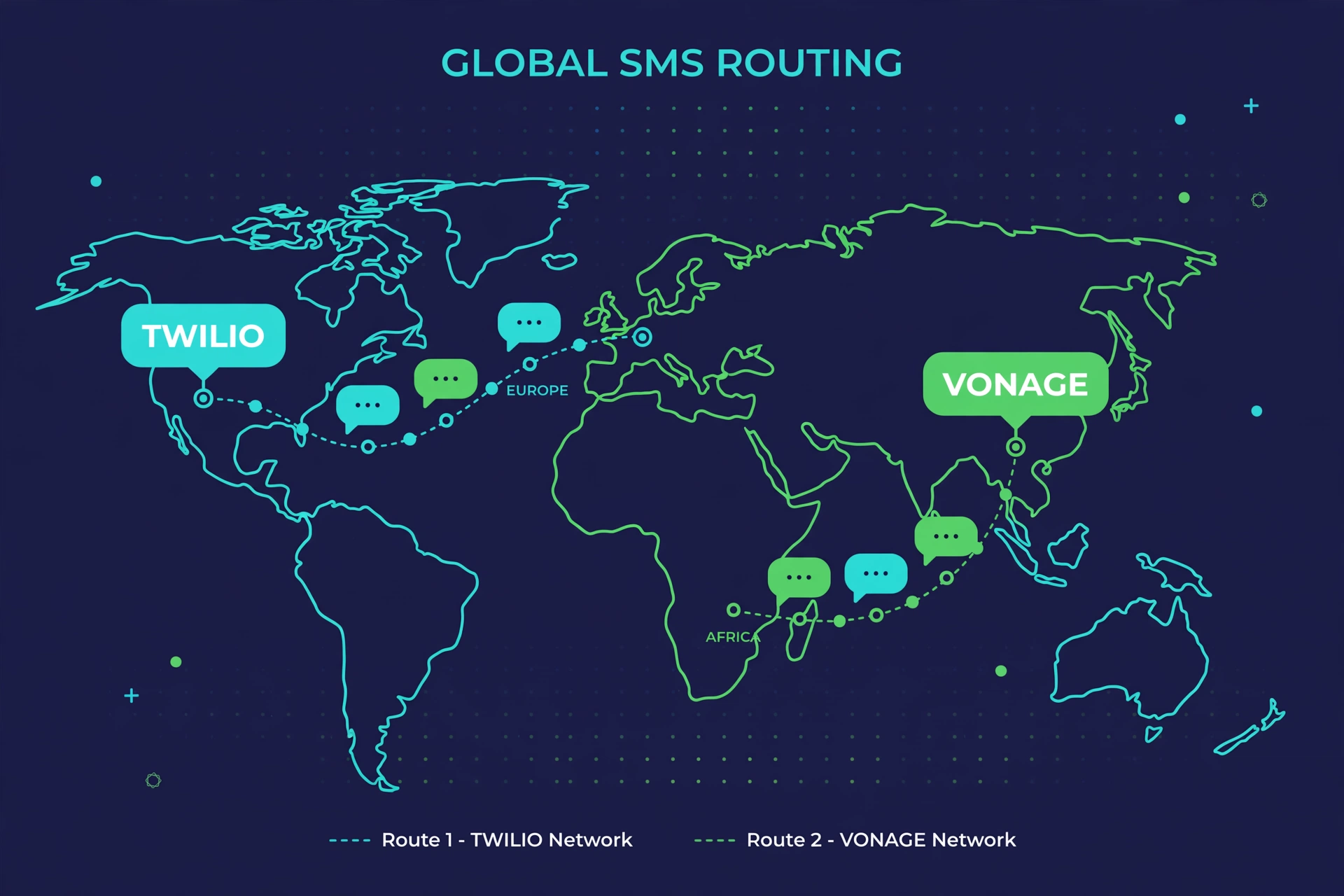
Twilio vs Vonage is the comparison that refuses to have one winner. Ask “which is cheaper” or “which is better” without saying where your messages go, and you will get two correct, opposite answers. Twilio tends to win on US traffic. Vonage, the CPaaS arm of Ericsson, tends to win on European and many international routes, where its carrier relationships and EU heritage change the math.
This article splits the verdict by route geography on purpose. That is the honest way to compare these two. We cover pricing structure, API design and SDKs, OTP and verification, alphanumeric sender ID handling, 10DLC support, coverage, and support, and we say where each claim comes from.
The short version
If most of your traffic is US 10DLC, Twilio usually wins on price and on documentation. If most of your traffic is European, especially markets that use alphanumeric sender IDs (Germany, France, the Netherlands, the UK), Vonage usually wins on price and on sender-ID handling. If your traffic is split, you may end up routing US traffic through Twilio and EU traffic through Vonage, which is more common in production than most vendors admit.
Pricing structure
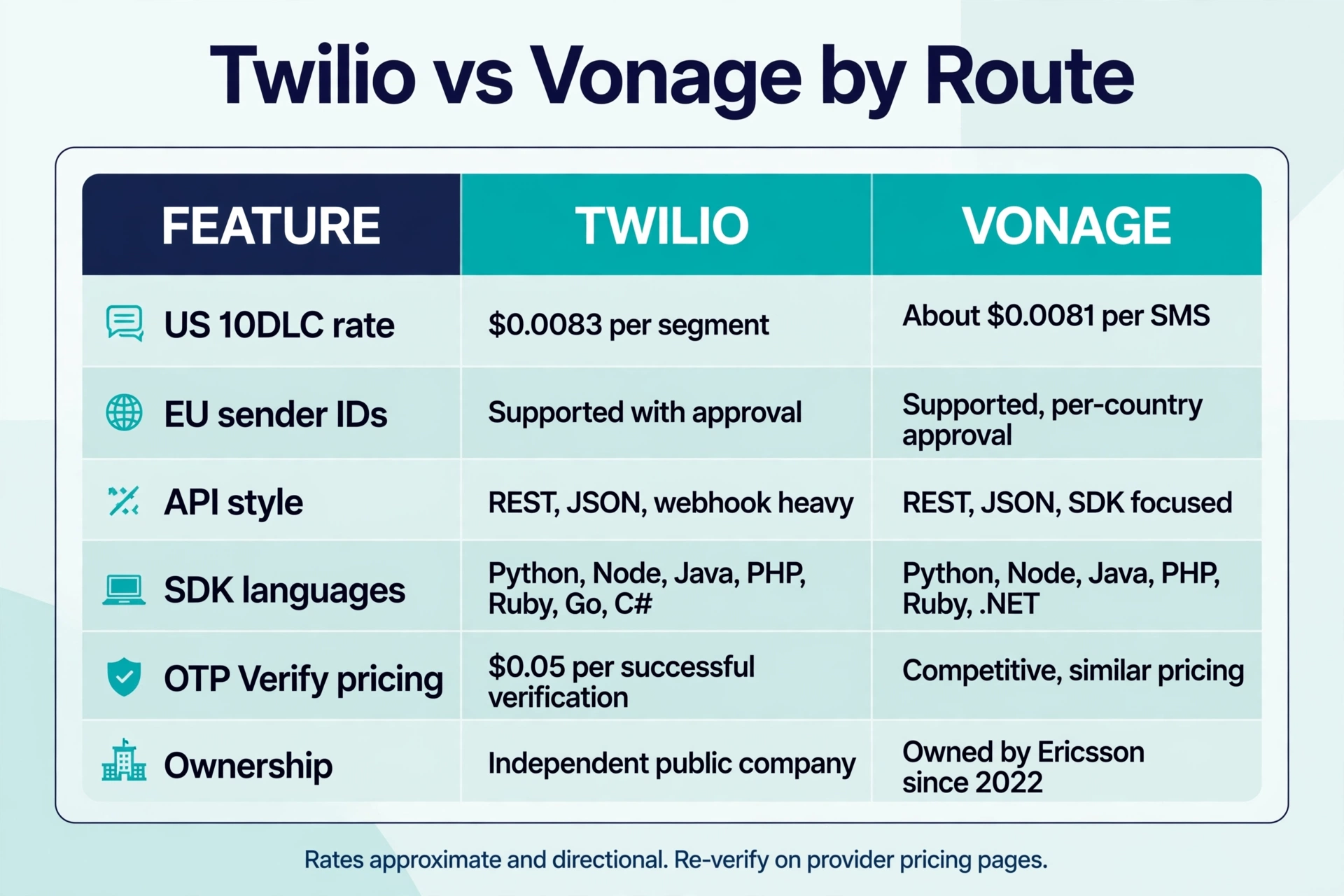
Both providers bill pay-as-you-go per message segment, and both pass through carrier fees and 10DLC charges separately. The headline numbers, at the time of writing, from third-party rate-card snapshots:
- Twilio: $0.0083 per US SMS segment, outbound and inbound.
- Vonage: roughly $0.0081 per US SMS in recent snapshots, which is effectively a wash with Twilio on US traffic.
The interesting part is outside the US. Vonage has historically priced European routes aggressively. Third-party snapshots from 2026 show Vonage charging around €0.0050 per SMS in Germany against Twilio’s roughly €0.0070, a gap of nearly 30% on that route by our arithmetic on those snapshots. Vonage’s UK rates are also typically competitive. Twilio, for its part, has enormous per-country coverage with a published rate card for nearly every destination, which makes it easier to forecast costs for a truly global footprint even when it is not the cheapest on any single route.
Two caveats. First, rate cards move, and both providers negotiate volume discounts, so if you send millions of messages, the list price is the start of a conversation, not the end. Second, “cheaper per message” is only meaningful for the same quality of route. Neither provider publishes audited delivery-rate data, so we do not claim one delivers better than the other anywhere. Price what you can see; test what you cannot.
For context on the fixed fees that sit around per-message rates (brand registration, campaign fees, number rental), see our 10DLC cost breakdown.
API design and documentation
Twilio’s API is the reference design for the whole category: consistent resource URLs, an error-code dictionary with remediation steps, and guides that read like they were written by someone who has debugged the problem at 2 a.m. Vonage’s API is a capable REST API with a second, omnichannel Messages API that handles SMS, MMS, WhatsApp, Facebook Messenger, and Viber behind one interface.
That omnichannel Messages API is Vonage’s most distinctive API feature. If your roadmap includes WhatsApp or Viber alongside SMS, Vonage lets you build on one abstraction. Twilio has the same channels, but they arrive as separate products with separate APIs (Programmable Messaging, the WhatsApp API, and so on). Developers who like one clean abstraction tend to prefer Vonage’s approach; developers who like specialist products with deep docs per channel tend to prefer Twilio’s.
On documentation quality, Twilio wins. Vonage’s docs have improved since the Ericsson acquisition, but they still trail on error-message clarity and on the depth of troubleshooting guides. This is a qualitative judgment based on developer community feedback, not a measured benchmark.
SDK language support
Both cover the standard set with official SDKs:
- Twilio: Python, Node.js, C#/.NET, Java, PHP, Ruby, Go, plus a CLI.
- Vonage: Node.js, Python, PHP, Java, Ruby, .NET, and Kotlin, covering both the SMS API and the omnichannel Messages API.
Rough parity. Vonage’s Kotlin SDK is a nice touch for Android-adjacent backends; Twilio’s Go library gets more maintenance attention. For mainstream languages, you will not feel a difference.
OTP and verification
Both offer managed verification products. Twilio Verify charges $0.05 per successful verification on top of channel fees at the time of writing, which makes a US SMS OTP cost roughly $0.058 all-in. Vonage Verify is priced similarly and competitively. Feature-wise, Twilio Verify is the more polished product, with built-in fallback channels (SMS to voice, for example) and fraud guardrails. Vonage’s offering is capable but less documented.
If OTP is your primary workload, price both on your actual verification volume and retry rate, because the platform fee per successful verification dominates the per-message cost at scale. A provider that is $0.001 cheaper per SMS but $0.005 more expensive per verification will lose on an OTP workload.
Alphanumeric sender IDs: Vonage’s home turf
This is the dimension where the geography split matters most. In many European and APAC markets, businesses send from alphanumeric sender IDs (a brand name like “ACME” instead of a number) rather than long codes. Vonage handles EU alphanumeric sender registration and routing more smoothly than Twilio in markets like Germany, France, and the Netherlands, based on consistent practitioner reports. Twilio supports alphanumeric sender IDs too, but its sender registration tooling and per-country quirks are less mature in these markets.
If your use case is marketing or notifications to European customers with a branded sender, default to evaluating Vonage first. If your use case is US transactional traffic on 10DLC numbers, default to Twilio.
10DLC and US throughput
Both are full CSPs with The Campaign Registry, supporting brand and campaign registration, sole-proprietor brands, and standard campaigns. US throughput is set by carrier and trust score, not by provider, so neither has a structural speed advantage on 10DLC. For the full picture of how 10DLC registration and sender types work, see what is 10DLC and 10DLC vs toll-free vs short code.
The practical difference is in the registration experience. Twilio’s TrustHub flow is the most guided in the industry; Vonage’s is functional. Practitioners report similar approval timelines (carrier-driven, not provider-driven), so treat registration UX as a convenience factor, not a deciding one.
Support and company trajectory
Vonage has been an Ericsson company since 2022. The acquisition brought enterprise-grade support and telecom credibility, which matters if your procurement team cares about vendor stability. The trade side, reported by some developers, is that Vonage’s startup-facing developer experience has become slightly more enterprise-flavored since the acquisition: more sales motion, less self-serve spontaneity.
Twilio remains the independent, developer-first company, with the most self-serve-friendly onboarding for first-time developers and paid support tiers for SLAs. Twilio gives new accounts trial credit (around $15, enough for roughly 1,900 US SMS at list rates); Vonage and Sinch offer trial credits as well.
Head-to-head summary
| Dimension | Twilio | Vonage | Our judgment |
|---|---|---|---|
| US SMS rate (at time of writing) | $0.0083/segment | ~$0.0081 | Effectively tied |
| EU routes (e.g. Germany) | ~€0.0070 | ~€0.0050 | Vonage, by ~30% |
| Pricing model | Pay-as-you-go per segment | Pay-as-you-go per segment | Tie |
| Omnichannel API | Separate products per channel | One Messages API (SMS, WhatsApp, Viber, more) | Vonage for abstraction lovers |
| Docs quality | Best in category | Improved, still behind | Twilio |
| SDKs | Python, Node, .NET, Java, PHP, Ruby, Go | Node, Python, PHP, Java, Ruby, .NET, Kotlin | Tie |
| Alphanumeric sender IDs (EU) | Supported, tooling less mature | Smoother registration and routing | Vonage |
| 10DLC support | Full TCR flow, guided TrustHub | Full TCR flow | Twilio, slightly |
| OTP/Verify | $0.05/successful verification | Competitive, similar pricing | Twilio on polish |
| Ownership | Independent | Ericsson (since 2022) | Vonage for procurement comfort |
Which should you choose?
Choose Twilio if: your traffic is mostly US, your team is learning SMS APIs for the first time and wants extensive docs, you need Twilio Verify for OTP with channel fallback, or you are building on other Twilio products.
Choose Vonage if: your traffic is mostly European or international, you send with alphanumeric sender IDs in EU markets, you want one omnichannel API for SMS plus WhatsApp and Viber, or your procurement team prefers an Ericsson-backed vendor.
Consider both if: your traffic is genuinely split by geography. Routing US 10DLC traffic through Twilio and EU alphanumeric traffic through Vonage is a legitimate production architecture, and the price difference on EU routes can pay for the extra integration work within months at volume.
FAQ
Is Vonage cheaper than Twilio?
On US traffic, they are effectively tied at the time of writing (roughly $0.008 per SMS segment). On many European routes, Vonage is meaningfully cheaper, around 20 to 30% on some snapshots. Always check both rate cards for your actual destinations.
What changed after Ericsson acquired Vonage?
Enterprise support and telecom credibility improved, which helps with procurement and large contracts. Some developers report the self-serve developer experience has become more sales-led since the 2022 acquisition. The API itself has continued to improve.
Which is better for WhatsApp messaging?
Both offer WhatsApp Business APIs. Twilio’s integration is generally considered smoother for developers getting started, while Vonage’s omnichannel Messages API puts WhatsApp behind the same interface as SMS and Viber. If WhatsApp is central to your roadmap, evaluate both hands-on rather than deciding on SMS pricing alone.
Does Vonage support 10DLC?
Yes. Vonage is a registered CSP and supports brand and campaign registration through The Campaign Registry, including sole-proprietor brands. Fees and timelines are set by TCR and the carriers.
Which has better documentation?
Twilio. This is the least controversial judgment in CPaaS. Vonage’s docs are adequate and improving, but Twilio’s error-code dictionary, guides, and community resources remain the standard.
Can I use Twilio and Vonage together?
Yes, and many teams do, typically splitting by geography: Twilio for US 10DLC, Vonage for EU and international routes. A simple router in your code, or an aggregator service, can send through both without changing your application’s messaging interface.
The bottom line
Twilio vs Vonage is a geography question disguised as a vendor question. Twilio wins the US on docs, developer experience, and a slight pricing edge; Vonage wins Europe on per-route pricing and alphanumeric sender-ID handling, with Ericsson behind it for enterprise comfort. Map your traffic by destination country first. The right provider usually becomes obvious once you do.
Want this set up for you?
I build SMS chatbots and API integrations for businesses. If you would like what this guide describes, done for you, get in touch.