Twilio vs Telnyx is the most financially interesting comparison in this cluster, because the price gap is the largest and the switching cost is the lowest. Telnyx charges roughly half of Twilio’s US per-segment rate, runs its own private carrier network, and ships a Twilio-compatible API (branded “Twexit”) designed so that migrating teams barely touch their code. That combination makes this less a “which is better” question and more a “what is actually stopping you” question.
This article centers on three things: the real all-in price difference at three volumes, what Telnyx’s Twilio compatibility actually covers, and an honest estimate of migration effort. Then we compare the rest: throughput, 10DLC tooling, SDKs, coverage, and support.
The price gap, all-in
At the time of writing, the headline numbers from provider pricing pages and rate-card snapshots:
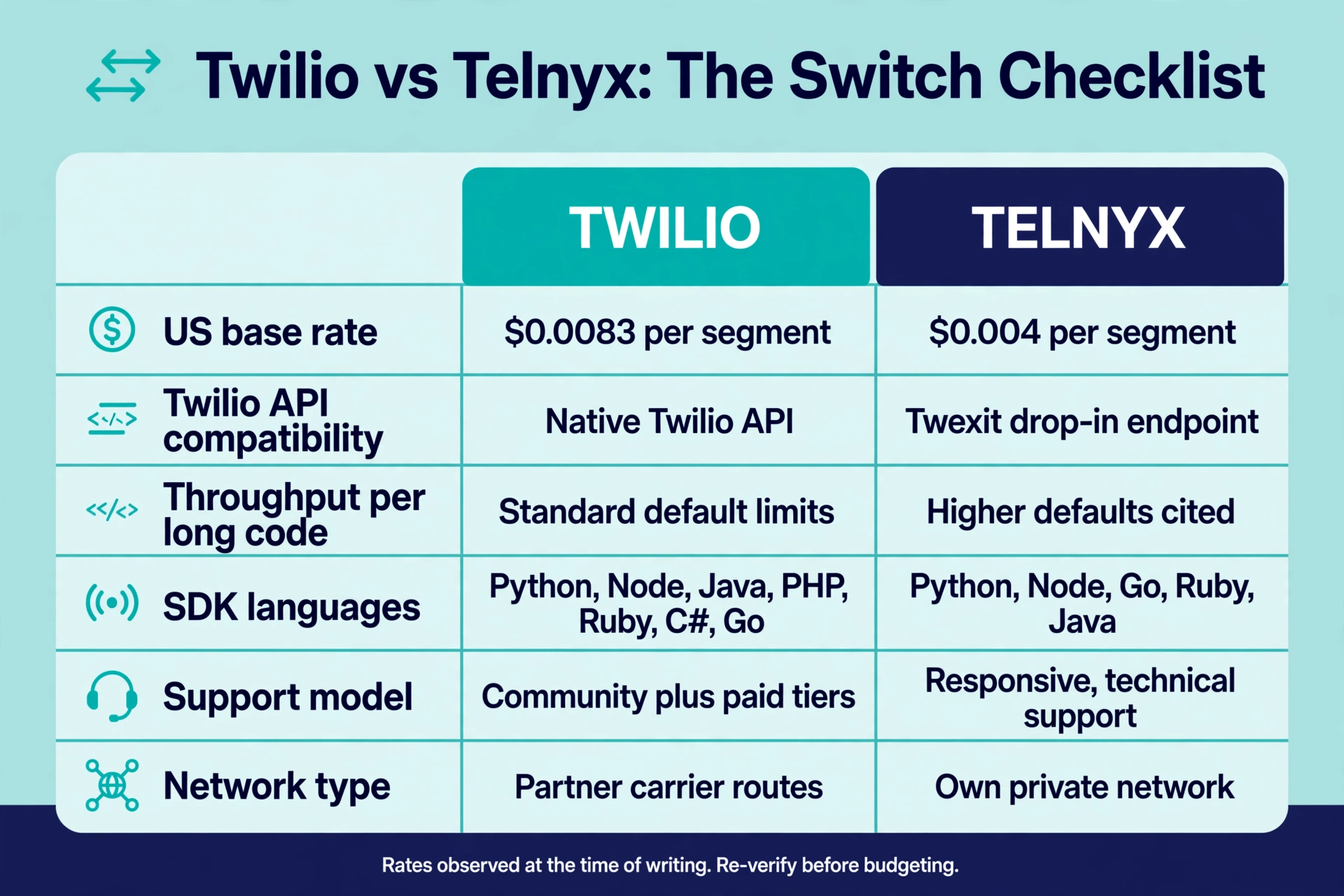
- Twilio: $0.0083 per US SMS segment, outbound and inbound.
- Telnyx: $0.004 per US SMS segment.
That is a 52% headline gap, the widest among the major Twilio alternatives. Both pass through carrier fees (roughly $0.0035 to $0.005 per message in the US) and 10DLC registration and campaign fees, so let us model the all-in cost the same way as our other comparisons: single-segment US 10DLC messages, blended carrier fee of $0.004, one brand, one standard campaign.
At 10,000 messages per month:
– Twilio: $83.00 + $40.00 + ~$11.50 in fixed fees = ~$134.50, or about $0.0135 per message.
– Telnyx: $40.00 + $40.00 + ~$11.50 = ~$91.50, or about $0.0092 per message.
A 32% all-in saving. Notice how the carrier fee, which is identical on both, eats into the headline gap. Anyone quoting you “half price” without mentioning carrier fees is selling, not informing.
At 100,000 messages per month:
– Twilio: ~$1,241.50, or about $0.0124 per message.
– Telnyx: ~$811.50, or about $0.0081 per message.
A 35% all-in saving, by our arithmetic from the rates above, roughly $430 per month, or about $5,160 per year.
At 1,000,000 messages per month:
– Twilio: ~$12,311.50, or about $0.0123 per message.
– Telnyx: ~$8,011.50, or about $0.0080 per message.
A 35% saving, roughly $4,300 per month. At this volume, both providers will negotiate, so treat list rates as the opening bid.
The honest framing: Telnyx is not “half price” all-in, because carrier fees are a fixed floor everyone pays. It is roughly one-third cheaper all-in on US traffic, which at six-figure monthly volumes is real money.
The Twexit API: how compatible is “compatible”?
Telnyx’s Twexit API is a Twilio-compatible messaging endpoint: you point your existing Twilio SDK or HTTP calls at Telnyx’s servers, swap the credentials, and most things keep working. User reviews consistently describe it as “mostly compatible” with Twilio codebases. Here is what that means in practice.
What usually works unchanged: sending SMS via the familiar Messages resource shape, basic status callbacks, and standard parameters like To, From, and Body. If your integration is a straightforward “send a text, get a delivery receipt,” the migration genuinely can be a base-URL and credential swap.
What needs attention: Twilio-specific products and features do not have Telnyx equivalents. Messaging Services (with sticky sender, geomatch, and scalers), Twilio Verify, Twilio Studio flows, and Twilio’s exact error-code taxonomy are Twilio-only. Webhook payload shapes are close but not identical, so if your code parses delivery receipts field by field, test every field. Number management APIs differ. And “mostly compatible” means edge cases, exactly the ones you discover in production, are where the differences live.
Our estimate of real migration effort: for a simple send-and-receive integration, a few hours including sandbox testing. For an integration that uses Messaging Services features, Verify, or deep webhook parsing, budget one to three days of engineering, mostly testing. That is still dramatically cheaper than a full rewrite against a foreign API, which is the entire point of Twexit.
Throughput
Telnyx is built for throughput. It operates its own private IP network and carrier infrastructure rather than reselling aggregator capacity, and it advertises higher per-number throughput than Twilio’s defaults (third-party research cites around 10 messages per second per long code on Telnyx’s standard setup, versus Twilio’s lower default long-code throughput). On 10DLC specifically, throughput is set by carrier and trust score for every provider, so the per-number advantage matters most for toll-free and international long-code sending.
Telnyx also tends to win on 10DLC registration speed in practitioner reports, with brand and campaign approvals sometimes clearing faster than Twilio’s. Timelines are carrier-driven and volatile, so treat this as a tendency, not a guarantee. For background on how registration works, see our 10DLC registration guide.
API design and documentation
Telnyx’s docs are genuinely good: clean reference, working code samples, and an OpenAPI spec the SDKs are generated from. They are not Twilio’s docs. Twilio’s error-code dictionary, troubleshooting guides, and decade of Stack Overflow answers remain a durable advantage. Telnyx compensates with responsive human support, which many small teams prefer to even particularly extensive documentation.
One structural note: because Telnyx’s SDKs are generated from its OpenAPI spec, they stay consistent across languages, but they can feel slightly less hand-tuned than Twilio’s. Both approaches work; Twilio’s feels more polished.
SDK language support
- Twilio: Python, Node.js, C#/.NET, Java, PHP, Ruby, Go, plus a CLI.
- Telnyx: Node.js, Python, PHP, Java, Ruby, and Go, generated from the OpenAPI spec.
Near parity on the mainstream set. If you are migrating via Twexit, you can even keep using Twilio’s SDKs pointed at Telnyx’s endpoints, which is the whole trick.
10DLC and sender management
Both are full CSPs with The Campaign Registry. Telnyx’s 10DLC tooling is well regarded, with clear fee passthrough and a portal that shows registration state plainly. Twilio’s TrustHub is the more guided experience. Functionally, both get you registered; the difference is UX polish versus speed-to-value.
Support
Telnyx’s support is a genuine differentiator at small and mid scale: responsive, technical, and included without a percentage-of-spend plan. Twilio’s free tier has no guaranteed response time, and SLAs start with paid plans (around $250/month or 4% of spend at the time of writing). At enterprise scale, Twilio’s dedicated support apparatus is deeper. The pattern across this cluster holds: Telnyx treats smaller accounts better; Twilio treats larger accounts better.
Head-to-head summary
| Dimension | Twilio | Telnyx | Our judgment |
|---|---|---|---|
| US base rate (at time of writing) | $0.0083/segment | $0.004/segment | Telnyx, by 52% headline |
| All-in US cost at 100K/mo (est.) | ~$0.0124 | ~$0.0081 | Telnyx, by ~35% |
| Twilio API compatibility | N/A | Twexit drop-in endpoint | Telnyx, unique advantage |
| Per-number throughput | Lower defaults | Higher defaults, private network | Telnyx |
| Docs | Best in category | Good, OpenAPI-generated | Twilio |
| SDKs | 7 languages + CLI | 6 languages, spec-generated | Tie, Twilio more polished |
| 10DLC support | Full, guided TrustHub | Full, fast, plain-spoken | Tie |
| OTP/Verify | Verify at $0.05/verification | Build it yourself | Twilio |
| Support | Paid tiers for SLAs | Responsive at small scale | Depends on size |
Which should you choose?
Choose Telnyx if: you want the biggest all-in saving available without rewriting your integration, you send high-throughput toll-free or international long-code traffic, or you want responsive support without paying a percentage of your bill for it. The Twexit compatibility makes this the lowest-risk switch in CPaaS.
Choose Twilio if: you rely on Twilio Verify, Messaging Services features, or Studio flows (none of which survive the migration), your team leans hard on documentation for self-service debugging, or you are embedded in the broader Twilio ecosystem.
The migration playbook: stand up a Telnyx account in parallel, point a staging copy of your Twilio integration at the Twexit endpoint, and run your full test suite against it. Watch the webhook payloads field by field. Migrate one low-risk traffic type first (notifications before OTP), then the rest. Keep Twilio as failover. Many teams end up here permanently: Telnyx primary, Twilio backup, which is also the lowest-cost high-availability setup among the options in this cluster at these volumes.
FAQ
Is Telnyx really half the price of Twilio?
On headline base rate, yes: $0.004 vs $0.0083 per US segment at the time of writing. All-in, the saving is closer to one-third, because US carrier fees (roughly $0.004 per message) are identical on both and form a price floor.
What is the Twexit API?
Telnyx’s Twilio-compatible messaging API. It accepts Twilio-shaped requests so that code written against Twilio’s API works against Telnyx with a base-URL and credential change. It covers core messaging; Twilio-specific products like Verify and Messaging Services do not carry over.
How long does migration from Twilio to Telnyx take?
For a simple send-and-receive integration, hours. For integrations using Messaging Services, Verify, or detailed webhook parsing, budget one to three days, mostly for testing. The webhook payload differences are where teams get surprised, so test receipts, not just sends.
Does Telnyx support 10DLC?
Yes, Telnyx is a registered CSP with The Campaign Registry and supports brand and campaign registration. Practitioners report competitive approval timelines, though registration speed is ultimately carrier-driven.
Which has better throughput, Twilio or Telnyx?
Telnyx advertises higher default per-number throughput and runs its own private network, which matters for toll-free and international long-code sending. On US 10DLC, throughput is set by carrier and trust score for all providers equally.
Is Telnyx reliable compared to Twilio?
Telnyx operates its own carrier-grade network and is widely used in production at scale. Neither provider publishes audited uptime or delivery-rate comparisons, so we do not claim one is more reliable. Running both with failover is the standard answer for teams where messaging is critical.
The bottom line
Twilio vs Telnyx is the rare comparison where the cheaper option also has the easier migration path. Telnyx saves roughly a third all-in on US traffic, ships a Twilio-compatible API that makes switching a days-long project instead of a weeks-long one, and treats smaller accounts well on support. Twilio keeps its edge on documentation, Verify, and ecosystem depth. If your integration is standard messaging without Twilio-only products, Telnyx is the strongest value pick in this entire cluster.
Want this set up for you?
I build SMS chatbots and API integrations for businesses. If you would like what this guide describes, done for you, get in touch.