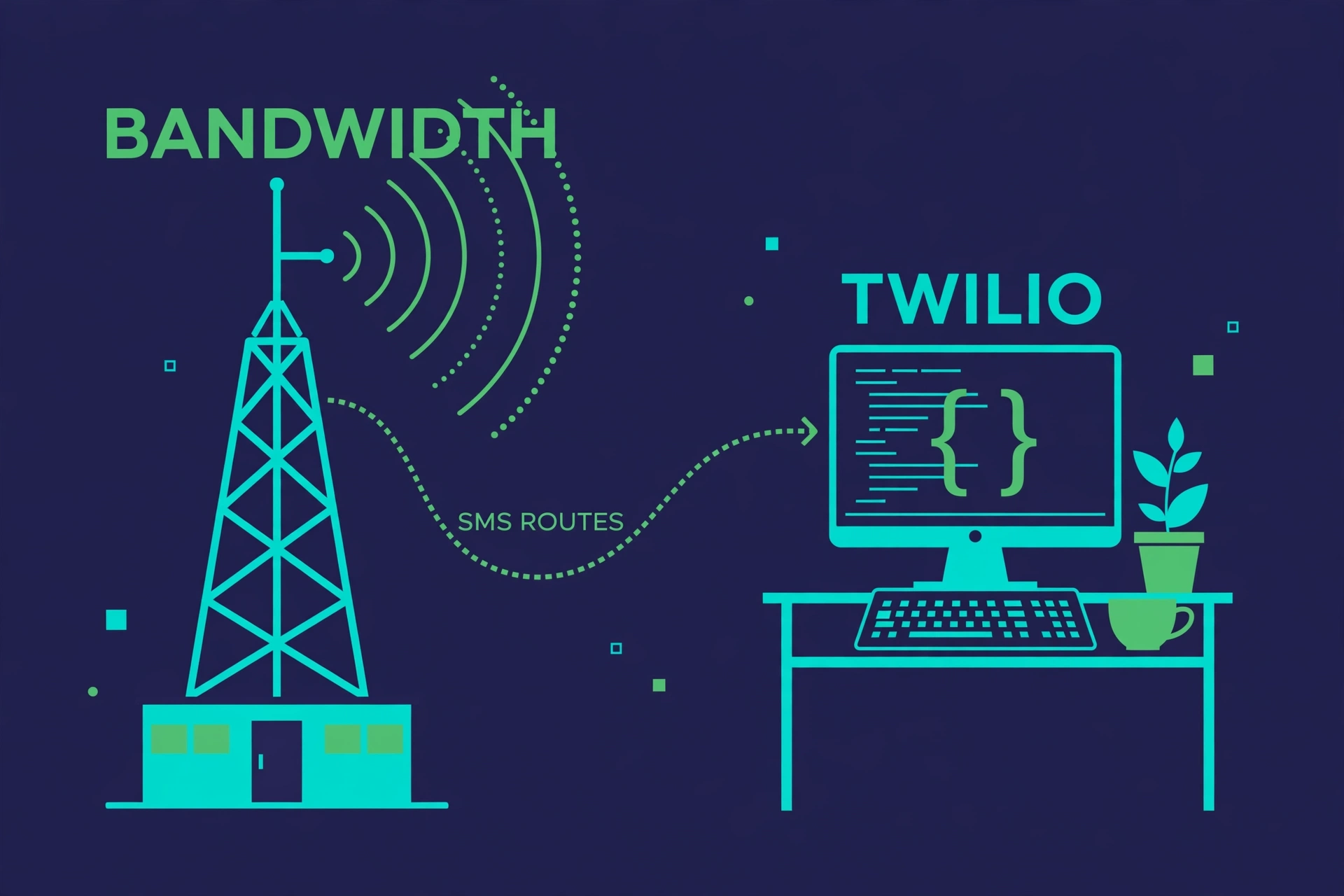
Twilio vs Bandwidth is the infrastructure purist’s comparison. Bandwidth is not another API company reselling aggregator capacity. It is a licensed US carrier (a CLEC) that operates its own voice and messaging network, and its SMS API rides on that network directly. Twilio is the developer platform with global breadth and particularly extensive documentation. If your traffic is US-centric and you care about what sits between your API call and the handset, this comparison matters.
The carrier-direct difference
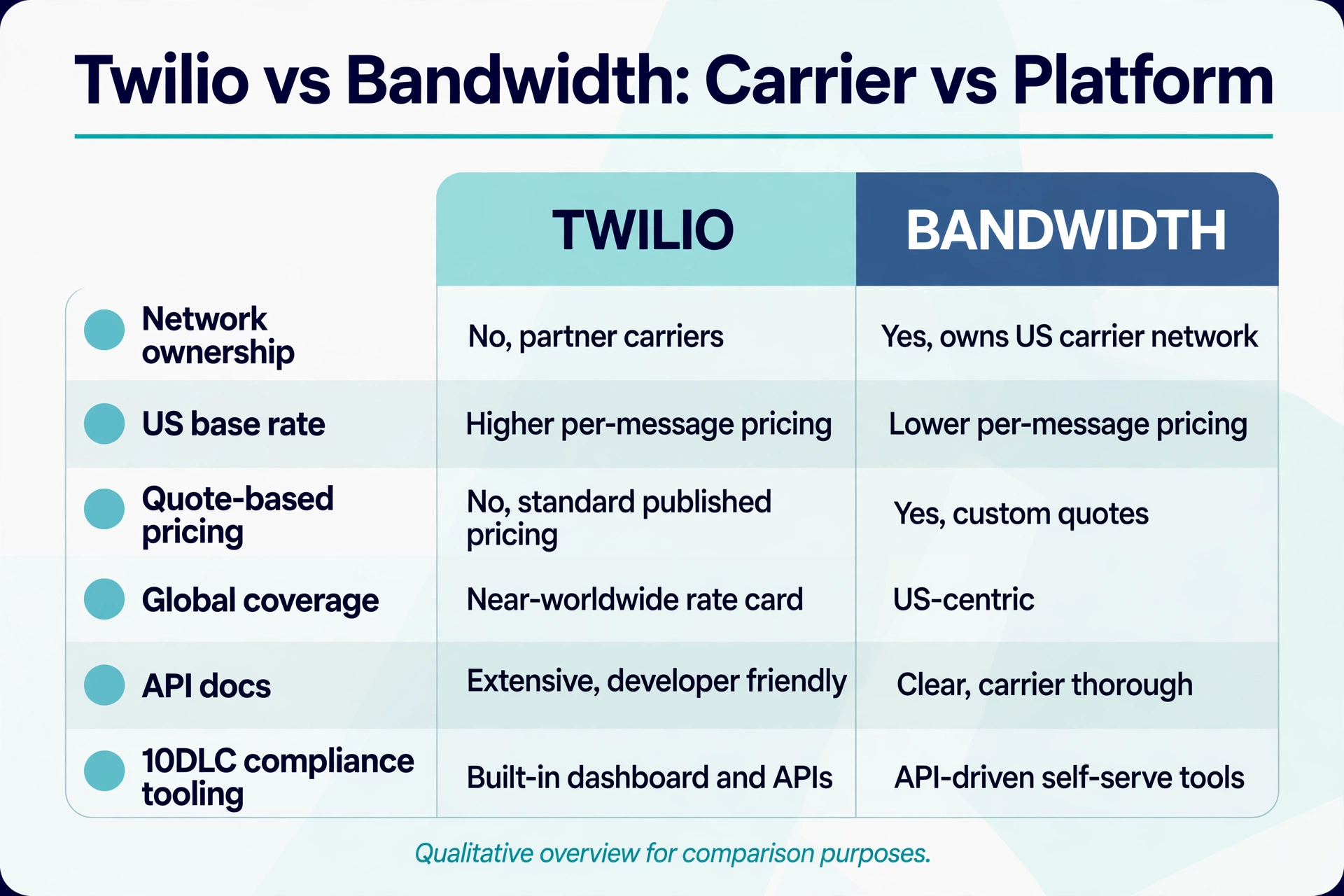
Most SMS APIs are software companies that buy network access from carriers and aggregators. Bandwidth is the network. As a licensed competitive local exchange carrier, it owns and operates US voice and messaging infrastructure directly. In practical terms, that means fewer intermediaries between your message and the recipient’s carrier, which Bandwidth positions as a latency and reliability advantage on US routes.
Does it matter for your use case? For standard marketing and notification traffic, the difference is mostly invisible; messages arrive either way. It matters more in three situations: high-volume US transactional traffic where per-message cost dominates, emergency-adjacent and 911-related communications where carrier-grade compliance and routing control are requirements, and voice-plus-messaging bundles where owning both networks simplifies the architecture.
Twilio, by contrast, built its reputation on software, not network ownership. Its strength is the platform around the message: docs, SDKs, Verify, Studio, and an ecosystem of integrations. On US routes, Twilio’s traffic rides quality upstream connections, but it is not the carrier.
There is one more angle worth weighing. Because Bandwidth owns network assets, its voice and messaging products share the same underlying infrastructure, which simplifies life for enterprises that need both. A contact center running Bandwidth voice trunks and Bandwidth SMS deals with one carrier relationship, one contract, and one support path. Twilio can match the functionality with its own voice and messaging products, but the commercial relationship is with a software vendor, not a carrier. For procurement teams that prefer carrier contracts, that distinction is decisive.
Pricing structure
At the time of writing, third-party rate-card snapshots show:
- Twilio: $0.0083 per US SMS segment, outbound and inbound, published.
- Bandwidth: roughly $0.004 to $0.005 per US SMS, typically quote-based.
Bandwidth’s pricing is usually negotiated rather than self-serve published, which reflects its enterprise sales motion. On list-style comparisons, Bandwidth undercuts Twilio by roughly 40 to 50% on US base rate. Both pass through carrier fees and 10DLC charges.
Model it all-in at 100,000 US messages per month (single-segment, $0.004 blended carrier fee, one campaign, using $0.0045 as Bandwidth’s midpoint):
- Twilio: ~$1,241.50, or about $0.0124 per message.
- Bandwidth: $450 + $400 + ~$11 = ~$861, or about $0.0086 per message.
A 31% all-in saving, directionally. The usual caveats apply: these are estimates from snapshot rates, Bandwidth will quote your actual volume, and carrier fees are identical on both.
The quote-based motion is worth planning around. Bandwidth will typically want your monthly volume, message types, and destinations before putting a number on paper, and the first quote is a starting point, not a floor. Bring your Twilio invoice or a 90-day traffic sample to the conversation; it gives the account team something concrete to price against and usually shortens the negotiation by a round. Also ask where carrier fees and 10DLC pass-throughs land in the quote versus on the invoice, because quote documents and rate decks do not always count them the same way. The enterprises that get the best Bandwidth pricing treat it like a carrier negotiation, not a SaaS signup.
911 and emergency-adjacent compliance
This is Bandwidth’s signature strength and a reason it appears in enterprise RFPs alongside or instead of Twilio. Because Bandwidth operates as a carrier, it has deep capabilities in emergency services communications: 911 call routing, emergency notification compliance, and the regulatory posture of a licensed carrier. For healthcare systems, universities, municipalities, and enterprises with emergency notification requirements, “our messaging provider is itself a carrier” is a meaningful procurement argument.
Twilio supports emergency-adjacent use cases through its platform, but it does so as a software provider, not a carrier. If your compliance team asks who owns the network path for your emergency alerts, the two vendors give different answers. Verify the specifics against Bandwidth’s documentation for your exact use case; emergency communications rules are jurisdiction-specific and this article is not legal advice.
API design and developer experience
Here the tables turn. Twilio’s API and docs are the category standard. Bandwidth’s API is capable and well documented for a carrier, but it reflects a carrier’s priorities: correct, thorough, and less focused on developer delight. Teams that come from Twilio often describe Bandwidth’s developer experience as functional rather than delightful, and the portal assumes more telecom knowledge than Twilio’s does.
Bandwidth’s portal and API cover the essentials: sending, delivery receipts, number management, and 10DLC registration support. What you will not find is Twilio’s galaxy of adjacent products. Bandwidth is a communications infrastructure company, not a platform company.
SDK language support
Twilio maintains official SDKs for Python, Node.js, C#/.NET, Java, PHP, Ruby, and Go, plus a CLI. Bandwidth offers SDKs and REST APIs with narrower official language coverage. For standard SMS operations over REST, this rarely blocks anyone, but Twilio wins on breadth and maintenance.
Geographic coverage: the trade-off
This is Bandwidth’s real limitation. Its network is US-centric by design. If your traffic is primarily US, that focus is a strength: deep, carrier-direct, cost-effective. If your traffic is global, Bandwidth is not the single-provider answer. Twilio’s per-country rate card covers nearly every destination on earth with consistent platform behavior.
The common production pattern: Bandwidth for US traffic, Twilio (or another global CPaaS) for international. This is not a compromise; it is how many US enterprises already architect messaging.
10DLC and throughput
Both support full 10DLC brand and campaign registration through The Campaign Registry. Bandwidth’s carrier status can make the registration conversation smoother with its direct carrier relationships, though timelines remain carrier-driven. Throughput on 10DLC is set by carrier and trust score for both. For background, see what is 10DLC and 10DLC vs toll-free vs short code.
Support
Bandwidth’s support reflects its enterprise carrier motion: account teams and SLAs for contracted customers, less self-serve spontaneity for small accounts. Twilio serves small accounts better self-serve and large accounts through paid tiers. If you are a startup, Twilio is the easier start. If you are an enterprise with a carrier-relationship procurement process, Bandwidth speaks that language natively, and the sales conversation will feel familiar rather than foreign.
Head-to-head summary
| Dimension | Twilio | Bandwidth | Our judgment |
|---|---|---|---|
| US base rate (at time of writing) | $0.0083/segment | $0.004-$0.005 (quote-based) | Bandwidth, by ~40-50% |
| All-in US cost at 100K/mo (est.) | ~$0.0124 | ~$0.0086 | Bandwidth, by ~31% |
| Network model | Software platform, upstream carriers | Licensed US carrier (CLEC) | Bandwidth for directness |
| 911/emergency posture | Software provider | Carrier-grade | Bandwidth |
| Global coverage | Near-worldwide rate card | US-centric | Twilio |
| Docs and SDKs | Particularly extensive docs | Capable, carrier-flavored | Twilio |
| 10DLC support | Full, guided TrustHub | Full, carrier relationships | Tie |
| Buying motion | Self-serve | Enterprise, quote-based | Depends on buyer |
Which should you choose?
Choose Bandwidth if: your traffic is US-centric and high-volume, you want carrier-direct routing with fewer intermediaries, per-message cost is a primary driver, or you have emergency notification or 911-adjacent compliance requirements where carrier status matters to procurement.
Choose Twilio if: your traffic is global, your team values Twilio’s extensive docs and SDKs, you need Verify or other Twilio-only products, or you want self-serve signup without a sales cycle.
Consider both if: you are a US enterprise with global reach. Bandwidth for domestic traffic and Twilio for international is a common, sensible architecture that plays each vendor’s strength.
FAQ
Is Bandwidth cheaper than Twilio?
On US traffic, yes, directionally: roughly $0.004 to $0.005 per SMS against Twilio’s $0.0083 at the time of writing. Bandwidth’s pricing is typically quoted per deal, so get a written quote at your volume.
What does carrier-direct mean?
Bandwidth operates as a licensed carrier with its own US network infrastructure, so your API traffic rides Bandwidth’s network directly rather than passing through third-party aggregators. In theory this means fewer hops; in practice the visible difference is mostly on cost and on compliance posture.
Is Bandwidth good for emergency notifications?
Bandwidth’s carrier status and emergency-services capabilities make it a strong candidate for emergency-adjacent communications (healthcare, education, municipal alerts). Verify the specifics against its documentation for your jurisdiction and use case.
Does Bandwidth support 10DLC?
Yes, Bandwidth supports 10DLC brand and campaign registration through The Campaign Registry.
Which is better for international SMS?
Twilio, clearly. Bandwidth is US-centric by design. For global traffic, Twilio’s near-worldwide rate card and consistent platform are the safer single-provider choice.
Can I use Bandwidth for US and Twilio for international?
Yes, and many enterprises do exactly this. Route by destination country in your own code or through a routing layer. It plays to each vendor’s strength.
The bottom line
Twilio vs Bandwidth is infrastructure versus platform. Bandwidth is the carrier: direct US network, aggressive per-message pricing, and a compliance posture that suits emergency-adjacent enterprise use cases. Twilio is the platform: global breadth, strong docs, and a developer ecosystem built over a decade. US-centric enterprises should price Bandwidth seriously, and always get the quote in writing since Bandwidth’s pricing is negotiated per deal. Everyone else should know exactly where their traffic goes before choosing. And whatever the headline numbers say, model the all-in cost with your actual carrier mix before you sign, because list rates are only the opening bid.
Want this set up for you?
I build SMS chatbots and API integrations for businesses. If you would like what this guide describes, done for you, get in touch.