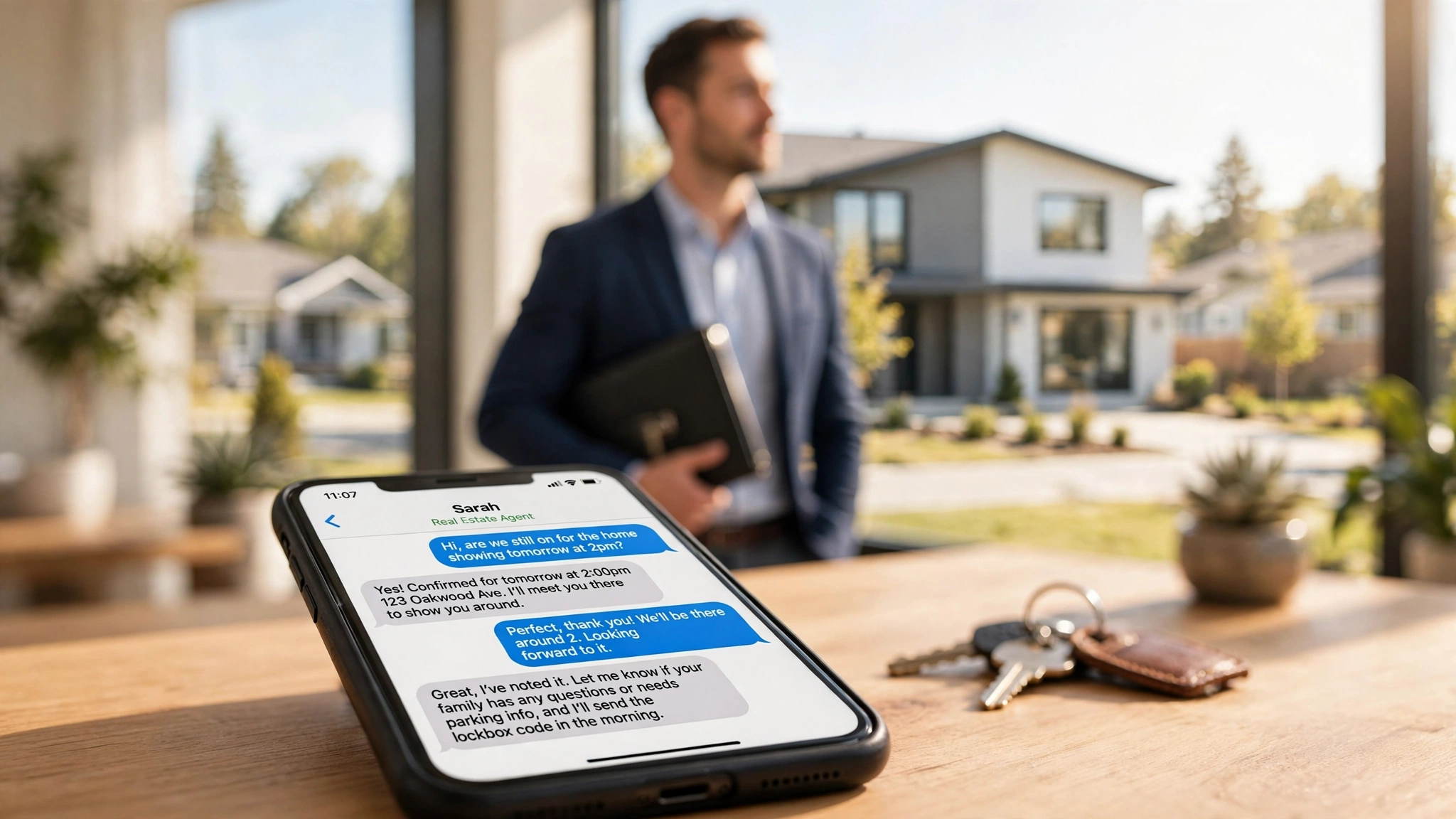
Buyers send inquiries to several agents at once, and the one who replies first usually gets the conversation. Most agents are in a showing, on a call, or driving when that inquiry lands. An SMS chatbot closes that gap. It texts new leads back in seconds, keeps cold leads warm for months, and books showings over text. When a Zillow inquiry, a Facebook lead ad, or a website form comes in, the bot opens a two-way text conversation, qualifies the lead, and books the showing. You step in when the conversation gets serious or the bot hits a question it cannot answer.
Why texting fits real estate so well
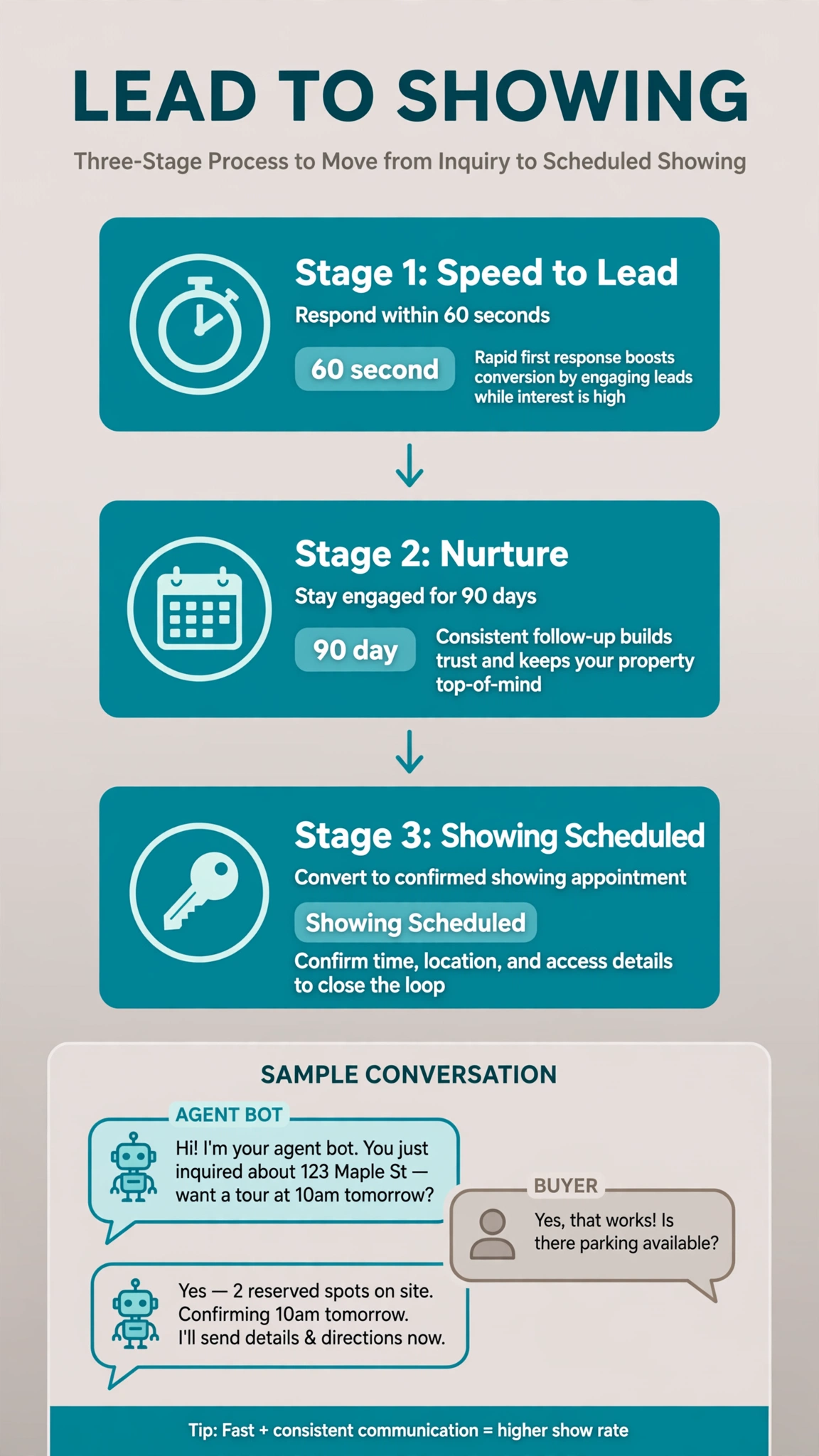
Buyers already expect to text their agent. NAR survey data reported by realtor.com shows that 71 percent of buyers said it was important that their agent communicate via text, rising to 77 percent among young Millennial buyers. Speed matters just as much. Harvard Business Review research, often cited by Inman, found that connecting with an inbound prospect within the first minute makes conversion dramatically more likely, while waiting past five minutes sharply reduces the odds.
Use cases: what an SMS chatbot actually does for an agent
New listing inquiry. A buyer taps “schedule a tour” on Zillow at 9:47 PM. The bot texts within a minute: “Hi Maya, this is Jorge’s team with Lakeside Realty. Saw your request for the Maple Ave townhome. Want a private tour or just more details?” The lead answers from the couch, the bot asks two or three qualifying questions, then offers tour times. By morning the agent has a booked showing and a full conversation history in the CRM.
Open house follow-up. Twenty people sign in at a Saturday open house. The bot texts each of them Monday morning: “Thanks for stopping by the open house on Maple Ave. Would a second look help, or are you still browsing?” Visitors who were curious but not ready talk to the bot instead of disappearing.
Cold lead revival. Every agent has leads who went quiet months or years ago. A bot that checks in every few months catches people at the moment they become ready again. Reply rates are often surprisingly high, because the text arrives when the lead was already thinking about a move.
Speed-to-lead texting: getting first contact right
The first text has one job. It confirms someone is on the case and opens a conversation. It does not need to sell anything.
Timing. Aim for under 60 seconds from the moment the inquiry arrives. The bot fires automatically. Quiet hours matter for outreach you initiate, so for bulk sends check your timing against state rules with our SMS quiet hours checker.
Keep first texts short, name the property, and end with an easy question.
- “Hi Daniel, this is Priya with Northside Realty. Saw your inquiry about 1420 Birch Lane. Would you like to tour it, or should I send the details first?”
- “Hey Maya, I just left you a voicemail. I know you might not be able to talk right now. Is there a good time for a quick call about your home search?”
Qualifying in the same conversation. Once the lead replies, the bot asks a few practical questions before the agent takes over: budget range, timeline, pre-approval status, and preferred neighborhoods. The answers sync to the CRM so the agent reads the whole thread before the first call.
Escalation rules. The bot should hand off the moment the lead asks something it cannot verify: price negotiations, contract terms, anything about a property’s condition. “Good question, let me have Priya confirm that for you” beats a made up answer. A confident wrong answer costs more trust than a quick handoff.
Long-term nurture: texts that do not annoy people
Most agents stop texting after three weeks, and the lead buys with someone else six months later. A chatbot handles the long game with check-ins that do not read like campaigns. A realistic cadence for a cold buyer lead: day 3 asks how the search is going and shares two new listings; week 3 mentions a rate dip and offers a lender introduction; month 2 flags a coming-soon listing that matches; month 6 asks if the timing has shifted. Each message offers something useful and asks a low pressure question.
If the lead stops replying, slow down. Move non responders to a monthly or quarterly touch and end the sequence after a year of silence. That protects your sender reputation and your relationship with the lead. One tactic worth borrowing: ask for updated preferences each quarter. “Is your price range still around $500K, or has that changed?” A one line answer refreshes the whole sequence with accurate data.
Showing-scheduling flows: the turn-by-turn conversation
Scheduling a showing manually takes four or five messages across two people and a calendar. Here is the same job in one bot thread, assuming the bot is connected to the agent’s calendar:
- Bot opens. “Want to see 1420 Birch Lane? I can set up a tour. Would Friday or Saturday work better?”
- Lead picks a day. “Saturday works.”
- Bot offers real availability. “Saturday I have 11:00 AM and 2:30 PM open. Which is better?”
- Lead picks a time. The bot confirms: “You’re booked for Saturday at 2:30 PM. I’ll text you the lockbox and parking details that morning.” It notifies the agent separately and logs the appointment plus the lead’s qualification answers.
- Reminders go out 24 hours before and the morning of the showing.
When buyers change plans, the bot handles “can we move it to Sunday” by rechecking availability and confirming the new time. If nothing works, it offers the closest options and flags the agent. An hour after the tour, the bot asks for feedback: “How was the tour? Was the layout what you expected?” A positive answer triggers similar listings. A negative one asks what to change, which improves the search.
TCPA compliance notes for agent outreach
This section is not legal advice. Texting rules for real estate are strict, actively enforced, and changing. Talk to your broker or an attorney before building any automated outreach.
Automated texts need prior express written consent. Under the TCPA, sending automated texts, and AI generated texts count as automated, to a cell phone without the recipient’s prior express written consent is a violation. The consent must name your company, not just the portal the lead came from. Consent does not transfer between businesses by default. Penalties run $500 to $1,500 per message, and real estate agents and brokerages have faced class actions over exactly this.
Never text purchased or scraped lists with a chatbot. This is the highest risk behavior in the entire topic. Buying a list of phone numbers or scraping numbers from listings does not give you consent. Some agents assume an “established business relationship” covers expired listings or FSBOs. Compliance guides say it does not cover automated texts to cell phones, and the listing relationship was with the listing agent, not with you. Expired does not equal consent.
Honor opt-outs fast and keep records. Anyone who replies STOP, or asks you to stop through any reasonable method, must be removed from your texting. Federal rules now require revocation to be honored across all your channels within 10 business days, and you may send at most one confirmation text. Keep timestamped records of every consent and every opt-out for at least four years.
Watch the clock and the DNC list. Federal rules restrict telemarketing texts to 8 AM to 9 PM in the recipient’s local time, and several states have stricter quiet hours. The Do Not Call Registry applies to text messages, so screen numbers before any marketing text. Clean your lists with our phone list cleaner first. Our free tools hub has the full set.
One-to-one consent is a moving target. The FCC’s one-to-one consent rule would have required consent forms to name a single specific seller. The Eleventh Circuit vacated it in January 2025 and the FCC postponed it, so recheck its status at the time you read this.
Choosing and setting up a real estate SMS chatbot
The options cluster into three groups: CRM built-ins and add-ons like Follow Up Boss or GoHighLevel; standalone real estate AI assistants in the Structurely mold with prebuilt qualification flows; and general builders like ManyChat or Tidio that run SMS through integrations. Check four things before you commit: native integration with your lead sources and CRM, real calendar connectivity, human handoff rules you control, and consent plus opt-out logging you can export. If a tool cannot show you the opt-out log, skip it.
Before you scale, run your expected volume through a bulk SMS cost calculator. A single text costs a few cents, but thousands of nurture touches add up fast.
Want this set up for you?
I build SMS chatbots and API integrations for businesses. If you would like what this guide describes, done for you, get in touch.
Frequently asked questions
How fast should an SMS chatbot reply to a new real estate lead?
Within 60 seconds. First-minute contact dramatically raises conversion odds, and waiting past five minutes sharply reduces them. An automated first text is the only reliable way to hit that window around the clock.
Can a real estate chatbot actually book showings over text?
Yes, with calendar integration. The bot offers real slots, the lead picks one, and the bot confirms, sends reminders, handles reschedules, and logs everything to the CRM. Without calendar connectivity it is just a conversation tool.
What questions should a real estate SMS chatbot ask?
Budget or price range, timeline, pre-approval status, preferred neighborhoods, and must haves like beds and baths. Keep it to four or five in the first conversation. The bot’s real skill is reading the answers and adjusting, not just running down a list.
Is it legal to have a chatbot text expired listings or FSBOs?
Not with automated texts unless you have each person’s prior express written consent. An expired listing or a public FSBO ad does not count as consent. Fines run $500 to $1,500 per text. Use email or direct mail to invite those owners to opt in to texts instead.
Do I need consent to text leads who filled out a form on my website?
Yes, as long as the form clearly identified your business and described the texts they will get. If the consent named only a third party portal, check with counsel before your bot starts texting.
How much does a real estate SMS chatbot cost?
It ranges from CRM add-ons costing tens of dollars per month to dedicated AI assistants priced per lead or per seat, plus per-message SMS costs for every text sent and received. Confirm current pricing with any vendor directly.
Will leads know they are texting with a bot?
Maybe, and that is fine. The guides agree on one rule: program a clear handoff. When the conversation turns to negotiations, contracts, or anything the bot cannot verify, the bot should bring in the agent by name. Transparency at the handoff builds more trust than a bot that guesses.
How do I stop the bot from annoying people who do not reply?
Slow the cadence after two or three unanswered messages, move non responders to monthly check-ins, and end sequences after a year of silence. Every automated text must include opt-out instructions, and every opt-out must be honored across all your channels within 10 business days.
Conclusion
An SMS chatbot gives a real estate agent three things that are hard to get any other way: a first text within seconds of every inquiry, nurture that keeps running when the agent gets busy, and showing scheduling that happens entirely over text. Good scripts, honest escalation rules, and clean consent practices decide who wins. The agents who build that get the appointment. The ones who text first without consent get the lawsuit.