A short code is the 5 or 6 digit number big brands use for text alerts, two-factor codes, and marketing blasts. Getting one sounds like buying a phone number. It is not. It is a multi-month approval process run by every mobile carrier you want to reach, and the provisioning phase most provider pages gloss over decides when you launch.
Provisioning means more than leasing a number. Each US carrier, AT&T, Verizon, T-Mobile, plus dozens of regional carriers, must individually configure its network to route messages to your code. That per-carrier work is why short codes carry the highest trust and throughput in the US, and also why they cost the most and take the longest to obtain.
This guide walks through the real sequence: leasing, the program brief, reviews, vetting, carrier review, and carrier testing. Timelines and costs change, so every figure below is sourced and labeled as volatile. Recheck the numbers before you budget.
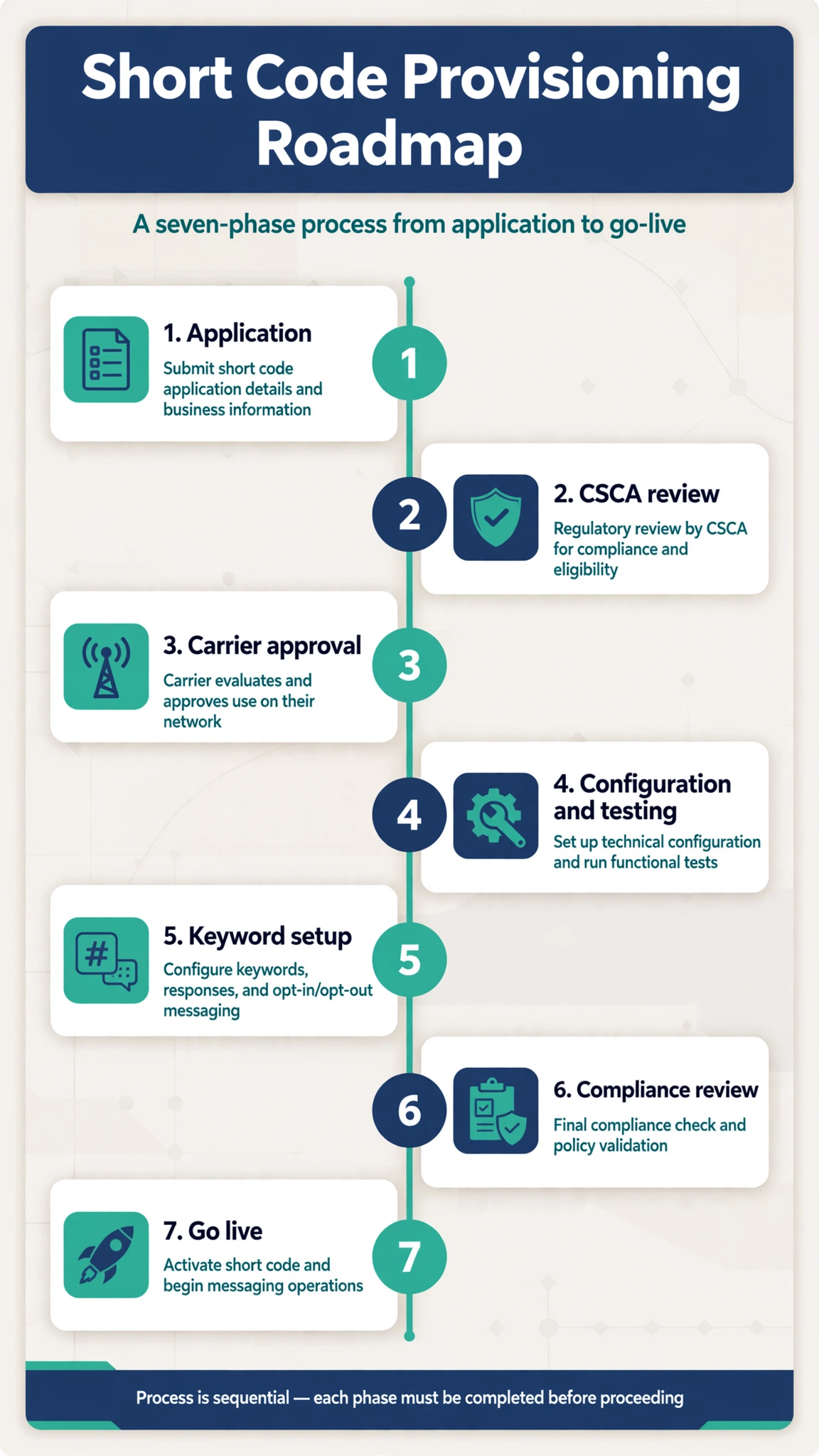
The step sequence, from decision to launch
The steps below follow how the process actually runs across the major platforms. AWS documents it as a 12 step flow in its End User Messaging guide, Azure describes it as a five section program brief followed by carrier review, and Twilio lays it out as a console application with Twilio review first and carrier review after. The substance is the same everywhere.
Step 1: Confirm you actually need a short code
Consider one when you need over 20 messages per second, daily volumes over 400,000, or maximum reliability for time critical traffic like one-time passcodes. They are a poor fit if you need voice, which short codes do not support, if your volume is modest, or if cost matters more than speed. 10DLC or toll-free messaging is cheaper and provisions in days, not months.
Step 2: Build your compliance package before you apply
This is where most applications slow down. Carriers require proof of a compliant program before they approve anything. Assemble these first:
- Opt-in workflow documentation. Show where and how people opt in: message frequency, the phrase “message and data rates may apply,” links to terms and privacy policy, opt-out instructions, and customer care contact info. Mockups of the actual opt-in screens help.
- SMS-specific privacy policy and terms and conditions. Carriers check how you handle SMS opt-in data. If your privacy policy allows sharing data with third parties, add an explicit carve-out stating that SMS opt-in data and consent are never shared.
- Message templates. Provide samples of your outbound messages plus the exact confirmation, HELP, and STOP responses. Keep them under 160 characters and include your brand name, opt-out language, and “message and data rates may apply” where required.
- Volume estimates. How many messages per user per month, and any expected spikes.
Get this right the first time. AWS warns that anything incomplete or incorrect in the application extends the whole timeline.
Step 3: Lease the code from the US Short Code Registry
Short codes are leased, not bought. Pick a random code from available inventory or a vanity code you select yourself, which costs more. Leases typically run 3, 6, or 12 months. Most businesses go through their provider or aggregator.
Step 4: Complete the program brief
The program brief is the formal application the carriers review. Across most platforms it has five sections: program content (what you will send, your call to action, recurrence), contact details, volume details (messages per user per month and spikes), template information (sample opt-in, opt-out, HELP, and message flows), and a final review of fees and compliance standards.
Step 5: Aggregator review and registrar revisions
Before carriers ever see your brief, your provider reviews it, then the registrar checks it against every carrier’s requirements. There are often several rounds of revisions, since each carrier applies the rules slightly differently. Answer questions the same day if you can. Delays in your replies add directly to the timeline.
Step 6: Business vetting
Once the documentation passes, your company goes through vetting, similar to a credit check: your business data is validated and you prove you belong to the company, usually through a domain validation email. Only after vetting does your code move into carrier review, and per AWS that is when the timer really starts.
Step 7: Carrier review
Now each carrier reviews your application on its own. There is no central authority and no guaranteed turnaround, and the same brief can sail through at one carrier while drawing follow-up questions at another. In rare cases a carrier rejects the application and asks for changes. Your code is only as fast as the slowest carrier.
Step 8: Carrier testing and certification
This is the phase most short code guides skip, and it is where the process gets concrete. After a carrier approves your brief, it connects your short code to its network for testing. Your provider’s aggregator confirms the program works end to end on that network before the code is certified active.
What does that testing look like? Each carrier verifies the mandatory keyword flows from your brief: HELP must return your help message, STOP must opt the tester out and return your confirmation, and inbound keywords must route to your application. In Canada the aggregator sends a formal READY FOR TESTING notice to the CWTA at least 10 business days before activation; missing it delays activation.
Watch for two things. First, the number can be confirmed in your provider account, and billing can start, before every carrier finishes its configuration, so do not confuse “the code exists in your account” with “the code works everywhere.” Second, testing runs carrier by carrier, so a problem on one network can send you back for fixes while others are already live. If you plan to send MMS, enable it during initial provisioning.
Step 9: Activation and launch
When each carrier finishes provisioning, your provider confirms the code is active across the networks and you can start sending. Honor opt-outs immediately, keep your terms and privacy policy current, and expect ongoing compliance testing, which in Canada can lead to suspension for unresolved issues.
How long short code provisioning takes
The honest answer is a range. Current sources put it at:
- 8 to 12 weeks from submission to full carrier activation is the most commonly cited range (AWS, Microsoft Azure, Sinch, Tychron).
- 10 to 12 weeks in Salesforce’s guidance, which warns to expect delays around holidays and carrier network freeze periods.
- 6 to 8 weeks after the application reaches the registry (Bloomreach), with timelines varying by campaign complexity and carrier review speed.
- 4 to 12 weeks on Community.com, and 6 to 12 weeks per EngageLab, which suggests asking providers about pre-approved inventory if speed matters.
Why such a wide spread? Every carrier runs its own review queue and the slowest one sets your launch date. Holidays and carrier network freeze windows stall everything, incomplete applications add revision rounds, and a week of silence on a carrier question stalls the whole process. Provider quality matters more here than in 10DLC or toll-free.
Treat every timeline figure as volatile. They drift as carriers change internal processes.
What short code provisioning costs
Short codes have three layers of cost: the lease, one-time fees, and per-message costs. Figures below are what providers published recently. They change, and provider pricing varies, so use them for budgeting only.
The lease. A random short code runs around $500 per month and a vanity code around $1,000, paid to the US Short Code Registry in 3, 6, or 12 month terms. Some providers quote their own tiers; Sinch lists a $1,000 one-time carrier setup fee with $1,000 or $1,500 monthly pricing for random or vanity. Confirm which schedule your provider uses.
One-time fees. Expect an application or setup fee on top of the lease, recently ranging from around $750 to $1,500. One Twilio-based example itemized a $650 application processing fee plus an optional $500 MMS enabling fee.
Per-message and carrier fees. Published per-message rates range from about $0.0065 to $0.049 per SMS before carrier passthrough fees, with carrier fees adding roughly $0.0025 to $0.005 per segment. MMS costs more, on the order of a few cents per message plus higher carrier fees.
Migration costs. Moving an existing short code between providers usually completes with little downtime, but some carriers charge for it. Verizon introduced a $500 one-time fee per migrated standard-rated code in May 2026, per Tychron. Ask about migration charges before switching providers.
There are no 10DLC-style TCR brand or campaign fees for short codes. Approval runs through the carriers directly, outside the 10DLC system entirely.
FAQ
How long does it take to get a short code approved?
Plan on 8 to 12 weeks from a complete submission to full activation across US carriers, longer around holidays. The timeline is set by the slowest carrier, and none commit to a date. Incomplete applications, slow replies, and network freeze periods all add time.
How much does a short code cost?
Around $500 per month for random or $1,000 for vanity, leased in 3, 6, or 12 month terms, plus one-time setup fees of $650 to $1,500 and per-message rates before carrier fees. Get a written quote.
Do short codes need 10DLC or TCR registration?
No. Short codes are provisioned directly with each carrier through the carriers’ own vetting process, entirely separate from The Campaign Registry. The same compliance standards, including CTIA guidelines and carrier consent rules, still apply.
What is a short code program brief?
It is the formal application the carriers review. It describes your program: what you will send, how people opt in and out, contact and customer care details, expected volumes, and your exact sample messages and keyword responses (HELP, STOP, confirmation).
What is the difference between a random and a vanity short code?
A random code is assigned from available inventory. A vanity code is one you choose, like a number that spells a word. Vanity codes cost roughly twice as much per month and depend on availability.
Can I keep my short code if I switch providers?
Yes. Short codes migrate between providers while keeping the same number and subscriber base, though some carriers charge a one-time migration fee. Confirm the cost before you commit.
Can I use a US short code internationally?
No. Short codes are country specific and approved only by the carriers in the country where they are registered. You need a separate short code registration in each country you want to reach.
What is the fastest way to get a short code?
Use an experienced aggregator with direct carrier connections, submit a complete application the first time, and answer every carrier question immediately. Some providers hold pre-approved inventory. Ask what a faster turnaround claim actually accelerates.
A note on compliance and changing rules
This article is general information, not legal advice. Short code rules come from the carriers, the CTIA, and federal law including the TCPA, and they change. The figures and process details here reflect recent provider publications, which drift. Before you apply or budget, verify current requirements with your provider and official registry sources, and have counsel review your opt-in flows and policies.
The bottom line
Short code provisioning is a carrier-by-carrier approval process, not a purchase. Expect 8 to 12 weeks, a monthly lease of roughly $500 to $1,000, setup fees on top, and a testing phase where each carrier verifies your program on its own network. The teams that launch fastest build their compliance package first, submit a complete brief, and answer every carrier question the same day. If that timeline or price tag does not fit, 10DLC gets businesses sending in days. But when you need high throughput with minimal filtering, this process is the price of entry.
Want this set up for you?
I build SMS chatbots and API integrations for businesses. If you would like what this guide describes, done for you, get in touch.