When you outgrow the no-code marketing builders, the enterprise conversational AI market is where you land. Gupshup and Yellow.ai are two of the biggest names in it, and on paper they look similar: AI agents, dozens of channels, big enterprise logos, serious compliance posture. Underneath, they come from different places and they are built for different buyers.
One important note before we start: neither vendor publishes straightforward list pricing for enterprise deployments. You will not find a pricing page with a per-message rate the way you would with Twilio. So this comparison deliberately avoids pricing claims. Anyone who tells you exactly what either platform costs without knowing your volume, channels, and region is guessing. We will compare what can actually be compared: channel breadth, AI approach, regional strengths, and fit.
Where each vendor comes from
Gupshup started as a messaging company. Its roots are in SMS and carrier messaging, and it grew into a conversational messaging platform that now markets 30+ channels through a single API: SMS, WhatsApp, RCS, voice, Instagram, Messenger, Telegram, Viber, web chat, and more. It processes a huge volume of messages, with vendor materials citing over 6 billion messages per month across tens of thousands of businesses. Gupshup is headquartered in Silicon Valley but its center of gravity is strongly India and APAC, with deep capability in Indian vernacular languages and voice.
Yellow.ai started as an enterprise AI platform. Headquartered in San Mateo, it positions around Dynamic AI agents for enterprises: autonomous, goal-driven agents rather than scripted bots. It claims customers in 85+ countries and over 1,000 enterprises, with public logos across retail, automotive, and financial services, and recognition from analyst firms like Gartner, Forrester, and IDC. Its heritage is the enterprise AI platform sale: no-code and low-code tools for business teams, with the governance large companies require.
The shorthand: Gupshup is a messaging platform that added AI. Yellow.ai is an AI platform that covers messaging. That history shapes everything below.
Channel breadth and the SMS question
For an SMS chatbot program specifically, channel breadth matters in two ways: how good the SMS channel itself is, and how well SMS works alongside everything else.
Gupshup’s SMS credentials are the real thing. SMS is its home turf, not an add-on. It supports two-way SMS, campaigns, and conversational SMS journeys, and it pairs SMS with RCS, which matters more every year as RCS adoption grows. If your strategy is “start on SMS, graduate rich conversations to RCS or WhatsApp,” Gupshup’s channel ladder is purpose-built for that. It is also a major RCS player and Google partner, which is relevant if rich messaging is in your future.
Yellow.ai covers SMS as one channel among many in its omnichannel platform. The SMS support is there, but the platform’s energy goes into the AI agent layer that sits above channels. If your vision is one AI agent that handles SMS, voice, chat, and email with shared memory and shared training, Yellow.ai’s architecture matches that vision more directly.
Neither vendor is going to lose an SMS deal on channel checkboxes. The difference is emphasis: Gupshup will sell you messaging depth, Yellow.ai will sell you agent intelligence.
LLM approach: proprietary model versus agent platform
This is the most interesting technical difference.
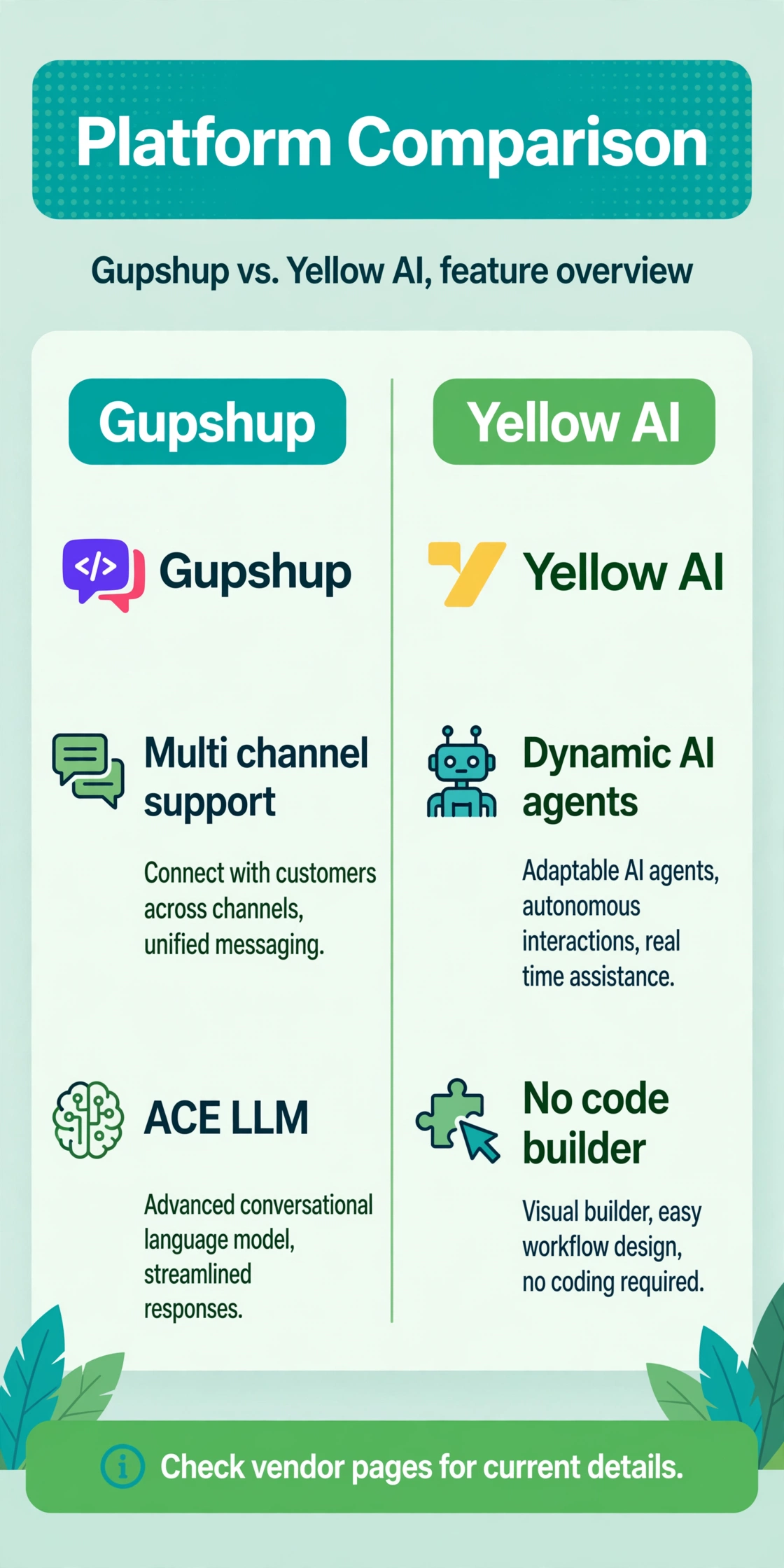
Gupshup has built ACE LLM, its own proprietary fine-tuned model for conversational responses, alongside its AI Agents product line: industry-trained, autonomous agents plus a low-code Conversation Builder for rule-based flows. The pitch is a full stack: their model, their channels, their tooling, tuned for conversational commerce and support at massive scale. For buyers who want one throat to choke and a model tuned specifically for messaging conversations, that vertical integration is appealing.
Yellow.ai’s pitch centers on Dynamic AI agents: autonomous agents that pursue goals across conversations, built on a no-code/low-code platform that enterprise business teams can operate. The emphasis is less “we built the model” and more “we built the agent orchestration, guardrails, and enterprise controls.” For large companies, the differentiator is often governance: who can change the agent, what it is allowed to do, how it is tested, and how every conversation is audited.
In practice, both will let you build an SMS agent that answers questions, takes actions through API integrations, and escalates to humans. Gupshup’s edge is messaging-native AI at scale. Yellow.ai’s edge is enterprise agent governance. If you are a telecom or bank sending millions of transactional SMS conversations, Gupshup’s heritage fits. If you are a global enterprise standardizing AI agents across support, HR, and commerce with strict controls, Yellow.ai’s framing fits.
Regional strengths
This is where the comparison gets practical.
Gupshup is exceptionally strong in India, the Middle East, Southeast Asia, and Latin America: markets where WhatsApp, SMS, and RCS dominate and where vernacular language support decides deals. It markets 100+ languages and has genuine depth in Indian languages including voice. If your customers text in Hindi, Hinglish, Arabic, or Spanish across these regions, Gupshup’s regional investment shows.
Yellow.ai plays globally with an enterprise footprint across 85+ countries and offices on multiple continents. Its customer stories skew toward large multinational brands running standardized deployments across regions. If you are a global company that needs the same agent platform in the US, Europe, and APAC with centralized governance, Yellow.ai’s enterprise sales and delivery model is built for that.
Neither claim should be read as verified market share. These are observed positioning differences. Ask both vendors for customer references in your specific region and industry, and weight those references heavily.
Integrations and developer experience
Gupshup is developer-centric. The single-API model across 30+ channels appeals to engineering teams, and integrations with CRMs, ecommerce platforms, and custom APIs follow an API-first pattern rather than a catalog of one-click SMB connectors. If your team is comfortable with APIs and webhooks, Gupshup feels natural. If you want point-and-click integrations with no code, it will feel heavier.
Yellow.ai leads with no-code/low-code. Business teams can build and iterate on agents without engineering, which is the whole enterprise AI platform promise. Developers still get APIs and customization, but the center of gravity is the business user. For companies where the chatbot is owned by customer experience or digital teams rather than engineering, that matters.
Compliance and regulated industries
Both vendors court regulated verticals: banking, financial services, insurance, healthcare, and government. Expect HIPAA, SOC 2, and GDPR-aligned postures from both, along with audit-grade conversation logs.
The practical advice: do not take any vendor’s compliance page as the final word. Regulated buyers should run their own security review, confirm data residency options for their region, and check how consent records and opt-outs are handled specifically on the SMS channel. SMS carries its own regulatory load (TCPA in the US, plus carrier and state rules), and the platform’s general compliance posture does not automatically cover your messaging program’s consent practices. Our GDPR guide for SMS chatbots and customer support automation guide cover the surrounding issues. As always, this is general information, not legal advice.
How to evaluate them honestly
Since neither publishes pricing, your evaluation has to be a structured pilot, not a feature checklist. Here is a process that works:
- Define one SMS use case with measurable outcomes. Appointment reminders with confirmation rates, support deflection with containment rates, or collections with promise-to-pay rates. Vague pilots produce vague results.
- Ask both vendors to build the same pilot. Same use case, same success metrics, same timeline.
- Test in your actual languages and regions, not just English. Vernacular quality is where enterprise deals are won or lost.
- Measure escalation quality, not just containment. A bot that contains 70% of conversations but mangles the 30% it escalates is worse than a bot that contains 50% cleanly.
- Get references in your industry and call them. Ask what broke, what the real total cost was, and what they would do differently.
FAQ
Which is better for SMS chatbots, Gupshup or Yellow.ai?
It depends on your priority. Gupshup has deeper messaging heritage with SMS, RCS, and WhatsApp through one API, which suits high-volume messaging programs. Yellow.ai leads with autonomous AI agents and enterprise governance, which suits companies standardizing AI across channels. Run the same pilot on both.
Do Gupshup or Yellow.ai publish pricing?
No. Both sell enterprise plans through their sales teams, and pricing depends on volume, channels, and region. Be skeptical of any third-party article quoting exact prices for either.
Which is better for RCS?
Gupshup is the stronger RCS story. It is a major RCS player and Google partner with RCS as a native channel alongside SMS, which matters if you plan to migrate conversations from plain SMS to rich messaging.
Which handles Indian languages better?
Gupshup markets 100+ languages with strong Indian vernacular capability, reflecting its regional depth. Test your specific languages with both vendors rather than trusting marketing claims.
Can either replace a Twilio-based custom build?
They replace different parts of it. Gupshup can replace the messaging infrastructure plus add AI. Yellow.ai can replace the agent layer while still needing messaging connectivity. Teams with strong engineering sometimes use Gupshup’s APIs the way they would use Twilio’s, with their own orchestration on top.
What should I ask for in a demo?
Ask for a live SMS conversation in your language, an escalation to a human agent with context preserved, the audit log of that conversation, and a reference customer in your industry. Then ask for the total cost model in writing.
The bottom line
Gupshup and Yellow.ai are both serious enterprise platforms, and the honest answer is that either can power an SMS chatbot program. Choose Gupshup if messaging is the center of your strategy: SMS depth, RCS readiness, regional language strength, and API-first developer ergonomics. Choose Yellow.ai if the AI agent is the center: autonomous goal-driven agents, no-code enterprise tooling, and governance for global deployments. Do not choose based on a feature grid or a quoted price you found in a blog post. Choose based on a pilot, in your language, measured against your metrics.
Want this set up for you?
I build SMS chatbots and API integrations for businesses. If you would like what this guide describes, done for you, get in touch.