ClickSend vs TextMagic is a comparison for the non-developer buyer. Both are small-business messaging platforms with APIs attached, not developer platforms with dashboards attached. That distinction matters because the buyer here is often an office manager, a marketer, or a founder, not an engineer. The right questions are different: how fast can I send my first campaign, do my credits expire, what does it really cost per message, and how painful is the API if I eventually need it.
We evaluate both from the non-developer seat: dashboard campaign UX, prepaid credit expiry, real per-message cost after carrier fees, and API onboarding time for a first-time sender.
Pricing models
Both are pay-as-you-go at heart, but the details differ.
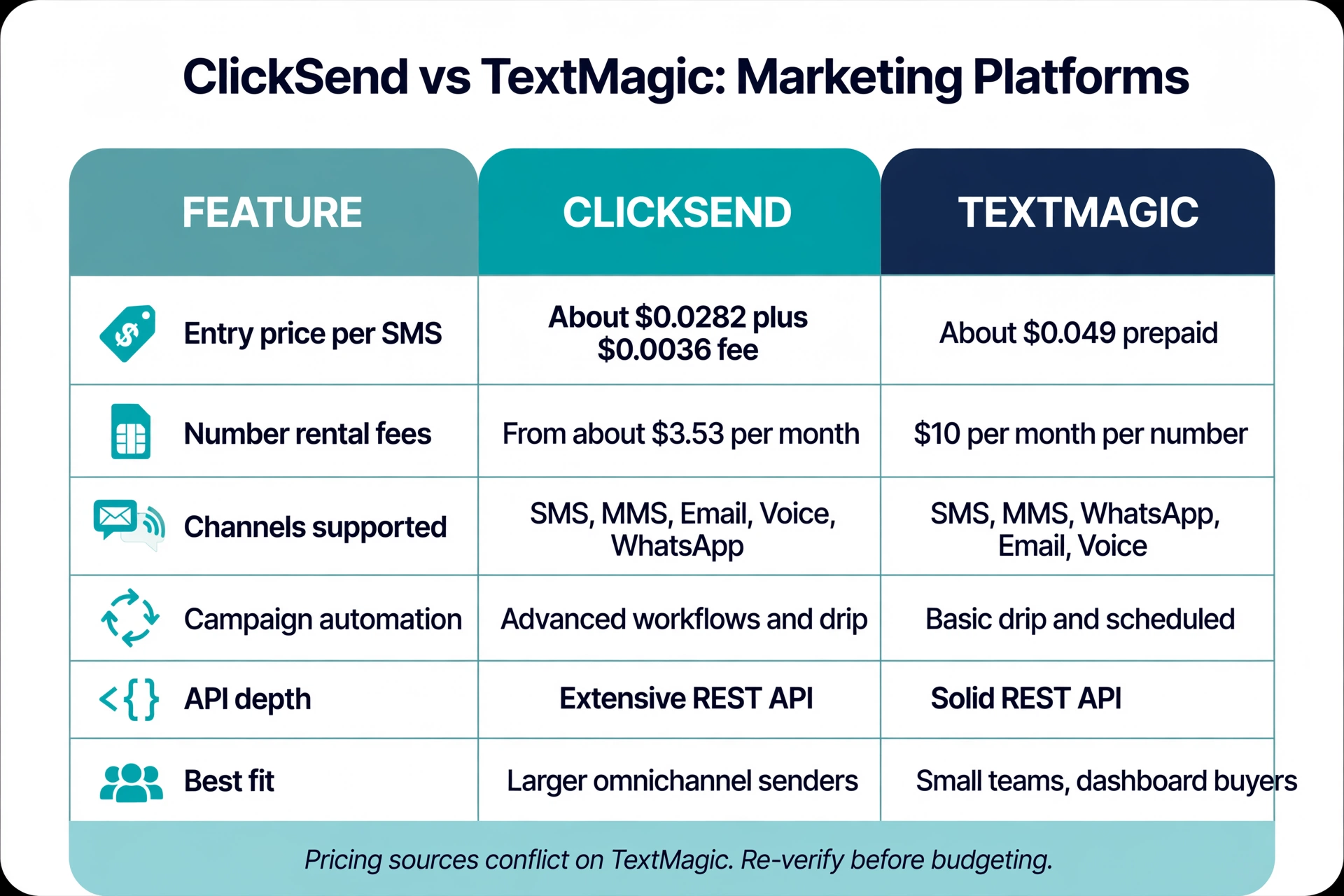
ClickSend charges per message with no monthly fees and no contracts. At the time of writing, third-party sources cite about $0.0282 per US SMS at the entry tier, dropping toward $0.0081 at 150,000+ messages, plus a flat carrier fee of about $0.0036 per SMS regardless of carrier or number type. Inbound SMS is free. Credits do not expire. Volume discounts kick in through top-up tiers (larger top-ups earn up to 21% off). Dedicated numbers start around $3.53/month.
TextMagic is where it gets confusing, because sources conflict. Third-party roundups cite $0.049 per SMS prepaid, plus $10/month per number and $10/month per 10DLC campaign. TextMagic’s own blog, meanwhile, cites a US outbound API rate of $0.0074 per message with platform plans from $45/month for 3,000 contacts. These describe different products (the prepaid dashboard product vs the API/connectivity offering with platform plans), but the company does not make the distinction obvious. We present both and flag the conflict: confirm which product and price applies to you on textmagic.com before budgeting.
The practical takeaway: ClickSend’s pricing is simpler to understand (one per-message rate, no expiry, no monthly fee). TextMagic’s pricing requires you to figure out which of its pricing faces you are looking at.
Real cost per message
Using the entry-tier figures at the time of writing:
- ClickSend: ~$0.0282 + $0.0036 carrier fee = ~$0.0318 per US SMS all-in, with no monthly fee. At higher top-up tiers the base rate falls substantially.
- TextMagic (prepaid dashboard): ~$0.049 per SMS plus $10/month per number and $10/month per 10DLC campaign. For a business sending 1,000 messages a month on one number, that is $49 + $20 = $69, or $0.069 per message, more than double ClickSend’s entry rate.
TextMagic’s API-facing rate ($0.0074) would change this math completely, which is exactly why the pricing-face confusion matters. If you are a developer buying connectivity, TextMagic’s API rate is competitive with budget CPaaS. If you are a small business buying the dashboard product, ClickSend is cheaper at entry volume. Know which buyer you are.
Dashboard and campaign UX
Both are built for non-developers, and both do the basics well: contact lists, campaign composition, scheduling, delivery reports, and two-way messaging.
ClickSend’s dashboard is utilitarian and broad: it covers SMS, MMS, and RCS for new customers, plus email, voice, fax, and even postal mail on the wider platform. Reviewers describe the interface as straightforward but not beautiful. Its strength is doing the fundamentals without enterprise complexity.
TextMagic’s dashboard is the more polished of the two, with a modern interface, live chat, and channels beyond SMS (WhatsApp, Messenger, email campaigns). Reviewers tend to rate TextMagic’s UX higher for day-to-day campaign work, and its reporting and analytics get particular praise from small teams that live in the dashboard. Its weakness is the pricing confusion described above, not the product.
Judgment: TextMagic for dashboard polish, ClickSend for pricing simplicity. Neither requires a developer for standard campaigns.
First campaign reality
Both let you send a first test campaign without talking to sales, which is the bar that matters for this buyer. ClickSend’s free trial puts you in the dashboard fast; the friction, such as it is, comes later at 10DLC registration, where you will provide business details and wait for carrier approval like everyone else. TextMagic’s onboarding is similarly self-serve on the prepaid face, with the caveat that you should confirm which product you are trialing before you invest time in it. The practical advice: run the same test campaign on both, a 500-message send to a small seed list, and compare not just the price but the delivery report detail and the support response when something looks off. An hour of side-by-side testing beats a week of reading reviews.
Prepaid credits and expiry
ClickSend: credits do not expire, no monthly fee, no contracts. This is genuinely buyer-friendly for seasonal or irregular senders.
TextMagic: prepaid credits on the dashboard product; terms should be confirmed on its pricing page. The platform-plan face ($45/month and up) is a subscription instead. Confirm expiry terms for the exact product you buy, since the two faces may differ.
For a business that sends in bursts (a retailer with seasonal campaigns, a school with term-time alerts), non-expiring credit is a real economic advantage. Do not underestimate it.
API onboarding for first-time senders
Both offer APIs, and both are simpler than Twilio’s by design. ClickSend’s API is frequently praised for straightforward docs and Postman collections; developers describe getting a first message out quickly. TextMagic offers API access with the standard operations and decent documentation.
Neither API will trouble a competent developer. The difference is philosophical: ClickSend’s API is a first-class product for a company that also serves non-developers, while TextMagic’s API sits alongside a richer multichannel platform. If your roadmap includes WhatsApp or Messenger alongside SMS, TextMagic’s broader channel set is worth weighing.
Channels and coverage
ClickSend: SMS, MMS, RCS for new customers, plus voice, email, fax, and postal mail on the wider platform. Coverage cited at 220+ countries and territories. Owned by Sinch since 2022 (via MessageMedia), which gives it enterprise-grade upstream without enterprise buying friction.
TextMagic: SMS, MMS, WhatsApp, Facebook Messenger, Instagram, voice, email campaigns, live chat. Coverage cited at 140+ countries in its own materials. The channel breadth is the standout: few small-business platforms cover this many channels natively.
10DLC and compliance
Both support US 10DLC. ClickSend’s 10DLC setup is cited around $19.50 one-time ($4.50 brand + $15 campaign) with $10/month standard or $1.50/month low-volume campaign fees. TextMagic’s 10DLC fees on the prepaid face run about $10/month per number plus $10/month per campaign. Both handle the registration mechanics for you; neither exempts you from providing proper opt-in documentation. For the process, see our 10DLC cost guide and toll-free verification process.
Head-to-head summary
| Dimension | ClickSend | TextMagic | Our judgment |
|---|---|---|---|
| Pricing model | Pay-as-you-go, no monthly fee | Pay-as-you-go or platform plans (two faces) | ClickSend for simplicity |
| US per-SMS entry (at time of writing) | ~$0.0282 + $0.0036 carrier fee | ~$0.049 prepaid (API face $0.0074) | ClickSend for dashboard buyers |
| Credit expiry | Credits do not expire | Confirm per product | ClickSend |
| Dashboard UX | Utilitarian, broad | More polished, multichannel | TextMagic |
| API onboarding | Straightforward, Postman collections | Standard, decent docs | Tie, ClickSend slightly |
| Channels | SMS, MMS, RCS, voice, email, fax, mail | SMS, MMS, WhatsApp, Messenger, email, voice | TextMagic for breadth |
| Coverage | 220+ countries cited | 140+ countries cited | ClickSend on paper |
| Ownership | Sinch group since 2022 | Independent | Neutral |
Which should you choose?
Choose ClickSend if: you want simple pay-as-you-go pricing with no expiry and no monthly fee, you send irregularly or seasonally, or you want Sinch-backed infrastructure without enterprise buying friction.
Choose TextMagic if: dashboard polish and multichannel breadth (WhatsApp, Messenger, email) matter to you, or you are a developer buying the API face at its competitive per-message rate. Just confirm which pricing face applies before you commit.
Decide by buyer type: non-developer sending campaigns from a dashboard? ClickSend’s pricing simplicity wins. Developer buying SMS connectivity? Price TextMagic’s API rate against ClickSend’s and pick the cheaper for your volume.
FAQ
Which is cheaper, ClickSend or TextMagic?
For dashboard buyers at entry volume, ClickSend (about $0.032 all-in per US SMS at the time of writing) is cheaper than TextMagic’s prepaid dashboard rate (about $0.049 plus monthly number and campaign fees). For API buyers, TextMagic cites a $0.0074 rate that changes the comparison; confirm current pricing on both sites.
Do ClickSend credits expire?
No. ClickSend states that credits do not expire, with no monthly fees and no contracts. This suits seasonal or irregular senders.
Is ClickSend owned by Sinch?
Yes. ClickSend joined MessageMedia in 2019 and became part of the Sinch group in 2022. It operates as a small-business brand with enterprise-grade upstream.
Does TextMagic have an API?
Yes. TextMagic offers API access alongside its dashboard, with standard send, receive, and reporting operations. Its developer experience is straightforward but less celebrated than its dashboard UX.
Which is better for a non-technical small business?
Both are built for non-developers. TextMagic’s dashboard is generally rated more polished; ClickSend’s pricing is simpler and its credits never expire. Try both free trials with a real campaign before deciding.
Do both support 10DLC?
Yes. Both handle 10DLC brand and campaign registration. Expect roughly $19.50 one-time setup on ClickSend’s face and around $10/month per number plus $10/month per campaign on TextMagic’s prepaid face, at the time of writing. Confirm current fees on each provider’s site.
The bottom line
ClickSend vs TextMagic is a buyer-type question. ClickSend is the simpler buy: one per-message price, no expiry, no monthly fee, Sinch-backed, done. TextMagic is the broader product: a nicer dashboard and more channels, but with a confusing two-face pricing structure you must navigate carefully. Figure out which buyer you are first, then the choice is usually obvious. Before you budget, pull the current rates from both pricing pages and model your actual monthly volume, because the entry-tier numbers move more often than the marketing suggests.
Want this set up for you?
I build SMS chatbots and API integrations for businesses. If you would like what this guide describes, done for you, get in touch.