Every “Twilio alternative” roundup names the same two budget picks: Plivo and Telnyx. Both undercut Twilio on price, both offer full-featured SMS APIs, and both have loyal users who swear they would never go back. But they are not interchangeable. Plivo is the Twilio lookalike: a familiar API, broad international coverage, and a gentle learning curve for Twilio-trained teams. Telnyx is the infrastructure play: its own private network, the lowest headline rate of the two, and a Twilio-compatible API that makes migration nearly free.
This article compares them honestly on the dimensions that decide between two cheap providers: all-in price at three volumes, Twilio compatibility, throughput, API and docs, SDKs, 10DLC support, coverage, and support. No inflated claims, no recycled marketing.
Pricing: Telnyx wins, but mind the floor
At the time of writing:
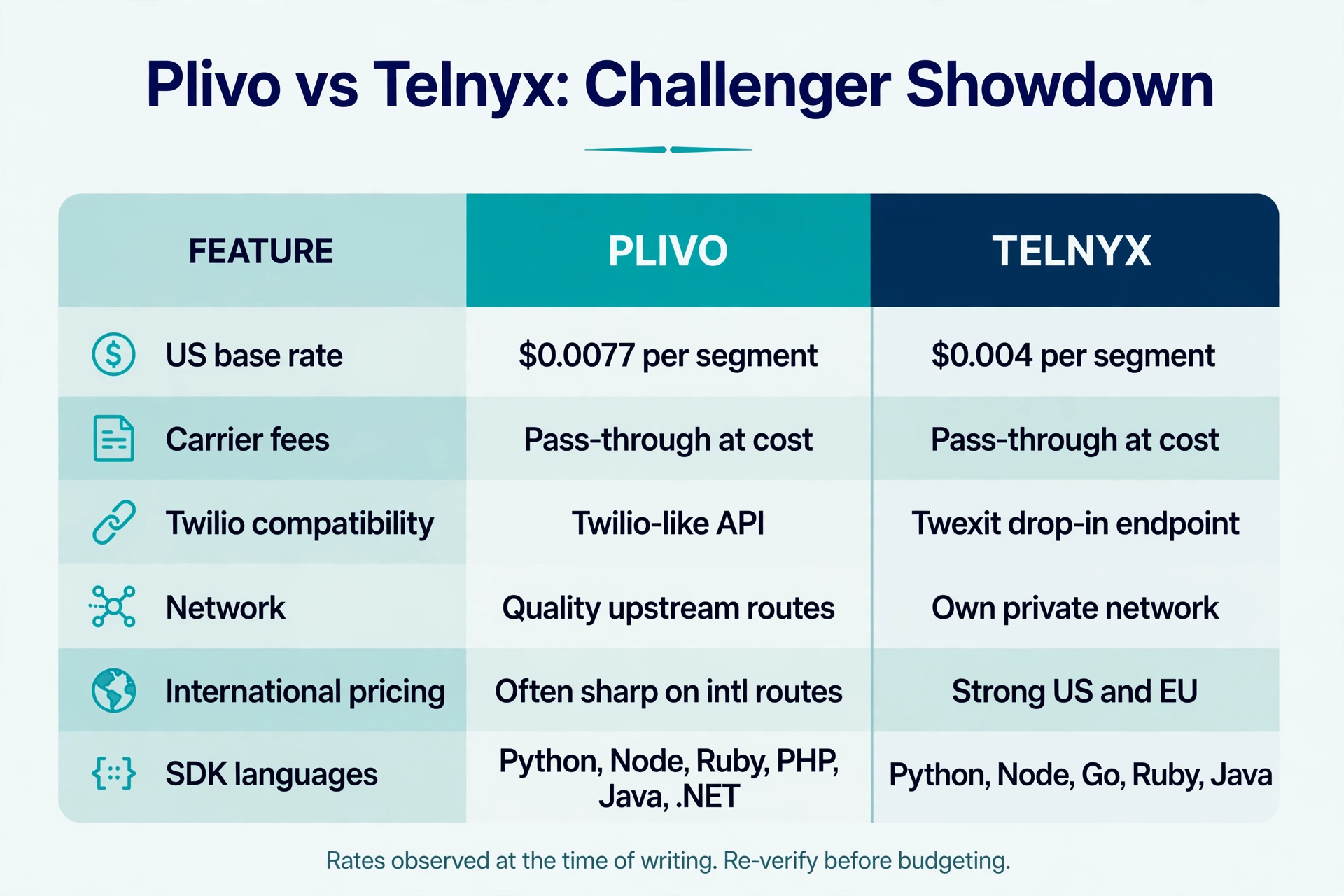
- Plivo: $0.0077 per US SMS on long code, pay-as-you-go, plus carrier surcharges of roughly $0.0035 to $0.0050.
- Telnyx: $0.004 per US SMS segment, plus carrier pass-through.
Telnyx’s headline rate is 48% lower than Plivo’s. But as established in our other comparisons, carrier fees (roughly $0.004 blended) are identical on both and form a price floor that no provider can go under. Strip the carrier fee out of both quotes and the percentage gap looks even larger than it is, which is why honest comparisons always model the all-in number. All-in at 100,000 US single-segment messages per month, with one campaign:
- Plivo: $770 + $400 + ~$11 = ~$1,181, or about $0.0118 per message.
- Telnyx: $400 + $400 + ~$11 = ~$811, or about $0.0081 per message.
A 31% all-in saving for Telnyx. At 10K per month the gap is similar in percentage terms (fixed fees dilute both equally). At 1M per month, Telnyx saves roughly $3,700 per month, and both providers will negotiate, so get quotes.
The honest summary: Telnyx is meaningfully cheaper on US traffic, by about a third all-in. Plivo’s pricing advantage over Twilio is real but modest; Telnyx’s advantage over Plivo is the larger of the two gaps. Where Plivo can close the distance is on specific international routes, where its rate card is sometimes sharper. As always, price your actual destinations.
One cost that rarely appears in these comparisons: number porting and sender reputation. If you are migrating an existing 10DLC campaign from Twilio (or from one of these two to the other), the brand and campaign registration moves with fees and a waiting period, and toll-free numbers need re-verification on the new provider. Budget a week or two of overlap where you pay for numbers on both sides, and keep your Twilio account warm as failover during the transition. The migration itself is technically simple on both APIs; the calendar time lives in the carrier paperwork. Teams that plan the overlap pay once; teams that rush it pay twice and explain the outage.
Twilio compatibility: both, differently
This is a subtle but important distinction. Plivo’s API is Twilio-like by design: similar endpoints, similar parameters, similar webhooks. Migrating from Twilio to Plivo is easy because the APIs rhyme.
Telnyx goes further with Twexit, an explicitly Twilio-compatible endpoint: point your existing Twilio SDK calls at Telnyx’s servers, swap credentials, and most things work. User reviews describe it as “mostly compatible.” For a team migrating off Twilio, Telnyx’s compatibility story is stronger and more literal. For a team starting fresh, the difference is moot; both APIs are easy to learn.
Edge cases exist on both. Neither replicates Twilio-only products (Verify, Messaging Services, Studio). Test webhooks field by field on either migration path.
Throughput and network
Telnyx operates its own private IP network and carrier infrastructure, and it advertises higher default per-number throughput than typical (third-party research cites around 10 messages per second per long code). Plivo rides quality upstream connections with standard throughput characteristics. On US 10DLC, throughput is carrier and trust-score driven for every provider, so this dimension matters most for toll-free and international long-code traffic, where Telnyx’s network story is stronger.
For background on how 10DLC works, see our what is 10DLC guide.
API design and documentation
Both have good docs; neither has Twilio’s docs. Plivo’s documentation benefits from the Twilio-likeness: if you know Twilio’s concepts, Plivo’s map onto them intuitively. Telnyx’s docs are clean and generated from an OpenAPI spec, which keeps them consistent across products. Practitioner sentiment slightly favors Telnyx’s docs for accuracy and Plivo’s for familiarity. Call it a tie with different strengths.
SDK language support
- Plivo: Python, PHP, Node.js, Ruby, Java, .NET, Go.
- Telnyx: Node.js, Python, PHP, Java, Ruby, Go.
Near-identical coverage of the mainstream set. Both are fine for standard stacks; neither matches Twilio’s maintenance cadence.
10DLC support
Both are registered CSPs with The Campaign Registry, supporting brand and campaign registration, sole-proprietor brands, and standard campaigns. Telnyx’s 10DLC tooling gets slightly better practitioner marks for speed and clarity; Plivo’s is solid and complete. Registration fees and timelines are set by TCR and carriers, not by either provider. Our 10DLC registration guide covers the process independent of vendor.
Geographic coverage
Plivo markets international reach as a core strength and is frequently competitive on international routes, sometimes beating Telnyx on specific destinations in Asia, Africa, and Latin America. Telnyx’s strength is its owned network and strong US and European performance. If your traffic is US-heavy, Telnyx. If it is spread across many international destinations, price both route by route; Plivo wins more of those comparisons than the headline US rates suggest.
Support
Both punch above their weight on support for smaller accounts, which is part of why they win business from Twilio. Telnyx’s support is frequently praised as responsive and technical, with users citing fast answers on network-level questions. Plivo’s is solid with a reputation for being accessible to small teams. Neither has Twilio’s enterprise support apparatus, and neither charges a percentage of spend for SLAs the way Twilio’s paid tiers do. For the small-to-mid teams these providers serve, both are good; Telnyx gets the nod in practitioner reviews by a small margin.
Head-to-head summary
| Dimension | Plivo | Telnyx | Our judgment |
|---|---|---|---|
| US base rate (at time of writing) | $0.0077 | $0.004 | Telnyx, by 48% headline |
| All-in US cost at 100K/mo (est.) | ~$0.0118 | ~$0.0081 | Telnyx, by ~31% |
| Twilio compatibility | Twilio-like API | Twexit drop-in endpoint | Telnyx, more literal |
| Network | Quality upstream | Own private network | Telnyx |
| Throughput (non-10DLC) | Standard | Higher defaults | Telnyx |
| Docs | Good, familiar | Good, accurate | Tie |
| SDKs | 7 languages | 6 languages | Tie |
| 10DLC support | Full TCR flow | Full TCR flow, speedy | Tie, Telnyx slightly |
| International pricing | Often sharp on intl routes | Strong US/EU | Depends on routes |
| Support | Good for small teams | Responsive, technical | Telnyx, narrowly |
Which should you choose?
Choose Telnyx if: US traffic dominates your bill, you want the lowest all-in cost of the two, you value the Twexit migration path off Twilio, or higher default throughput matters for your use case.
Choose Plivo if: your traffic is heavily international and Plivo’s route pricing beats Telnyx on your destinations, your team is Twilio-trained and wants the most familiar API, or you prefer Plivo’s simpler pay-as-you-go posture.
The honest meta-answer: at these price points, both are excellent, and the price difference between them is smaller than the price difference between either and Twilio. Teams that agonize over Plivo vs Telnyx while still on Twilio are optimizing the wrong gap. Pick either, pilot on your routes, and keep the other as failover.
FAQ
Which is cheaper, Plivo or Telnyx?
Telnyx, on US traffic: $0.004 vs $0.0077 per message at the time of writing, working out to roughly 31% cheaper all-in at 100K messages per month. On international routes, compare destination by destination; Plivo wins some of those.
Is it easy to migrate from Twilio to Plivo or Telnyx?
Yes to both. Plivo’s API mirrors Twilio’s design, making migration straightforward. Telnyx’s Twexit endpoint goes further, accepting Twilio-shaped requests directly. Budget a few hours for simple integrations and a few days for complex ones, mostly for webhook testing.
Do Plivo and Telnyx support 10DLC?
Yes, both are registered CSPs with The Campaign Registry and support brand and campaign registration, including sole-proprietor brands.
Which has better throughput?
Telnyx advertises higher default per-number throughput and runs its own network. On US 10DLC, throughput is set by carrier and trust score for all providers, so the difference matters mainly for toll-free and international sending.
Which is better for international SMS?
It depends on the destinations. Plivo is frequently competitive on international routes across Asia, Africa, and Latin America. Telnyx is strong in the US and Europe. Price your actual top destinations on both.
Can I use Plivo and Telnyx together?
Yes. Many teams run one as primary and the other as failover, or split traffic by geography. Both are cheap enough that dual-provider redundancy costs little.
The bottom line
Plivo vs Telnyx is a good problem to have: two capable, cheap, Twilio-compatible providers. Telnyx wins on US price, network ownership, and the most literal Twilio migration path. Plivo wins on international route pricing breadth and API familiarity. For US-heavy traffic, Telnyx is the rational pick. For international-heavy traffic, price your routes before deciding. Either way, you are paying roughly a third less than Twilio, which was the point all along, and keeping the second provider as failover turns the price comparison into a resilience strategy for free. Before you commit, pull the live rate cards for your top five corridors, because the international winner changes with the destination list.
Want this set up for you?
I build SMS chatbots and API integrations for businesses. If you would like what this guide describes, done for you, get in touch.