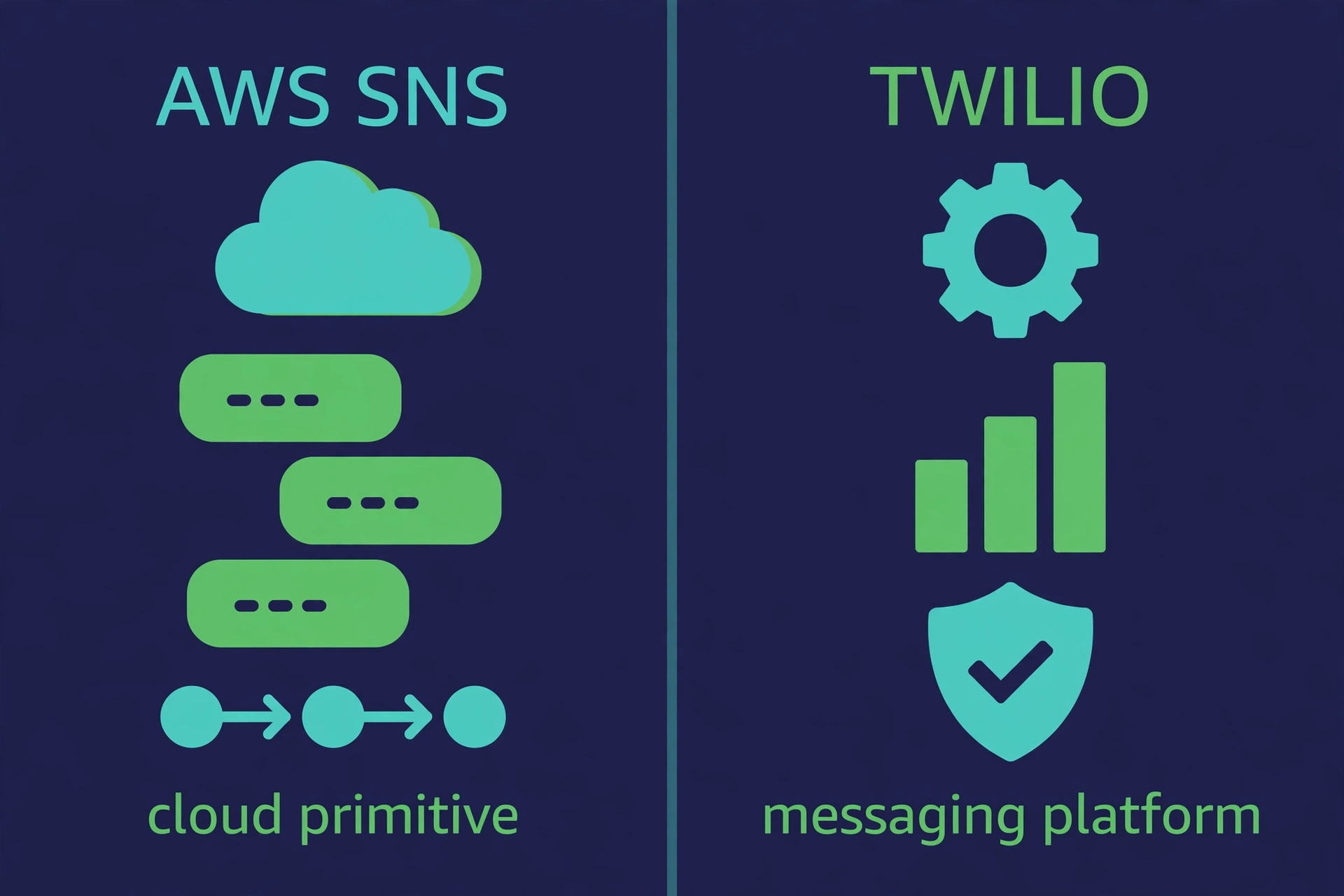
Twilio vs AWS SNS is not really a fight between two SMS APIs. It is a fight between two philosophies. Twilio is a communications platform: purpose-built for messaging, with docs, tooling, and support organized around the developer sending texts. AWS SNS (now under the AWS End User Messaging umbrella) is a cloud primitive: cheap, reliable infrastructure that sends SMS as one of many things it does, with minimal hand-holding.
If your team is already all-in on AWS, SNS is tempting. It is cheaper per message, it is already in your IAM policies and CloudWatch dashboards, and there is no new vendor to procure. This article is a decision framework for AWS-native teams: the total cost including 10DLC tooling gaps, the delivery visibility you give up, and the sender management SNS does not do for you.
The price comparison, honestly done
At the time of writing:
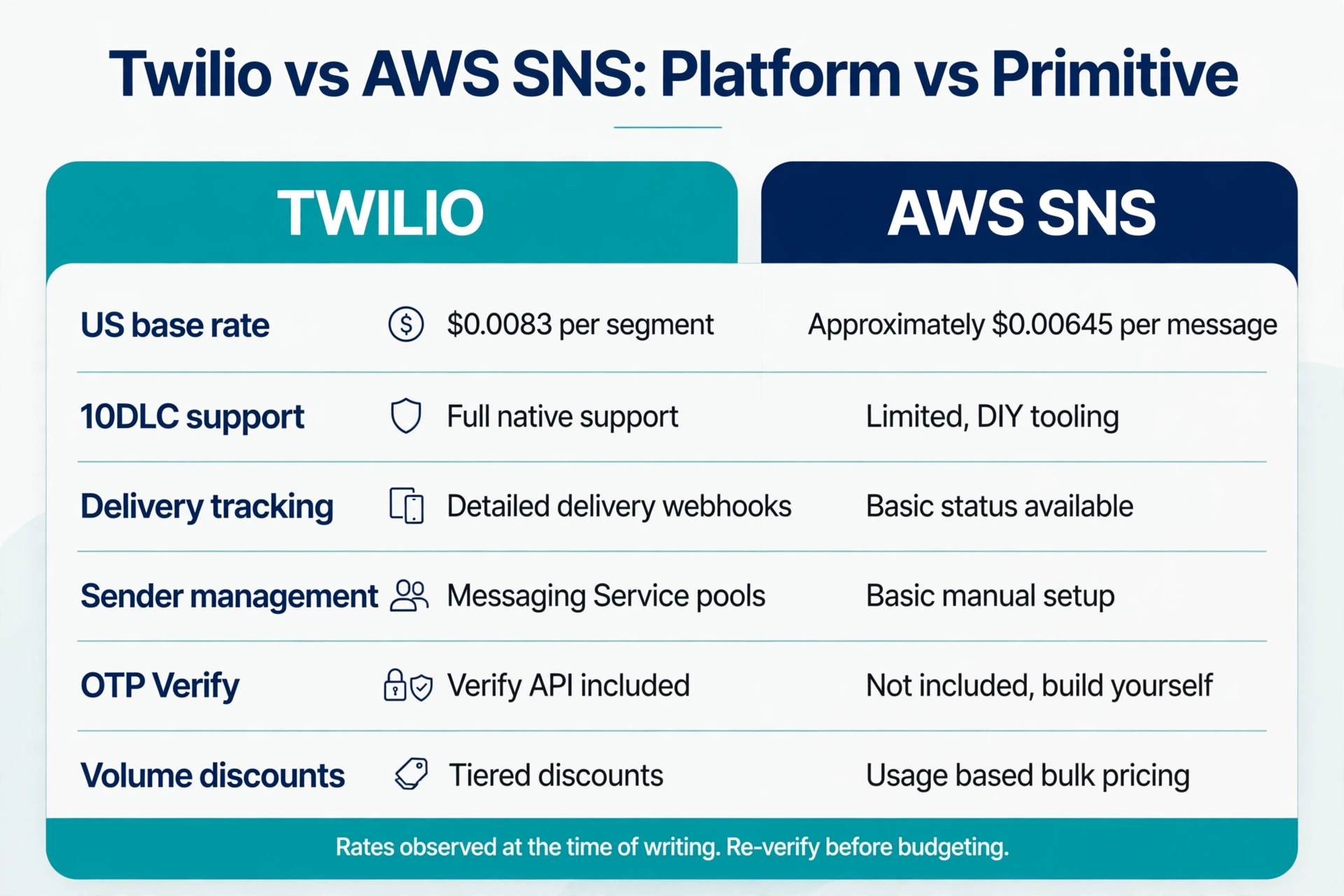
- Twilio: $0.0083 per US SMS segment, outbound and inbound.
- AWS SNS: roughly $0.00645 per US SMS in third-party snapshots.
SNS is about 22% cheaper on headline rate. Both pass through carrier fees, and SNS’s pricing varies by destination country like everyone else’s. All-in at 100,000 US messages per month (single-segment, $0.004 blended carrier fee):
- Twilio: ~$1,241.50, or about $0.0124 per message.
- SNS: $645 + $400 + ~$11 = ~$1,056, or about $0.0106 per message.
A 15% all-in saving. Real, but smaller than the headline suggests, and it comes with tooling gaps that have their own costs. That is the theme of this entire comparison: SNS is cheaper in dollars and more expensive in engineering time.
What SNS does not give you
10DLC tooling
This is the biggest gap. Twilio’s TrustHub walks you through brand registration, campaign registration, number assignment, and status tracking with a guided UI built for the purpose. AWS supports 10DLC through its End User Messaging console and APIs, and it works, but practitioners consistently describe it as weaker: less guidance, less hand-holding, and a registration experience designed by infrastructure people rather than messaging people.
Registration mistakes are expensive in this business. A rejected campaign can cost weeks (practitioner reports describe multi-week approval sagas on every provider), and the quality of the provider’s tooling is part of what you are paying for. If your team has done 10DLC registration before and knows the drill, SNS’s thinner tooling is a minor inconvenience. If this is your first 10DLC registration, Twilio’s guidance is worth real money. For the process itself, see our 10DLC registration guide.
Delivery visibility
Twilio gives you a message log UI, a debugger, per-message status with error codes, and a documented error dictionary. When a message fails, you can see why in seconds. SNS gives you CloudWatch metrics and delivery status logging that you configure yourself. It is powerful if you build on it and sparse if you do not. There is no Twilio-console equivalent where a developer clicks into a failed message and reads a remediation step.
For teams with strong observability practices, SNS plus CloudWatch plus your own dashboards can exceed Twilio’s visibility. For teams without that practice, Twilio’s out-of-the-box visibility wins by default.
Sender management
Twilio’s ecosystem around senders is deep: number purchasing and porting in-console, messaging services with sticky sender and geomatch, short code provisioning, toll-free verification flows. AWS supports origination identities (long codes, short codes, sender IDs) through its console, but the experience is utilitarian. Number management on SNS feels like infrastructure configuration; on Twilio it feels like a product.
Managed OTP
Twilio Verify ($0.05 per successful verification at the time of writing) is a managed OTP product with retry logic and fraud protection. SNS has no equivalent. On SNS, you build OTP yourself: code generation, expiry, retry throttling, and fraud detection. For an OTP-heavy workload, the engineering cost of building this usually exceeds the per-message saving.
What SNS gives you that Twilio does not
Fairness requires the other side. SNS has genuine advantages for AWS-native teams:
- No new vendor. Procurement, security review, IAM, billing, and support all stay inside AWS. For regulated enterprises, this alone can decide the question.
- CloudWatch and IAM integration. Metrics, alarming, and access control come free with your existing AWS setup.
- Pub/sub architecture. SNS is a notification service first and an SMS sender second. If your architecture already fans out events through SNS topics, adding SMS subscribers is nearly free operationally.
- Price. The per-message saving is real, and at very high volumes with simple use cases, it compounds.
The decision framework
Work through these in order:
1. Are you already deeply on AWS? If your team lives in the AWS console, uses IAM and CloudWatch fluently, and procures through AWS, SNS starts with a large operational advantage. If you are multi-cloud or AWS-light, that advantage evaporates.
2. Is this your first 10DLC registration? If yes, Twilio’s tooling advantage is significant. If your team has registered brands and campaigns before, SNS’s thinner tooling is manageable.
3. Do you need delivery visibility out of the box? If your team will not build custom observability, Twilio. If you already run a metrics-driven operation, SNS plus CloudWatch is fine.
4. Is OTP a major workload? If yes, Twilio Verify’s managed product usually beats building OTP on SNS primitives. Price the engineering time honestly.
5. What is the message complexity? Simple one-way notifications (alerts, reminders, status updates) are SNS’s sweet spot. Two-way conversational flows, keyword handling, and complex routing favor Twilio’s platform.
Head-to-head summary
| Dimension | Twilio | AWS SNS | Our judgment |
|---|---|---|---|
| US rate (at time of writing) | $0.0083/segment | ~$0.00645 | SNS, by ~22% headline |
| All-in US cost at 100K/mo (est.) | ~$0.0124 | ~$0.0106 | SNS, by ~15% |
| 10DLC tooling | Guided TrustHub | Functional, thinner | Twilio |
| Delivery visibility | Console, debugger, error dictionary | CloudWatch, self-built | Twilio out of box; SNS if you build |
| Sender management | Deep (numbers, messaging services) | Utilitarian origination identities | Twilio |
| Managed OTP | Verify at $0.05/verification | Build it yourself | Twilio |
| AWS integration | None | Native (IAM, CloudWatch, billing) | SNS for AWS shops |
| Docs | Best in category | AWS-standard reference docs | Twilio for messaging |
Which should you choose?
Choose AWS SNS if: your team is AWS-native with strong observability practices, your use case is simple one-way notifications, you have done 10DLC registration before (or have someone who has), and procurement simplicity matters.
Choose Twilio if: this is your first messaging deployment, you need delivery visibility without building it, OTP is a real workload, or your flows are two-way and complex.
The hybrid answer: many AWS shops use SNS for simple internal notifications and Twilio for customer-facing messaging. The two are not mutually exclusive, and splitting by use-case complexity is a defensible architecture.
One more practical consideration: sender identity management. On SNS, origination identities (long codes, short codes, sender IDs, toll-free numbers) are provisioned through the AWS End User Messaging console or APIs, and 10DLC brand and campaign registration live in the same place. It works, but the workflow assumes you already understand The Campaign Registry’s model; there is no TrustHub-style hand-holding that explains what a brand is or why a campaign got rejected. Teams doing 10DLC for the first time on SNS often burn a week on rejections that Twilio’s guided flow would have prevented. If your registration will be handled by someone who has done it before, discount this gap heavily. If it will be handled by a generalist backend developer, weight it at its full cost.
FAQ
Is AWS SNS cheaper than Twilio for SMS?
Yes, on per-message rate: roughly $0.00645 vs $0.0083 per US SMS at the time of writing. All-in, the gap narrows to about 15% at 100K messages per month because carrier fees are identical. Factor in the engineering cost of SNS’s thinner tooling before calling it cheaper overall.
Does AWS SNS support 10DLC?
Yes, through AWS End User Messaging. Brand and campaign registration are supported, but the tooling is less guided than Twilio’s TrustHub. Practitioners describe it as functional rather than delightful.
Can I see delivery status for SNS messages?
Yes, via CloudWatch metrics and delivery status logging that you configure. There is no Twilio-console-style per-message debugger out of the box; you build your own visibility or go without.
Does SNS have an OTP product like Twilio Verify?
No. You build OTP yourself on SNS primitives: code generation, expiry, retries, and fraud controls. For OTP-heavy workloads, this usually tips the decision toward Twilio Verify.
Which is easier for a first-time SMS integration?
Twilio, by a wide margin. The docs, the console, the error dictionary, and the guided 10DLC flow are built for developers doing this the first time. SNS assumes you already know AWS deeply.
Can I use both SNS and Twilio?
Yes. A common pattern is SNS for simple internal or infrastructure notifications and Twilio for customer-facing messaging. Route by use case, not by vendor loyalty.
The bottom line
Twilio vs AWS SNS is platform versus primitive. SNS wins on per-message price and on operational simplicity for teams already living in AWS. Twilio wins on everything that makes messaging actually work in production: 10DLC tooling, delivery visibility, sender management, and managed OTP. AWS-native teams with simple notification workloads and strong observability practices should absolutely consider SNS. Everyone else should price the engineering time honestly, because the cheapest per-message rate is not the lowest-cost system for this workload, and a week of debugging invisible delivery failures costs more than a year of per-message savings. Whichever direction you lean, price the comparison with your actual message mix and your team’s hourly rate, not the headline per-message figures alone. The rate on the pricing page is the start of the math, not the end of it.
Want this set up for you?
I build SMS chatbots and API integrations for businesses. If you would like what this guide describes, done for you, get in touch.