
In 2024, MessageBird renamed itself to Bird. If you have been in messaging for a while, you remember MessageBird as the Amsterdam-born CPaaS with 240 direct-to-carrier connections and a reputation for cheap international SMS. The rebrand was supposed to signal a simpler, more focused company. The question this article answers is what actually changed for buyers: pricing transparency, platform fees, product scope, and developer experience.
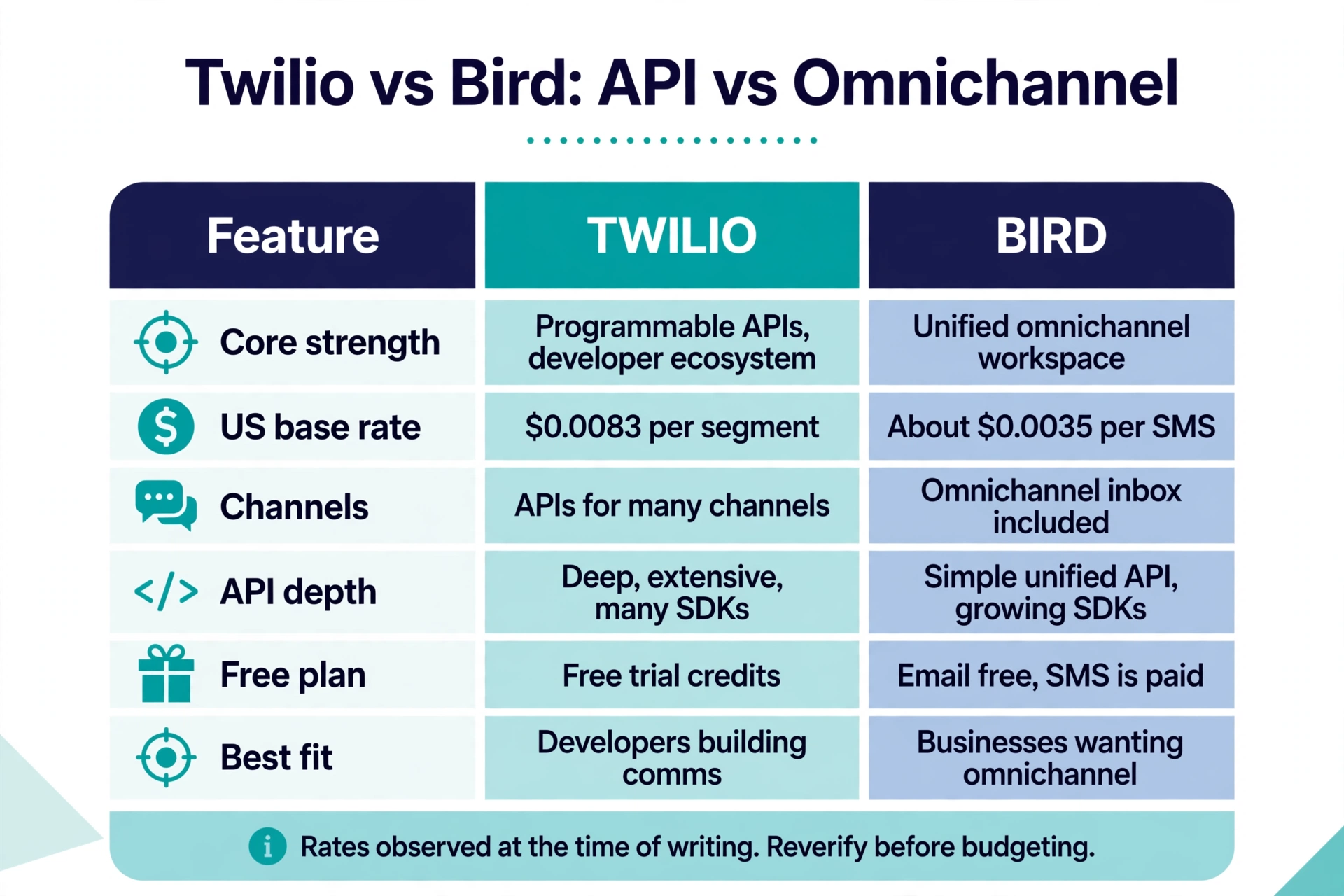
Short version: Bird is dramatically cheaper than Twilio on US per-message pricing at the time of writing, bills with no platform fees, and keeps MessageBird’s carrier-direct DNA. Twilio keeps its edge on documentation, ecosystem, and managed products like Verify. The rebrand simplified the story but also narrowed the product in ways worth knowing about.
What the rebrand actually changed
MessageBird became Bird in 2024, with messagebird.com redirecting to bird.com. Rebrands are usually cosmetic. This one came with three substantive shifts that third-party reviewers have documented:
-
Pricing transparency improved. Bird’s pricing page spells out per-message rates with an explicit “no platform fees, no per-seat tax, and no features locked behind an annual commit” stance. The old MessageBird pricing had a reputation for being harder to parse.
-
Product scope narrowed. Reviewers note that several products from the MessageBird era (a shared inbox, a CRM, a customer data platform, campaign builders) have disappeared, with their old URLs returning 404s. Bird’s current product list centers on the communications primitives: SMS, voice, WhatsApp, email, Verify, Lookup, RCS, push, and phone numbers. If you chose MessageBird partly for the all-in-one platform story, verify that the pieces you need still exist.
-
Positioning sharpened around price. Bird now leads with low per-message rates and no platform fee, positioning directly against Twilio’s premium. The company story (founded 2011, built its own carrier connections rather than licensing a stack, acquired SparkPost and Pusher along the way) remains the credibility backbone.
One caution: the “products removed” claim comes from a single third-party review. We flag it rather than assert it, because product pages change and the reviewer may have caught a site migration mid-flight. Check bird.com for the current product list before deciding.
Pricing: the starkest gap in this cluster
At the time of writing, the numbers are not close:
- Twilio: $0.0083 per US SMS segment, outbound and inbound.
- Bird: $0.0035 per US SMS on long code and toll-free (read from Bird’s own US pricing page in September 2026), $0.0070 on short code, with inbound around $0.003. No monthly minimum, pay-as-you-go from a prepaid wallet.
That is roughly 58% cheaper than Twilio on headline US rate, the largest headline gap among the Twilio comparisons in this cluster. Carrier fees and 10DLC charges apply on top for both. Number rental on Bird runs about $1.00/month for a US local number and $2.00/month for toll-free, versus Twilio’s $1.15/month local.
Model it all-in at 100,000 US messages per month (single-segment, $0.004 blended carrier fee, one campaign):
- Twilio: ~$1,241.50, or about $0.0124 per message.
- Bird: $350 + $400 + ~$11 = ~$761, or about $0.0076 per message.
A 39% all-in saving. At 1M messages per month, the gap is roughly $4,800 per month in Bird’s favor. These are estimates from the rates above, not quotes, but the direction is unambiguous: Bird is the price leader here by a wide margin.
The honest caveats: Bird’s pricing is prepaid-wallet based, which some finance teams dislike. And as with every provider in this cluster, neither publishes audited delivery data, so the price gap is the only hard number you get. The right move is a paid pilot on your real routes before committing volume.
The prepaid model also changes how you budget day to day. Twilio’s postpaid billing gives finance one monthly invoice with line items; Bird’s wallet means topping up credit, setting auto-recharge thresholds, and watching the balance during a launch week. For a startup this is trivially easy. For an enterprise with procurement controls, it can mean extra approval cycles just to keep the wallet funded. Ask Bird about invoicing options at your volume before assuming postpaid works the same way. The per-message saving is real; the operational cost of the billing model is the part nobody puts in the rate table.
API design and developer experience
Bird’s SMS API is a clean REST API with the standard operations. Developer experience is good but not Twilio-good: the docs are clear, the API is straightforward, and the “no platform fee” simplicity extends to the product (fewer upsells, fewer tiers to understand). What you do not get is Twilio’s decade of community answers, error-code dictionary depth, or the ecosystem of tutorials.
Bird’s pitch to developers is essentially: the API does what it says, the price is the price, and support answers when you ask. For teams that found Twilio’s ever-expanding product surface overwhelming, that simplicity is a feature. For teams that lean on docs to debug at 2 a.m., Twilio remains safer.
SDKs and integrations
Both offer REST APIs usable from any language. Twilio’s official SDKs (Python, Node.js, .NET, Java, PHP, Ruby, Go) are more numerous and more actively maintained. Bird’s SDK coverage is narrower, which is typical for a smaller vendor. In practice, sending SMS over REST is simple enough that SDK breadth matters less here than in more complex products, but it is still a Twilio advantage.
10DLC and sender options
Both support US 10DLC registration through The Campaign Registry, plus toll-free and short code sending. Bird’s 10DLC fees sit on top of its low base rate, which keeps the all-in math attractive. Twilio’s TrustHub remains the more guided registration experience. For the registration process itself, see our 10DLC registration guide and toll-free verification process.
Support
Bird’s support scores are mixed in third-party reviews: the pricing and compliance dimensions rate well, while customer service ratings are modest. Twilio’s paid support tiers are expensive but deep. Neither is a clear winner; expect self-serve competence from both and budget for the paid tier if messaging is business-critical.
Head-to-head summary
| Dimension | Twilio | Bird (formerly MessageBird) | Our judgment |
|---|---|---|---|
| US SMS rate (at time of writing) | $0.0083/segment | $0.0035 long code/toll-free | Bird, by ~58% headline |
| All-in US cost at 100K/mo (est.) | ~$0.0124 | ~$0.0076 | Bird, by ~39% |
| Platform fees | Percentage-based support tiers | None stated | Bird |
| Billing | Postpaid, invoicing at scale | Prepaid wallet, pay-as-you-go | Depends on finance team |
| Docs and community | Particularly extensive docs, biggest community | Good, smaller community | Twilio |
| SDKs | 7 languages + CLI | Narrower official coverage | Twilio |
| Product scope | Huge (Verify, Studio, Segment, more) | Narrowed to comms primitives | Twilio for breadth |
| 10DLC support | Full, guided TrustHub | Full, fees on top | Tie |
| OTP/Verify | Verify at $0.05/verification | Verify product listed | Twilio on maturity |
Which should you choose?
Choose Bird if: per-message cost is your primary decision factor, you want transparent pay-as-you-go pricing with no platform fees, and your integration is standard send-and-receive SMS. The price gap is large enough to justify a pilot on its own.
Choose Twilio if: you need Verify, Studio, or other Twilio-only products, your team depends on Twilio’s extensive docs, or you are building on the wider Twilio platform.
Watch out for: Bird’s narrowed product scope. If you need the inbox, CRM, or CDP-style products from the MessageBird era, confirm they still exist before migrating. And run a paid pilot: at these price levels, the only question that matters is how Bird performs on your routes.
FAQ
Is Bird the same company as MessageBird?
Yes. MessageBird rebranded to Bird in 2024; messagebird.com redirects to bird.com. Same company, founded in 2011, same carrier-direct infrastructure story.
How much does Bird charge per SMS?
At the time of writing, $0.0035 per US SMS on long code and toll-free, $0.0070 on short code, with inbound around $0.003. Carrier fees and 10DLC charges apply on top. There is no monthly minimum and no platform fee stated. Re-verify on bird.com’s pricing page, since a second source quotes $0.00331.
Why is Bird so much cheaper than Twilio?
Bird built its own direct-to-carrier connections rather than licensing aggregator capacity, which removes middlemen from its cost structure, and it runs a leaner product and support operation than Twilio. Whether the saving holds on your routes is something a pilot will tell you.
What happened to MessageBird’s inbox and CRM products?
A third-party review reports their pages now return 404s, suggesting Bird narrowed its product scope to communications primitives. We flag this rather than assert it; check bird.com’s current product list.
Does Bird support 10DLC?
Yes, Bird supports 10DLC registration through The Campaign Registry, with registration and campaign fees on top of its per-message rates.
Which is better for a startup, Twilio or Bird?
If you are optimizing for cost and your needs are standard SMS, Bird’s pricing is hard to beat. If you are optimizing for development speed and might need Verify, WhatsApp, or other Twilio products later, Twilio’s ecosystem is worth the premium.
The bottom line
The 2024 rebrand turned MessageBird into a simpler, cheaper, more focused Bird. On price, it is the most aggressive Twilio alternative in this cluster, undercutting Twilio by more than half on headline US rates with no platform fees. Twilio’s advantages, docs, ecosystem, managed products, are real but they are not price advantages. If your SMS needs are standard and your priority is cost, Bird deserves a pilot. Just verify the current product list first, because the rebrand narrowed more than the name. Run both on real traffic for a week before you commit.
Want this set up for you?
I build SMS chatbots and API integrations for businesses. If you would like what this guide describes, done for you, get in touch.