Twilio vs Sinch is a clash of two buying motions. Twilio is the self-serve developer platform: sign up, grab an API key, send your first message in minutes, and scale on published pricing. Sinch is the enterprise CPaaS: sales-led onboarding, negotiated volume pricing, and carrier infrastructure it owns outright in more countries than almost anyone else. Comparing them on headline price alone misses the point. The real question is which buying motion fits your company.
This article contrasts self-serve developer onboarding against Sinch’s enterprise motion, with special attention to Verification API pricing for OTP-heavy workloads, where Sinch is most competitive. We cover pricing structure, API and docs, SDKs, verification, infrastructure and coverage, support, and who should pick which.
Two companies, two motions
Twilio’s motion is bottom-up. A developer finds the docs, prototypes in an afternoon, puts a credit card down, and grows the account over years. Pricing is published, support tiers are published, and the whole thing works without ever talking to sales (until you want volume discounts).
Sinch’s motion is top-down. You talk to sales, you describe your volumes and routes, you get a negotiated rate card, and you get an account team. Published list pricing exists but is less central to how deals actually get done. This frustrates developers who want to self-serve, and it delights procurement teams who want a negotiated contract with SLAs.
Neither motion is wrong. They serve different buyers. The mistake is evaluating Sinch like a self-serve API (where it looks expensive and slow to start) or evaluating Twilio like an enterprise vendor (where it looks pricey at scale without negotiation).
Pricing structure
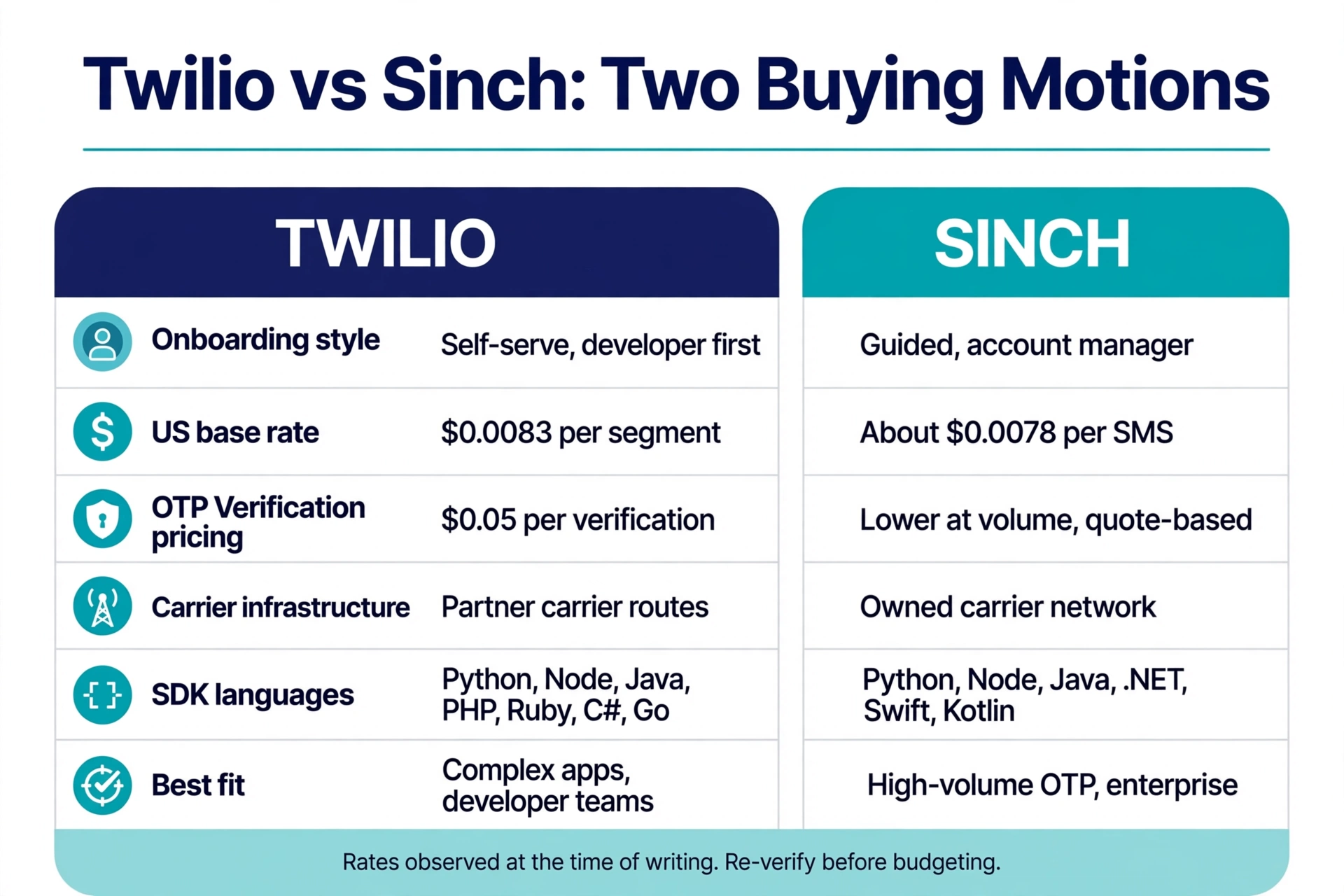
At the time of writing, third-party rate-card snapshots put the two close on US list pricing:
- Twilio: $0.0083 per US SMS segment, outbound and inbound, published.
- Sinch: roughly $0.0078 per US SMS in snapshots, with actual pricing typically negotiated by volume.
On list rates, Sinch is a touch cheaper. In practice, Sinch’s enterprise deals are where the real discounting happens: at serious volume, negotiated Sinch rates can undercut Twilio meaningfully, especially on international routes where Sinch’s owned infrastructure removes middlemen. Twilio also negotiates at scale, so the honest advice is the same for both: if you send millions of messages a month, get both on a call and make them compete. The list-price comparison is for everyone else.
Both pass through carrier fees and 10DLC charges. For the fixed-fee layer both providers sit on top of, see our 10DLC cost breakdown.
Verification APIs: the OTP battleground
This is where the comparison gets most interesting. OTP and two-factor traffic is high-volume, price-sensitive, and operationally demanding (retries, fraud detection, fallback channels), which is why both vendors sell managed verification products instead of raw SMS for this workload.
Twilio Verify charges $0.05 per successful verification on top of channel fees at the time of writing, with SMS attempts billed whether or not they deliver. It is a polished product: automatic retry logic, fraud guardrails, and fallback to voice built in.
Sinch’s Verification API is priced to win enterprise OTP deals, with lower per-verification costs at enterprise volume according to third-party comparisons. The exact numbers are quote-based, which is frustrating for evaluation but normal for this segment. Sinch also brings its owned carrier infrastructure to verification traffic, which it positions as a deliverability advantage on international OTP routes.
Our judgment: for OTP-heavy workloads at enterprise scale, Sinch deserves a quote even if you love Twilio’s API. The per-verification fee dominates OTP economics, and this is the line item where Sinch competes hardest. For smaller OTP volumes, Twilio Verify’s self-serve simplicity usually wins because you can start today without a sales cycle.
API design and documentation
Twilio’s docs are the category standard: interactive examples, an error-code dictionary, and guides written for real debugging. Sinch’s docs are professional and complete but reflect the enterprise motion: correct, thorough, and slightly less delightful. The REST APIs on both sides cover the standard operations (send, receive, delivery receipts, number management).
One practical difference: Sinch’s platform grew by acquisition (MessageMedia, Inteliquent, and others), which means you may encounter multiple API flavors and product names depending on which Sinch product you buy. Twilio’s platform is more unified. Ask your Sinch rep exactly which API you will integrate against before you start building, because “Sinch” can mean more than one thing.
SDK language support
- Twilio: Python, Node.js, C#/.NET, Java, PHP, Ruby, Go, plus a CLI.
- Sinch: official SDKs for Python, Java, Node.js, and .NET (C#), maintained on Sinch’s public GitHub. There is no dedicated PHP SDK, only REST tutorials.
Twilio wins on breadth and maintenance cadence. If your stack is PHP-heavy, note the gap and plan to use Sinch’s REST API directly, which is perfectly workable but less convenient.
Infrastructure and geographic coverage
Sinch’s strongest structural asset is infrastructure it owns. The company operates its own carrier infrastructure in more countries than most competitors and holds direct carrier relationships that matter for international delivery, particularly across Europe and APAC. Twilio’s strength is breadth of published coverage: a per-country rate card for nearly every destination and a platform that behaves consistently everywhere.
For US-centric traffic, this dimension is close to a wash. For global enterprise messaging, especially OTP to emerging markets, Sinch’s owned infrastructure is a genuine differentiator worth testing. As always, neither vendor publishes audited delivery-rate comparisons, so “test on your routes” beats “trust the pitch deck.”
10DLC and US compliance
Both are full CSPs with The Campaign Registry, supporting brand and campaign registration. Twilio’s TrustHub is the more guided self-serve flow; Sinch handles registration through its enterprise onboarding. Throughput on 10DLC is carrier and trust-score driven for both. If you are new to 10DLC, our 10DLC registration guide walks through the process independent of provider.
Support
This is the starkest contrast in the cluster. Twilio’s free tier has no guaranteed response time; SLAs come with paid plans priced as a share of spend. Sinch’s enterprise accounts get account teams, negotiated SLAs, and human beings who know your traffic. If you are a startup, Twilio’s model serves you better. If you are an enterprise with compliance requirements and a procurement process, Sinch’s model is built for you.
Head-to-head summary
| Dimension | Twilio | Sinch | Our judgment |
|---|---|---|---|
| Buying motion | Self-serve, published pricing | Sales-led, negotiated | Depends on your company |
| US list rate (at time of writing) | $0.0083/segment | ~$0.0078 | Sinch, slightly |
| Volume pricing | Negotiated at scale | Negotiated, aggressive at scale | Sinch at enterprise volume |
| OTP/Verification | Verify at $0.05/verification | Lower per-verification at volume (quote-based) | Sinch for OTP scale |
| Docs | Best in category | Professional, less delightful | Twilio |
| SDKs | 7 languages + CLI | Python, Java, Node, .NET (no PHP SDK) | Twilio |
| Infrastructure | Broad published coverage | Owned carrier infra in many countries | Sinch for intl depth |
| 10DLC support | Full, guided TrustHub | Full, via enterprise onboarding | Tie |
| Support | Paid tiers for SLAs | Account teams, negotiated SLAs | Depends on size |
Which should you choose?
Choose Twilio if: you want to self-serve from signup to production without a sales call, your team values documentation quality, you need Verify for OTP at moderate volume, or you are building on the broader Twilio platform.
Choose Sinch if: you are an enterprise buyer who prefers negotiated contracts and SLAs, OTP is a major workload and you want competitive per-verification pricing at volume, or your traffic is heavily international and you want owned carrier infrastructure behind it.
Do both if: you are at enterprise scale. Get quotes from both, run a proof of concept on your actual routes, and let the numbers decide. The sales-led motion means the first quote is never the last.
FAQ
Is Sinch cheaper than Twilio?
On US list rates, slightly (roughly $0.0078 vs $0.0083 per SMS at the time of writing). At enterprise volume, Sinch’s negotiated pricing can be meaningfully cheaper, especially on international routes. Get written quotes at your volume; list rates are the starting point.
What is the Sinch Verification API?
Sinch’s managed OTP product, competing with Twilio Verify. It handles verification code delivery with retry and fraud logic, and it is priced to win enterprise OTP deals with lower per-verification costs at volume. Exact pricing is quote-based.
Does Sinch have a PHP SDK?
Not a dedicated one. Sinch maintains official SDKs for Python, Java, Node.js, and .NET. PHP developers use the REST API directly, which is fully documented but less convenient than a native SDK.
Who owns Sinch?
Sinch is an independent public company headquartered in Sweden. It has grown significantly by acquisition, including MessageMedia and Inteliquent, which gives it owned carrier infrastructure in many markets.
Which is better for international SMS, Twilio or Sinch?
Sinch has an edge on infrastructure depth (owned carrier connections in more countries), while Twilio has an edge on published coverage breadth and consistent platform behavior. For global enterprise traffic, test both on your actual destination mix.
Can I migrate from Twilio to Sinch easily?
There is no drop-in compatibility layer like Telnyx’s Twexit. Expect a standard API migration: rewrite the send and webhook code against Sinch’s API, test thoroughly, and migrate traffic gradually. Budget days to weeks depending on integration depth.
The bottom line
Twilio vs Sinch is a buying-motion decision first and a price decision second. Twilio is the most self-serve-friendly developer platform in CPaaS for teams getting started on their own, with the docs and ecosystem to prove it. Sinch is the enterprise specialist, with owned infrastructure, negotiated pricing, and verification pricing that undercuts Twilio at OTP scale. Startups should default to Twilio; enterprises with serious OTP or international volume should get a Sinch quote before deciding. Either way, make them compete on your actual routes.
Want this set up for you?
I build SMS chatbots and API integrations for businesses. If you would like what this guide describes, done for you, get in touch.