If you have priced an SMS API recently, you have probably landed on the same two names: Twilio, the default choice with particularly extensive documentation, and Plivo, the budget-friendly lookalike that promises a nearly identical API at a lower per-message price. They look like the same product with different price tags. The reality is more interesting than that.
This comparison goes beyond headline rates. Headline per-message prices are the least honest number in SMS pricing, because the number you actually pay includes the base rate, carrier pass-through fees, 10DLC registration and campaign fees, and number rental. We model the all-in cost per delivered message at three volumes (10K, 100K, and 1M messages per month), then compare the two on the dimensions that matter after you sign up: API design and docs, SDK support, 10DLC tooling, throughput, geographic coverage, and support.
How this comparison is run
Every dimension below is either documented on a provider’s own site or a qualitative judgment, and we say which is which. Pricing figures were checked against provider pricing pages and reputable third-party snapshots on 2026-09-28; every price is labeled “at the time of writing” because SMS rate cards move. Where a figure comes from a third party rather than the provider, the verification notes at the end of this article say so. We claim no delivery-rate or uptime numbers. No provider publishes independently audited comparisons of those, and any article that cites them is recycling marketing claims.
Pricing: the headline lie and the all-in truth
Twilio pricing structure
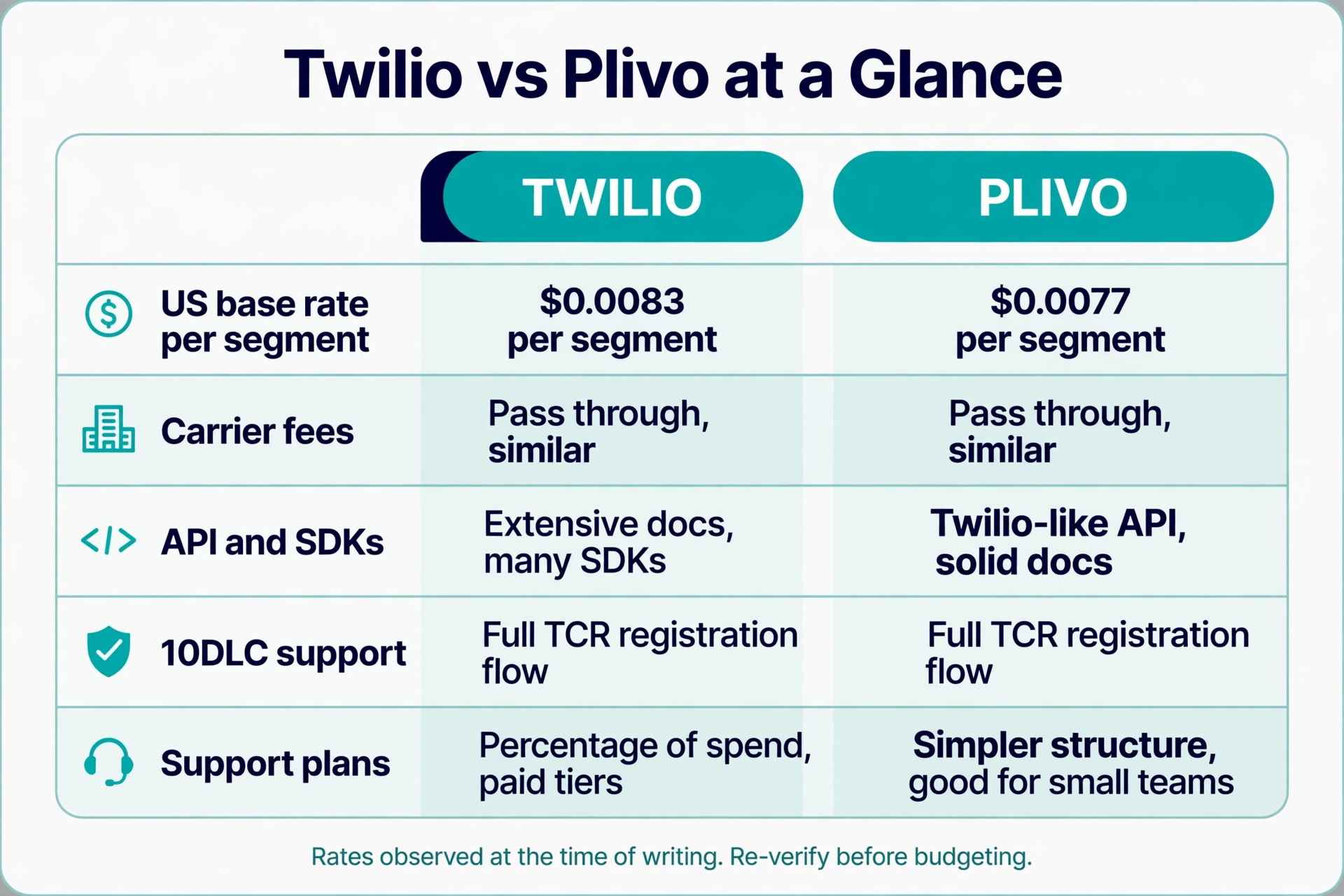
Twilio’s US SMS pricing, at the time of writing, is $0.0083 per segment outbound and $0.0083 per segment inbound. A segment is one 160-character GSM-7 message (or 70 characters for Unicode). Long messages split into multiple segments, and you pay per segment. This is the highest headline base rate among the major US SMS APIs.
The base rate is not the whole story. On top of it, Twilio passes through US carrier fees per message (roughly $0.0035 to $0.005 depending on the carrier, at the time of writing), charges $1.15 per month per local number, and bills separately for A2P 10DLC brand and campaign registration and monthly campaign fees. Twilio’s paid support plans are also priced as a percentage of spend (starting around $250/month or 4% of the bill), which matters if you need guaranteed response times.
Plivo pricing structure
Plivo’s US pricing, at the time of writing, is $0.0077 per outbound message on a long code, on a pay-as-you-go model with no subscription. Carrier surcharges apply on top, typically $0.0035 to $0.0050 per message depending on carrier. A2P 10DLC fees apply on top as well, and US long-code numbers run about $0.50 per month. So the headline gap is $0.0083 vs $0.0077, which looks small, about 7%. The real gap is larger once you compare everything stacked around it.
All-in cost at three volumes
Model assumptions: US 10DLC long-code sending, single-segment messages, blended carrier fee of about $0.004 per message, one brand registration, one standard campaign. These are estimates, not quotes.
At 10,000 messages per month:
– Twilio: $83.00 (base) + $40.00 (carrier) + ~$11.50 (number and campaign fees) = ~$134.50, or about $0.0135 per message.
– Plivo: $77.00 (base) + $40.00 (carrier) + ~$11.00 (number and campaign fees) = ~$128.00, or about $0.0128 per message.
At this volume the difference is small, roughly 5%. Fixed fees (registration, number rental) dilute the per-message gap.
At 100,000 messages per month:
– Twilio: $830 + $400 + ~$11.50 = ~$1,241.50, or about $0.0124 per message.
– Plivo: $770 + $400 + ~$11.00 = ~$1,181.00, or about $0.0118 per message.
Still roughly a 5% gap. Fixed costs are fading; the base-rate difference is doing the work.
At 1,000,000 messages per month:
– Twilio: $8,300 + $4,000 + ~$11.50 = ~$12,311.50, or about $0.0123 per message.
– Plivo: $7,700 + $4,000 + ~$11.00 = ~$11,711.00, or about $0.0117 per message.
The honest conclusion: Plivo is cheaper, but only modestly so on US traffic, about 5 to 7% all-in at these volumes. Where Plivo’s advantage grows is on volume-discounted international routes and in the absence of Twilio’s percentage-based support tiers. The headline “Plivo is 35 to 40% cheaper than Twilio” claims you see in some roundups are describing specific international routes or volume-negotiated rates, not US list pricing. Do not budget on those.
One more cost line item teams forget: inbound messages. If your flow is two-way (confirmations, replies, keyword opt-outs), Twilio bills inbound at the same $0.0083. Factor your reply ratio into the model.
API design and documentation
Twilio’s docs are widely considered the strongest in CPaaS. Every endpoint has interactive examples, every error code has a dictionary entry with remediation steps, and the guides (like the 10DLC registration walkthroughs) are genuinely good. If your team values self-service debugging at 2 a.m., this is a real, durable advantage.
Plivo’s API is deliberately Twilio-like. The REST endpoints, parameter names, and webhook patterns closely mirror Twilio’s, which is why Plivo is the easiest Twilio alternative to migrate to. The docs are solid and complete, but thinner: fewer guides and a smaller community on Stack Overflow and Reddit when you hit something weird. For a standard send-and-receive flow, you will not feel the difference.
Judgment call: Twilio wins on docs depth and community size; Plivo wins on “feels familiar if you already know Twilio.”
SDK language support
Both providers cover the mainstream languages with official SDKs. In practice, Twilio’s libraries get more frequent updates and better TypeScript types in the Node SDK, which reflects Twilio’s larger engineering team. If you work in a mainstream language, both are fine.
10DLC and throughput
Both providers are direct CSPs to The Campaign Registry and offer full brand and campaign registration flows. This is the dimension where cheap API providers sometimes fall apart, and neither Twilio nor Plivo does. Both support:
- Standard and sole-proprietor brand registration
- Standard and low-volume-mixed campaign types
- Toll-free verification as an alternative sender type
- Short code provisioning for high-volume senders
Throughput on 10DLC is set by the carrier and your trust score, not by the provider, so do not let any comparison page tell you one API is “faster” on 10DLC. The trust-score tiers apply equally to both. Twilio’s messaging services add traffic-shaping extras (sticky sender, geomatch, scalers) that Plivo does not match.
For background on how 10DLC registration works and what it costs, see our guides to what 10DLC is, 10DLC registration, and 10DLC cost.
Geographic coverage
Both are global APIs, but with different strengths. Twilio publishes per-country pricing for nearly every destination and has deep coverage in North America and Europe. Plivo is frequently cheaper than Twilio on specific international routes (parts of Asia, Africa, and Latin America). If your traffic is mostly US, this dimension is a wash. If a large share goes to a handful of international destinations, price both providers on exactly those routes.
Support
This is the starkest structural difference. Twilio’s free Developer support tier has no guaranteed response time; guaranteed SLAs start with the paid Production plan (around $250/month or 4% of spend, at the time of writing). Plivo includes support in a simpler structure and is widely reported to be more responsive at small account sizes, which makes sense: Plivo’s customers skew smaller, and the company competes on service as well as price.
If you are a two-person startup sending 20,000 messages a month, Plivo’s support experience will likely feel better. If you are an enterprise spending six figures a month, Twilio’s personalized support plans and dedicated teams are built for you.
Head-to-head summary
| Dimension | Twilio | Plivo | Our judgment |
|---|---|---|---|
| US base rate (per segment, at time of writing) | $0.0083 | $0.0077 | Plivo, by ~7% on headline |
| All-in US cost at 100K/mo (est.) | ~$0.0124 | ~$0.0118 | Plivo, by ~5% |
| Carrier fees | Pass-through, ~$0.0035-$0.005 | Pass-through, ~$0.0035-$0.005 | Tie |
| Number rental | $1.15/mo local | ~$0.50/mo long code | Plivo |
| API/docs | Particularly extensive docs, huge community | Twilio-like API, thinner guides | Twilio |
| SDKs | Python, Node, .NET, Java, PHP, Ruby, Go | Python, PHP, Node, Ruby, Java, .NET, Go | Tie, Twilio fresher |
| 10DLC support | Full TCR flow, traffic-shaping extras | Full TCR flow, basics covered | Twilio, slightly |
| International pricing | Broad coverage, premium rates | Often cheaper on intl routes | Plivo on price |
| OTP/Verify | Verify at $0.05/successful verification | No managed verify equivalent | Twilio |
| Support | Paid tiers for SLAs | Simpler, responsive at small scale | Depends on your size |
Which should you choose?
Choose Twilio if: your team values documentation quality and community size, you need Twilio Verify for OTP, you want traffic-shaping features like messaging services and scalers, or you are already embedded in the Twilio ecosystem (Segment, SendGrid, Flex). The premium is real but modest, and for many teams the docs alone justify it.
Choose Plivo if: you are cost-sensitive on international routes, you want a Twilio-compatible API with lower base rates and cheaper number rental, or you want responsive support without paying a percentage of your spend for it. Migration from Twilio is famously easy because the APIs mirror each other.
Consider both if: you run multi-provider routing. Many teams send through Twilio as primary and Plivo as failover (or route international traffic to Plivo), which hedges against both outages and price changes. An aggregator or a simple weighted router in your own code gets you there.
FAQ
Is Plivo really 40% cheaper than Twilio?
Not on US list pricing. At the time of writing, the all-in difference on US 10DLC traffic is roughly 5 to 7%. The 35 to 40% figures come from specific international routes or negotiated volume rates. Always model your own routes and volumes.
How hard is it to migrate from Twilio to Plivo?
Among the easiest migrations in CPaaS. Plivo’s API is deliberately Twilio-compatible: same endpoint shapes, similar parameter names, similar webhook payloads. Most teams report the code changes are a search-and-replace of the base URL, credentials, and a few field names. Test in sandbox first, especially inbound webhooks and status callbacks.
Does Plivo support 10DLC?
Yes. Plivo is a registered CSP with The Campaign Registry and supports brand and campaign registration, sole-proprietor brands, and standard campaigns, just like Twilio. Registration fees and timelines are set by TCR and the carriers, not by the provider, so expect similar costs either way.
Which has better documentation, Twilio or Plivo?
Twilio, by a clear margin. Plivo’s docs are complete for standard use cases, but Twilio’s error-code dictionary, guides, and community resources are the best in the category. If your team is learning SMS APIs for the first time, Twilio’s docs will save you hours.
Does Twilio Verify work with Plivo?
Twilio Verify is a Twilio product and only works on Twilio. If you migrate to Plivo, you build OTP retry and fraud logic yourself or use a dedicated verification provider.
Which is better for international SMS?
Plivo is usually cheaper on international routes, sometimes substantially. But “international” is 200 different rate cards. Price your actual top destinations on both providers before deciding, and remember that the cheapest route on paper is not always the most reliable one in production.
The bottom line
Twilio vs Plivo is not a blowout in either direction. Plivo is genuinely cheaper, by a single-digit percentage on US traffic and more on many international routes, with an API your Twilio-trained developers already know. Twilio earns its premium with particularly extensive documentation, Verify for OTP, and deeper traffic-shaping features.
Want this set up for you?
I build SMS chatbots and API integrations for businesses. If you would like what this guide describes, done for you, get in touch.