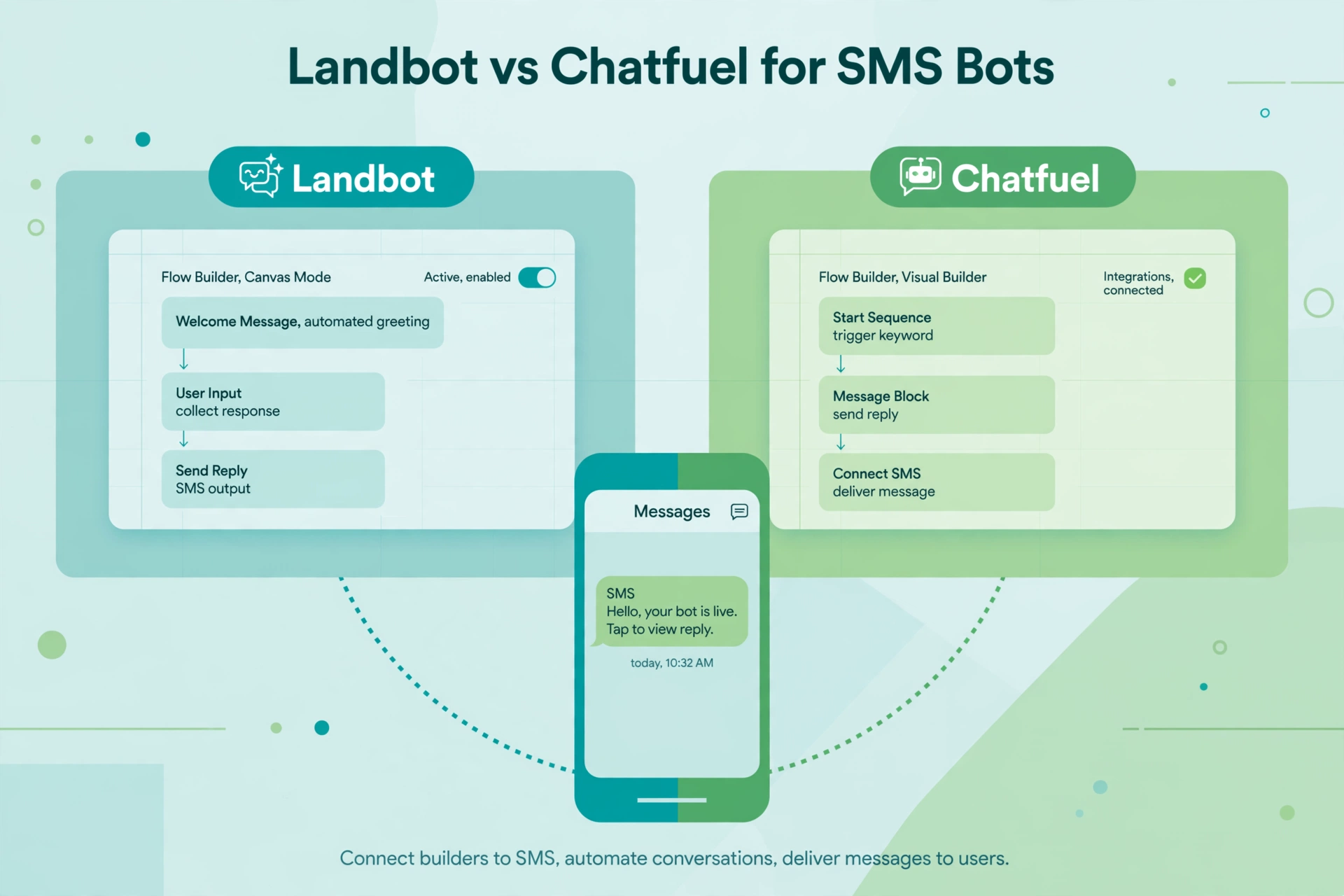
Let us start with the uncomfortable truth: if you are choosing between Landbot and Chatfuel specifically for SMS bots, you are choosing between two platforms that do not do native SMS. This comparison is really about which one gives you the least painful path to texting, and which one’s strengths make the workaround worth it.
That sounds like a strange article to write, but it is an honest one. Both are good visual bot builders. Both have real strengths. Neither will let you open an account and start sending SMS campaigns this afternoon. Here is what each one actually offers.
The SMS situation on each platform
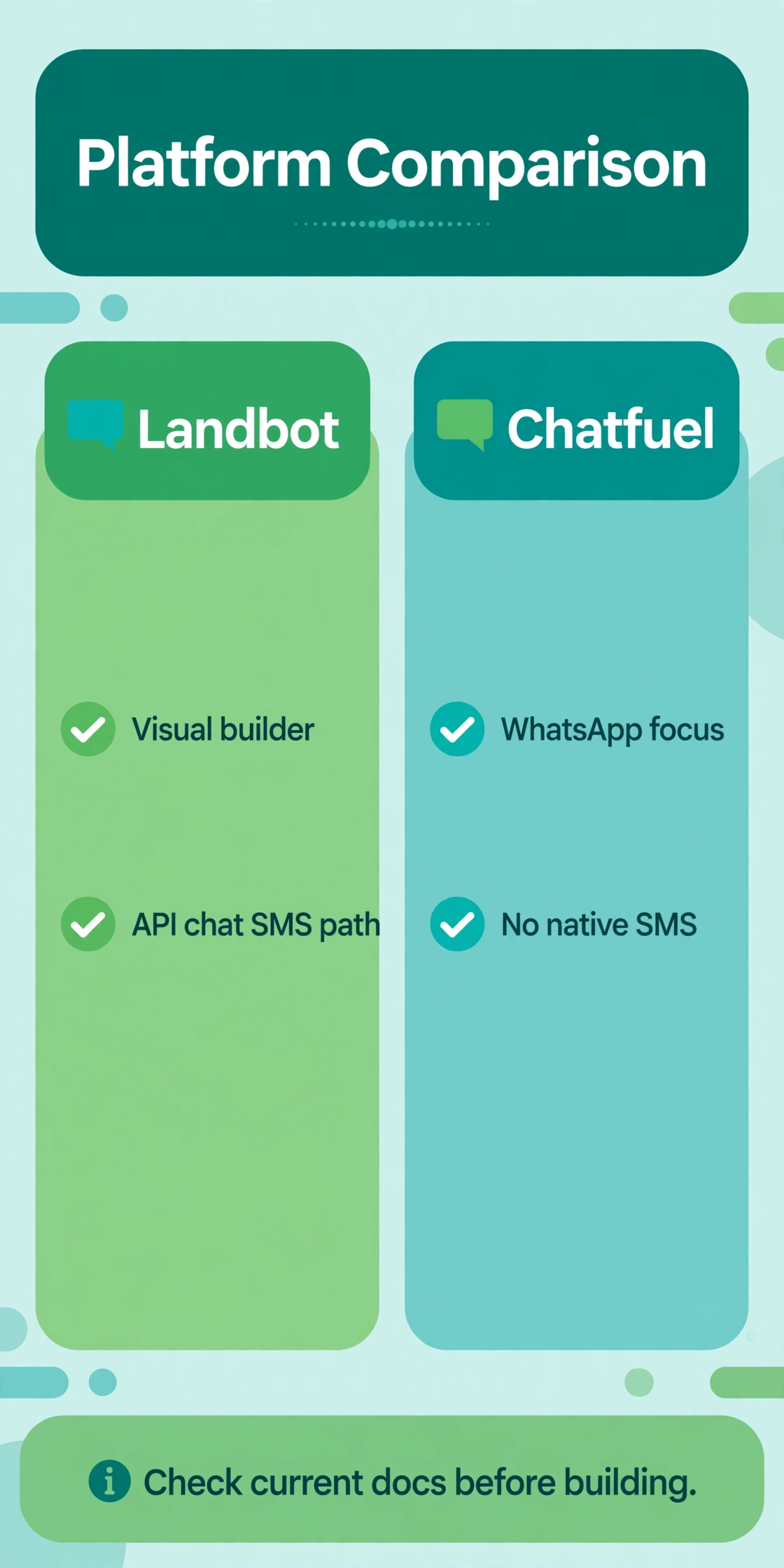
Landbot’s native channels are web chat, WhatsApp, and Facebook Messenger. That is the list. SMS is not on it.
But Landbot has something Chatfuel does not: a documented developer path to SMS. Landbot’s APIchat bot channel is designed exactly for non-native channels, and Landbot’s own help documentation names SMS explicitly, with a published example of building an SMS bot using ClickSend plus the APIchat bot. The architecture is straightforward: you build the conversation logic in Landbot’s visual builder, and a custom middleware service translates messages between Landbot and the SMS provider over webhooks. Landbot is upfront that you should have a developer on your team for this, because the middleware is custom code you build and maintain.
Chatfuel’s native channels are Messenger, Instagram, WhatsApp, and a website widget in beta. SMS is not on that list either, and Chatfuel has no equivalent of APIchat: no documented SMS bridge, no first-party middleware pattern. The only path is the generic one: connect Chatfuel to an SMS provider through Zapier or Make and shuttle messages back and forth. It is the same class of workaround as Landbot’s, but without Landbot’s purpose-built channel for it, so it tends to be clunkier for real two-way conversations.
Score it this way: Landbot gives you a supported, documented, developer-grade path to SMS. Chatfuel gives you a generic automation workaround. Neither gives you native SMS. If SMS is the actual goal rather than a side quest, you should probably be looking at ManyChat, a dedicated SMS platform, or Twilio instead. But if you are already committed to one of these builders for other reasons, Landbot’s path is the more serious one.
What each platform is actually good at
Landbot is the visual conversation designer. Its block-based drag-and-drop builder is one of the nicest in the category, with conditional logic, formulas, variables, and rich media, all aimed at making web chat feel like an experience rather than a form. It is popular for lead generation flows, conversational landing pages, and support routines. It offers AI agents for lead generation, appointment booking, and customer support, plus built-in live chat for human handoff. Think of Landbot as the tool you pick when the conversation itself is the product: the bot is the landing page.
Chatfuel is the AI-first social commerce platform. Its strength is generative conversation on WhatsApp and Instagram: built-in ChatGPT integration, AI agents for lead qualification and product recommendations, deep Meta API integration with product catalog sync. It is popular with mid-market ecommerce brands running ad-driven WhatsApp campaigns. Think of Chatfuel as the tool you pick when your customers live in messaging apps and ask messy product questions.
For SMS specifically, notice the mismatch. SMS is plain text: no rich media, no carousels, no buttons. Landbot’s visual richness does not transfer to SMS at all; an SMS bot built through APIchat is a text-only experience wearing a fancy builder. Chatfuel’s generative AI would theoretically suit SMS well, since SMS is all about natural language, but Chatfuel cannot reach the channel natively.
Pricing reality
Landbot’s pricing is tiered by plan. Landbot’s own blog lists Pro at 150 euro per month with a 14-day free trial and custom pricing for Business accounts. Third-party reviews cite paid plans starting around $46 per month, which suggests lower tiers exist or existed alongside the Pro positioning. Treat both as reported figures and check landbot.io pricing directly, because the plan names have shifted over time. On top of the plan, an SMS deployment adds the SMS provider’s per-message costs and the engineering time for the middleware.
Chatfuel prices by channel and conversation volume: roughly $23.99 per month for Facebook and Instagram, roughly $34.49 for WhatsApp at the same volume, and enterprise from about $300 per month, with a 50-conversation trial instead of a free tier. An SMS workaround adds Zapier or Make costs plus the SMS provider’s per-message rates.
Neither pricing story is simple, and neither includes the real cost of the workaround: building it, monitoring it, and fixing it when something in the chain changes. Budget the integration, not just the subscription.
Builder experience compared
If you are choosing on builder quality alone, this is a taste question.
Landbot’s builder is the more visual and playful: bricks and blocks, a canvas that feels designed, strong templating for common flows like lead gen and appointment booking. Non-technical marketers tend to love it. The tradeoff is that very complex logic can get sprawling on the canvas, and the AI agent features add cost.
Chatfuel’s builder is more utilitarian, with its energy going into the AI layer rather than the canvas. You spend less time drawing branches and more time training the AI on your products and policies. For teams comfortable with generative AI and less interested in hand-drawing every path, that is a better fit.
For an SMS bot built through a workaround, the builder matters less than you would think. The SMS experience is constrained by the channel: short messages, no rich UI, keyword and natural-language input. Pick the builder your team will actually maintain, because the workaround’s reliability depends on someone tending it.
Compliance: the workaround tax
Here is the part people forget. When SMS runs through a middleware chain, every compliance obligation still applies, and now it spans multiple systems. Consent capture has to be recorded somewhere authoritative. STOP requests have to propagate through the middleware to the SMS provider and back to the bot’s contact record instantly. Quiet hours have to be enforced by something, and “something” needs to be a deliberate choice, not an accident of architecture.
This is general information, not legal advice, but the principle is simple: the more systems in the chain, the more places consent and opt-out handling can break. If you go the Landbot APIchat route, design the compliance flow before you design the conversation flow. Our TCPA consent guide covers what the consent records need to look like.
Who should pick which
Pick Landbot if you love the visual builder, your primary bots live on web chat and WhatsApp, and SMS is a secondary channel you are willing to reach through a developer-built APIchat integration. The documented path exists, the builder is excellent, and the middleware pattern is honest engineering.
Pick Chatfuel if your business runs on WhatsApp and Instagram commerce, you want AI-first conversations with minimal flow drawing, and SMS is barely on your roadmap. Do not pick Chatfuel for an SMS-led strategy; the workaround is the weakest of the options here.
Pick neither if SMS is the main event. A native SMS platform will beat both on reliability, compliance simplicity, and total cost once you factor in the workaround engineering.
FAQ
Does Landbot support SMS?
Not natively. Landbot’s native channels are web, WhatsApp, and Messenger. It offers a documented developer path to SMS through the APIchat bot channel plus custom middleware, with a published ClickSend example.
Does Chatfuel support SMS?
No. Chatfuel has no native SMS and no documented SMS bridge. The only option is wiring an SMS provider through Zapier or Make.
Which is better for SMS bots?
Landbot, because its APIchat channel gives developers a supported pattern for connecting SMS providers to the visual builder. Chatfuel’s generic automation workaround is less suited to real two-way SMS conversations.
Can I run keyword campaigns like text JOIN on either?
Only through the workarounds, with an SMS provider handling the keywords and the bot platform handling logic via middleware or automation. Neither platform offers native SMS keyword campaigns.
How much does the SMS workaround cost?
The platform plan plus the SMS provider’s per-message rates plus engineering time to build and maintain the middleware or automation. Get the integration cost estimated before committing.
Should I just use a native SMS platform instead?
If SMS is your primary channel, yes. The workarounds described here make sense when SMS is secondary to a web chat or WhatsApp strategy, not when texting is the core of the program.
The bottom line
Landbot versus Chatfuel for SMS bots is a contest neither wins outright, because neither does native SMS. Landbot takes the round on the strength of its documented APIchat developer path, which is a real engineering pattern rather than a Zapier prayer. Chatfuel’s strengths lie elsewhere, in AI-driven WhatsApp and Instagram commerce, and it should be chosen for those, not for SMS. If texting is central to your plan, skip both and pick a platform with a native SMS channel. Your compliance team will thank you.
Want this set up for you?
I build SMS chatbots and API integrations for businesses. If you would like what this guide describes, done for you, get in touch.