
This is not legal advice. The rules below come from court decisions and FCC orders, but telecom law moves fast and this summary cannot cover your situation. This area is also developing quickly, with several key decisions issued between 2022 and 2026. Before your chatbot sends its first marketing text, have a qualified telecom attorney review your consent flows and message programs.
The short answer
Yes, AI chatbots can send marketing texts. AI creates no legal loophole and adds no separate penalty either. An AI-generated marketing text is treated the same as any other marketing text under the TCPA: you need prior express written consent before you send it, and each message sent without consent is a separate violation worth $500 to $1,500.
Two headlines get misread. One: a court ruled chatbot texts are not “artificial voices.” Two: the FCC cracked down on AI robocalls. Some conclude either that AI texts are unregulated or that they face the same strict rules as AI voice calls. Neither is true.
What Risher v. Adecco actually held
The case everyone cites is Risher v. Adecco, Inc. (N.D. Cal., Nov. 2022), and it gets misquoted a lot.
Adecco, a staffing company, used a chatbot called Mya to text a job seeker about employment opportunities. He sued under the TCPA, arguing the chatbot imitated human conversation, so the texts had a “voice” in the metaphorical sense covered by the TCPA’s ban on non-emergency calls to cell phones made using “an artificial or prerecorded voice.”
The court called his position “not frivolous,” then dismissed it. In plain English, the holding was: text messages are not “voices” under the TCPA. Words get their ordinary meaning, and in ordinary language a silent text is not a voice. The TCPA’s ban on “prerecorded” voices makes the metaphorical reading even less plausible, because to record something means to convert sound into permanent form. The claim was dismissed without leave to amend, meaning the court thought the theory could not be fixed with better pleading. Other courts have reached the same conclusion, including the Second Circuit in Soliman v. Subway (2024).
What Risher did NOT hold
This is where the misreading happens. The court did not say chatbot texts are exempt from the TCPA. It answered one narrow question: does an “artificial or prerecorded voice” claim work against text messages? No. Autodialer rules, consent rules, and do-not-call rules all still apply to chatbot texts, since the Supreme Court treats texts as “calls” under the TCPA (Campbell-Ewald v. Gomez, 2016).
So Risher closed one door (the “metaphorical voice” theory) and left every other TCPA door wide open.
The FCC’s AI voice rules vs. AI text rules
In February 2024, the FCC issued Declaratory Ruling FCC 24-17, holding that AI-generated voices, both fully simulated and cloned, count as “artificial voice” under the TCPA. It took effect immediately. The practical effect: AI voice calls to cell phones now clearly require the same consent as traditional robocalls, and marketing AI voice calls require prior express written consent.
Notice the word in all of that: voice. The ruling is about calls that speak. It does not say anything about texts, because texts do not have a voice. Risher and the later cases make that explicit.
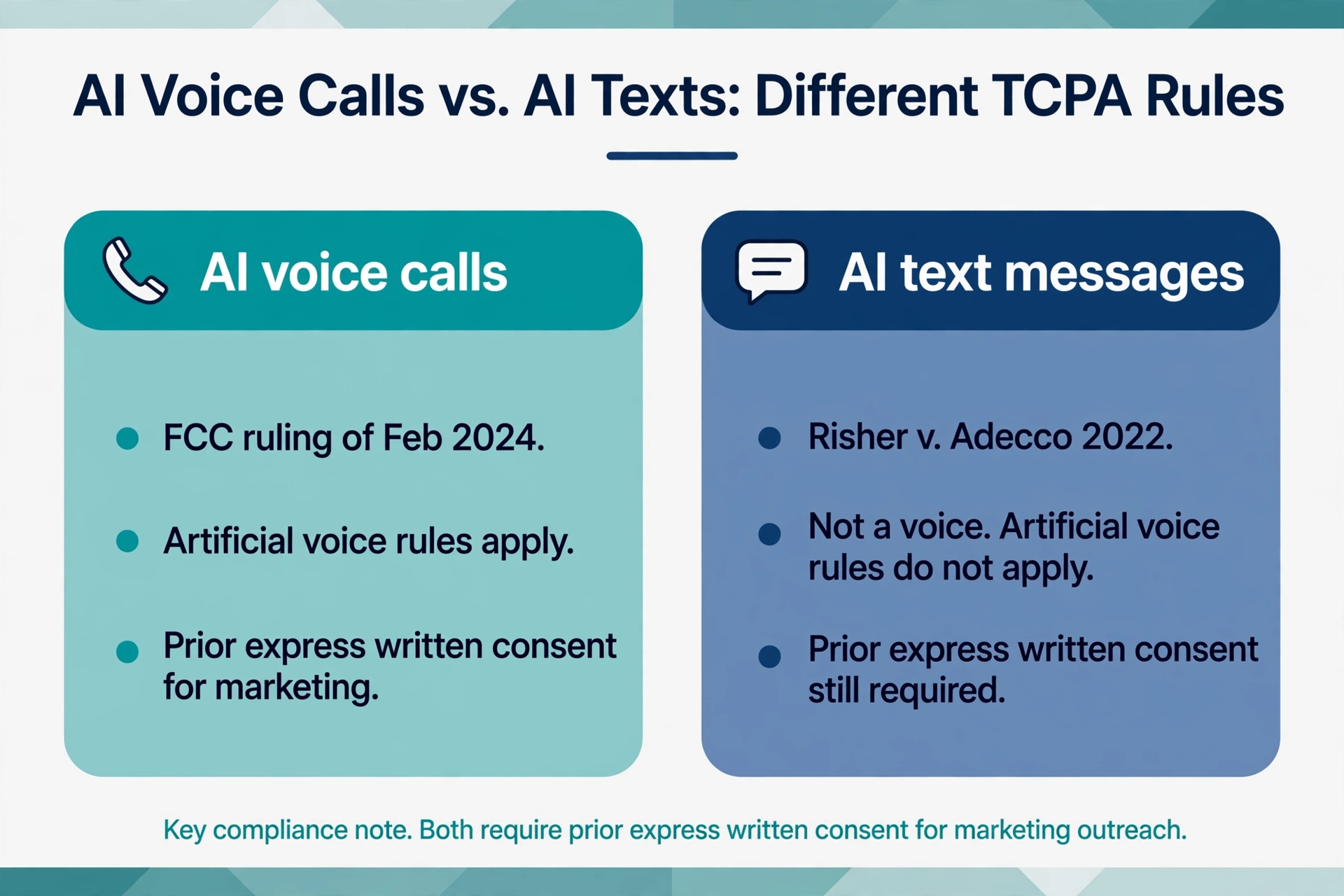
- AI voice calls (a bot that phones someone and talks): covered by the artificial voice rules. Marketing requires prior express written consent. The human-like quality of the voice is legally irrelevant.
- AI text messages (a chatbot sending texts): NOT covered by the artificial voice rules, because texts are not voices. But they are covered by the ordinary text marketing rules, which also require prior express written consent for marketing. The destination is the same; the legal route is different.
- Hybrid flows (a text that links to a call, or a voicebot that follows up by text): each channel is judged on its own. Do not assume consent for one channel covers the other.
One more development to watch: in August 2024 the FCC proposed rules requiring AI-use disclosures at the start of AI-generated calls and AI-specific language in consent forms for AI-generated content, including texts. As of this writing the proposal is still just a proposal, and some states have started filling the gap with their own disclosure laws.
Consent rules for AI chatbot marketing
Here is the part that has not changed at all with AI: the consent standard. For marketing texts sent by any automated system, including an AI chatbot, the TCPA requires prior express written consent. The word “written” does not mean ink on paper. An electronic signature or a checked box counts, as long as the agreement meets the elements in 47 CFR 64.1200(f)(9):
- A clear and conspicuous disclosure that by agreeing, the consumer authorizes the seller to deliver advertising or telemarketing messages using an automatic telephone dialing system or an artificial or prerecorded voice to a specified phone number.
- The consumer’s affirmative agreement, such as clicking a checkbox or replying with a keyword. Pre-checked boxes do not count.
- The phone number itself, identified as the number where messages will be sent.
- No condition of purchase. Consent cannot be required as the price of buying something or getting a quote.
Beyond the federal requirements, build these into every chatbot marketing flow:
- Say who you are. Identify the brand in the opt-in language and in the messages. California’s B.O.T. Act requires bots to disclose their artificial identity in certain commercial interactions, and other states have added their own AI disclosure duties. A simple “Hi, this is [Brand]’s assistant” at the start of a conversation solves most disclosure concerns.
- Disclose frequency and costs. State how often messages may arrive and that message and data rates may apply.
- Give a working opt-out in every marketing message. “Reply STOP to end” is the standard. Under the FCC’s 2025 revocation rules, a consumer can revoke consent by any reasonable means, and replies like STOP, QUIT, END, REVOKE, OPT OUT, CANCEL, and UNSUBSCRIBE are presumed revocations you must honor within 10 business days.
- Log everything. Record who consented, when, through which channel, and the exact wording they saw. If a chatbot collects consent in conversation, store the transcript, not just a flag in your database.
The autodialer question for AI text bots
The trickiest unresolved issue is whether an AI chatbot counts as an “automatic telephone dialing system” (ATDS), which the TCPA bans for calls without consent alongside “artificial or prerecorded voice.” Risher took the voice prong off the table for texts. The autodialer prong remains.
The Supreme Court narrowed the federal ATDS definition in Facebook v. Duguid (2021): equipment qualifies only if it uses a random or sequential number generator to store or produce numbers. Most chatbot platforms text a stored list of existing contacts, which does not use random or sequential generation.
But be careful with that reading for three reasons:
- State mini-TCPA laws define autodialers differently. Florida’s Telephone Solicitation Act, for example, has its own broader definition and its own litigation history. A system that is not a federal ATDS can still violate state law.
- The DNC and consent rules do not care about your dialer. Even if your chatbot is not an ATDS, marketing texts still require prior express written consent and still must respect the Do Not Call Registry.
- Plaintiffs’ lawyers test new theories constantly. AI features like automatic number selection and conversational triggering are exactly the kind of technology that gets tested in court. Some commentators claim courts are expanding autodialer definitions to cover AI. That overstates the case law, but the direction of travel is toward more scrutiny, not less.
The honest position is this: the federal autodialer analysis favors compliant senders after Duguid, but it is not a safe harbor you can hide behind. Consent remains the defense that actually works.
A practical compliance checklist
If you are building or running an AI chatbot that sends marketing texts, work through this list before launch:
- Get prior express written consent with all four elements above, before the first marketing text goes out.
- Confirm consent in the conversation. If the chatbot collects the opt-in itself, have it restate what the user agreed to and log the transcript.
- Identify the brand and the bot. Do not let the chatbot pass as a human employee. A simple “Hi, this is [Brand]’s assistant” at the start of a conversation solves most disclosure concerns.
- Put STOP instructions in every marketing message and honor opt-outs immediately. Route keywords like STOP, QUIT, END, and CANCEL to suppression before any conversation logic runs.
- Respect quiet hours. Marketing texts generally must arrive between 8 a.m. and 9 p.m. in the recipient’s local time. Some states are stricter.
- Scrub against the DNC list and keep your own internal suppression list.
- Keep consent records for years. TCPA claims can surface long after the messages were sent. Your log is your defense.
- Get counsel to review the flow. This checklist covers the recurring issues, not your facts. State laws, carrier rules, and your specific use case can all add requirements.
Want this set up for you?
I build SMS chatbots and API integrations for businesses. If you would like what this guide describes, done for you, get in touch.
Frequently asked questions
Can a chatbot send promotional texts without consent?
No. AI-generated marketing texts are still marketing texts. The TCPA requires prior express written consent before you send them to US mobile numbers, and each message sent without consent is a separate violation with statutory damages of $500 to $1,500.
What did Risher v. Adecco actually decide?
The court decided that chatbot text messages are not “artificial or prerecorded voices” under the TCPA, so the artificial voice claim failed. It did not decide that chatbot texts are exempt from the TCPA. Autodialer rules, consent rules, and do-not-call rules all still apply.
Do AI voice calls and AI texts have different rules?
Yes. The FCC’s 2024 ruling on AI-generated voices applies the “artificial voice” rules to AI voice calls. Texts are not voices, so that ruling does not apply to them directly. Marketing texts independently require prior express written consent under the TCPA’s text rules, so the practical consent requirement is the same.
Does an AI chatbot have to say it is a bot?
Federal TCPA law does not currently require an “I am a bot” disclosure in texts, but state laws are heading that way. California’s bot disclosure law requires disclosure of artificial identity in certain commercial interactions, and other states have added AI disclosure duties. Even where not strictly required, identifying the bot avoids deception claims.
Can someone sue over a single AI marketing text?
Yes. The TCPA gives consumers a private right of action, and a single non-compliant text is actionable. Statutory damages are $500 per violation, tripled to $1,500 if the violation was willful or knowing. This is why TCPA cases so often become class actions.
Is consent collected by a chatbot as valid as consent on a web form?
It can be, if it meets the same elements: clear disclosure, affirmative agreement, the phone number, and no purchase condition. The challenge with in-chat consent is proving what the user saw. Log the full conversation, not just a timestamp.
The bottom line
The legal landscape for AI chatbot marketing texts is less exotic than the headlines suggest. Courts have refused to stretch the “artificial voice” rules to cover silent texts, and the FCC’s AI voice crackdown is about calls that speak. Neither creates a loophole. An AI-generated marketing text is a marketing text, and the TCPA’s consent rules apply to it in full: prior express written consent, honest identification, working opt-outs, and careful record-keeping.
The marketers who will get in trouble are not the ones using AI. They are the ones who assumed AI changed the rules. It did not.