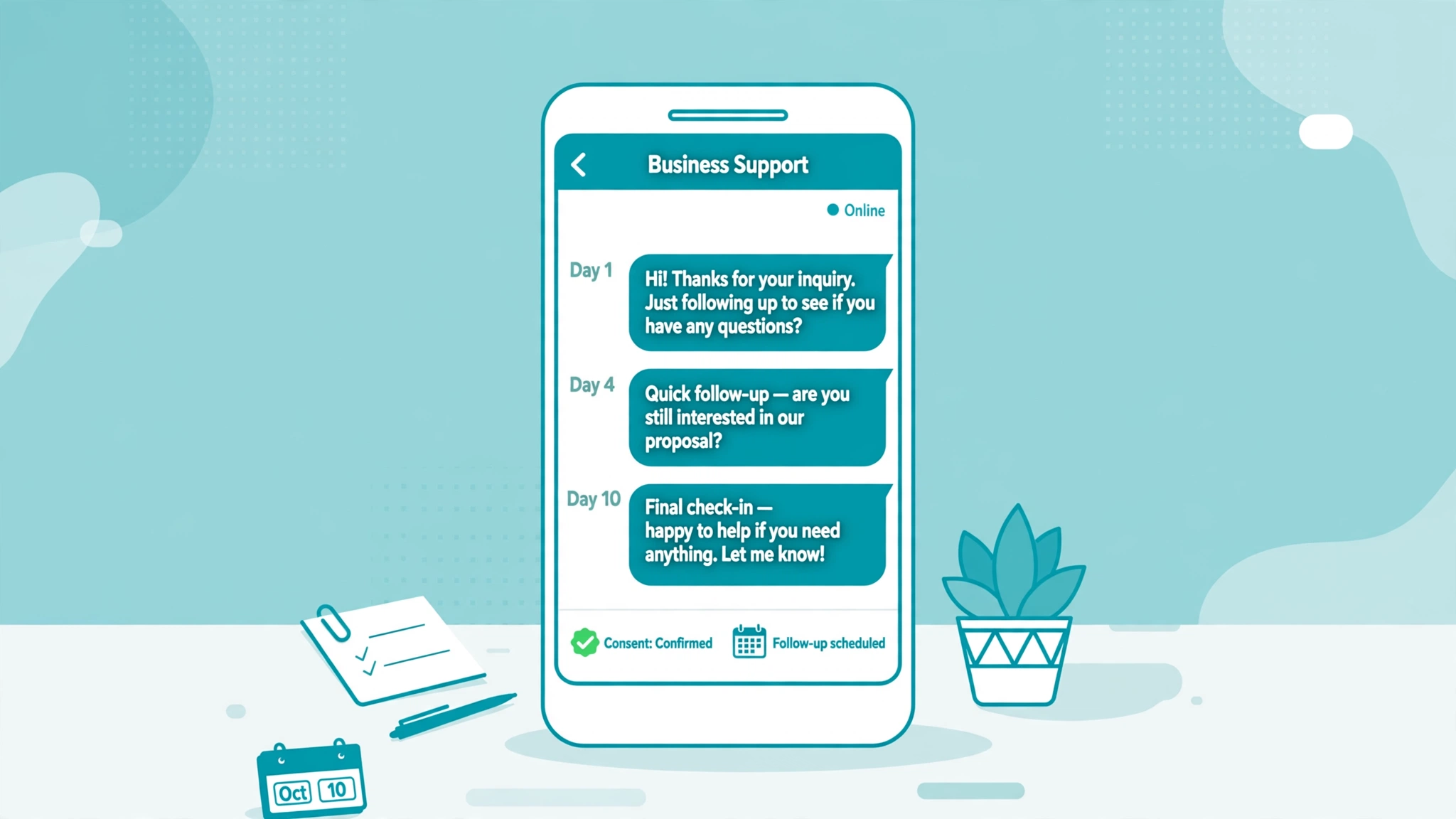
Most leads are not ready to buy the day they share their phone number. They are curious, a little cautious, and busy. Email can sit unread for days. A text gets read in minutes, which makes SMS the best channel for staying in touch while a lead makes up their mind.
SMS lead nurturing automation is the system that handles that follow-up for you. You set the schedule and write the messages once, and every new lead walks the same path. When someone replies, the system branches: hot leads get routed to sales, quiet leads keep receiving value, and anyone who opts out is removed instantly.
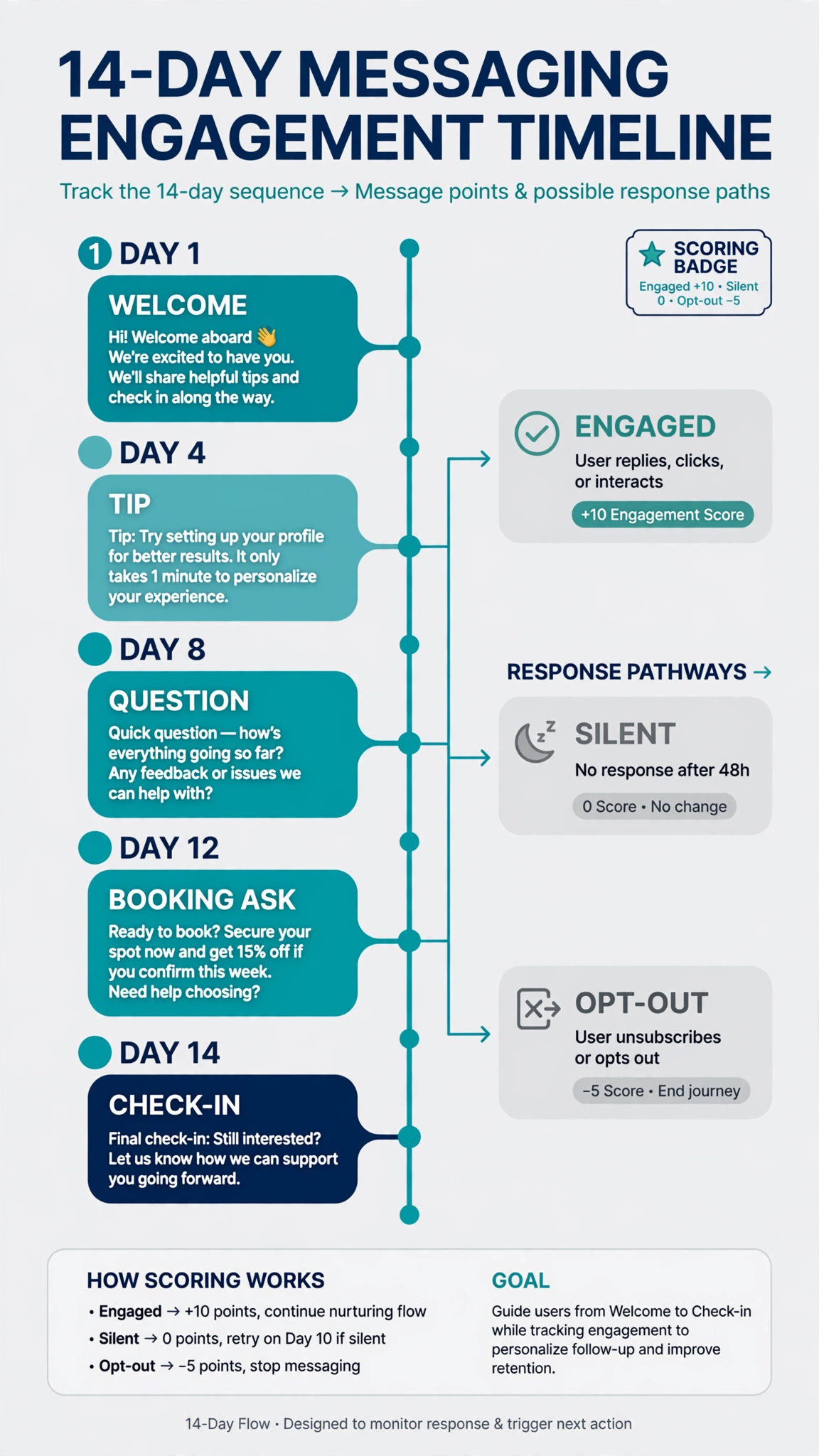
This guide maps a full 14-day SMS nurture sequence you can copy, then covers how to branch on replies, score engagement so your team calls the right people first, and stay inside the compliance lines that keep marketing texts legal.
Realistic Use Cases
A dental clinic texts new patient inquiries over two weeks: pricing on day one, insurance answers mid-sequence, and a booking link to close. The front desk only calls leads who reply.
A B2B software trial nudges users who never activated. Texts point to a two-minute setup video, then a template gallery, then a fifteen-minute onboarding call offer. Replies route to customer success.
A real estate agent nurtures buyer leads who browsed listings. The sequence sends a financing explainer, a neighborhood guide, and a showing invitation. When a lead replies with a budget, the agent takes over.
A local gym follows up on free-pass signups. Early texts share class schedules, mid-sequence texts answer the price objection before it comes up, and day fourteen offers a tour with a trainer.
The pattern is the same every time. Early touches confirm and add value, middle touches handle objections, and late touches ask for the next step. Only the content changes.
The 14-Day SMS Nurture Sequence Map
Six to eight touches over fourteen days is a safe cadence for most businesses. It keeps you visible without training people to ignore you. Send each touch inside local daytime hours and identify your business by name.
Timing matters as much as copy. Mid-morning (around 10 am to 12 pm) and early evening (around 5 pm to 7 pm) in the lead’s local time zone tend to pull the best replies. Never schedule sends late at night. State quiet-hour rules are strict, and the site’s SMS quiet hours checker is a quick way to confirm the allowed window for a lead’s state before you schedule.
Day one starts the clock at opt-in.
| Day | Timing | Message (adapt to your business) | Goal |
|---|---|---|---|
| 1 | Within 5 minutes of opt-in | Hi Ana, this is Bright Smile Dental. Thanks for requesting new patient info. Prices and insurance details are here: [link]. Reply STOP to opt out anytime. | Confirm the opt-in, set expectations, include opt-out language |
| 2 | Next morning, 10 am to 12 pm local | Quick question, Ana: what matters most for your first visit, price, location, or appointment times? Just reply with one word. | Start a two-way conversation with a low-effort question |
| 4 | 2 days later, early evening | Most patients ask if we take their insurance. We work with 40 plus plans, and cleanings start at 79 dollars. Details: [link] | Handle the number one objection with specifics |
| 6 | 2 days later, mid-morning | Here is what a first visit looks like at our office, a 3 minute walkthrough: [link]. No surprises. | Reduce uncertainty with a behind-the-scenes look |
| 8 | 2 days later, early evening | Ana, anything holding you back from booking? Reply and I will answer directly, or tap here to see open times: [link] | Invite objections out into the open |
| 10 | 2 days later, mid-morning | Priya came in nervous about her first cleaning in 6 years. She left saying it was easier than she expected. Her story: [link] | Social proof that mirrors the lead’s situation |
| 12 | 2 days later, early evening | We have 4 new patient slots open this week. Want me to hold one for you Thursday or Friday? Reply YES and I will set it up. | Direct booking ask with a concrete choice |
| 14 | 2 days later, mid-morning | Last check from us, Ana. If the timing is not right, reply PAUSE and I will check back next month instead of this week. Reply STOP to opt out. | Break-up text with a low-pressure off ramp |
A few notes on this structure. The first message always identifies the business and includes opt-out instructions. Keep each message under 160 characters when possible so it sends as a single segment, which keeps costs predictable. If you want to estimate what a sequence like this costs at your volume, the bulk SMS cost calculator gives you a quick number before you commit.
Notice the day fourteen message. A clean break-up text does two jobs. It re-engages leads who were quietly interested, and it gives everyone else a graceful exit. Leads who reply PAUSE move to a monthly check-in instead of being dropped or annoyed.
Branching Logic: What Happens When They Reply
A sequence that ignores replies is a scheduled blast, not automation. Every inbound reply should sort into one of three buckets, and each bucket changes what happens next.
Engaged: they reply with interest or a question
Pause the nurture sequence for this lead immediately. Nothing kills trust like an automated “just checking in” text landing while a real conversation is happening. Then route the reply: either an AI chatbot answers from your FAQ and booking rules, or a salesperson gets an alert with the full message history. The lead leaves the nurture track and their engagement score jumps (see the scoring section below). If the conversation stalls for 48 hours, they can re-enter the sequence at the next unsent touch.
Silent: they never reply
Silence is normal. Most leads read without replying. Silent leads stay in the sequence through day fourteen, with two adjustments.
First, vary the angle. If three value touches in a row got no reply, the next message should ask a direct question instead of pushing another link. Questions pull replies. Links do not.
Second, protect list health. After day fourteen with zero engagement, move silent leads to a monthly long-term cadence rather than starting another fourteen-day run. Texting the same silent list every two weeks is how opt-out rates climb.
Negative: not interested, wrong number, or STOP
Any variation of stop, unsubscribe, cancel, end, or quit must halt all marketing texts to that number immediately. Most SMS platforms handle this automatically, but your branching logic should treat it as a hard exit: remove the lead from every active sequence and flag the record as suppressed.
A polite “not interested” deserves similar respect. Send one short acknowledgment, such as “No problem, Ana. I will not text about this again. Reply START anytime if you change your mind.” Then suppress the number from marketing sequences. Arguing with a no is how complaints happen.
Engagement Scoring: Call the Right Leads First
When a hundred leads sit mid-sequence, your sales team cannot call all of them. Engagement scoring ranks each lead so humans spend time where it counts. Use simple point values anyone on the team can understand. These are starting weights, not industry standards. Tune them after your first month of data.
| Signal | Points |
|---|---|
| Replies to any sequence message | +10 |
| Asks a question about price, timing, or details | +15 |
| Clicks a link in a message | +5 |
| Books a call or requests a callback | +50 |
| No reply after a touch (decay) | -2 per touch |
| Replies STOP or complains | Exit sequence, suppress |
Then sort leads into tiers with clear actions.
Hot (40 points or more): alert sales within fifteen minutes. These leads asked questions, clicked links, and replied more than once. Intent is fresh, so speed matters.
Warm (10 to 39 points): keep them in the nurture sequence. They are reading and occasionally engaging. Let the automation do its job.
Cold (below 10 points): move to the monthly long-term cadence after day fourteen. Do not delete them. Cold leads convert later at surprising rates when a new trigger wakes them up.
Suppressed: anyone who opted out or complained. They receive nothing further unless they opt back in.
Score inside your CRM or SMS platform, not in a spreadsheet. The score should update the moment a reply or click lands, and tier changes should trigger automatically: a hot alert to the sales channel, a warm lead staying put, a cold lead shifting cadence. Manual scoring dies within a week because nobody maintains it.
Compliance Lines You Cannot Cross
Nurture texts are marketing texts, and the rules are strict. This is general information, not legal advice. Check the details with qualified counsel for your situation.
Consent comes first. In the US, the TCPA requires prior express written consent before you send marketing texts. A phone number pulled from an invoice, a business card, or an old customer record is not consent. Valid opt-ins include a website form with clear SMS disclosure, a keyword texted to your number, or a checkout box that is not pre-checked. Keep a record of every opt-in with a timestamp, the source, and the exact disclosure the person saw.
Identify yourself and offer an exit. State your business name and include opt-out instructions in the first message of the sequence. After that, make STOP work every single time, including common variants like END, CANCEL, UNSUBSCRIBE, and QUIT. Honor it within seconds and confirm it once.
Respect quiet hours. The federal rule blocks marketing texts before 8 am and after 9 pm in the recipient’s local time zone. Several states go further, and carrier rules can be stricter than federal law. A safe default is 9 am to 8 pm recipient-local unless you have verified the specific state’s window. When in doubt, check the SMS quiet hours checker before you schedule a send.
Watch frequency like a metric. Most businesses land well at four to six texts per month for ongoing marketing. A fourteen-day nurture sequence is denser than that by design, which is fine for a short burst, but it is exactly why the sequence ends. Track your opt-out rate per campaign. If it climbs past about one percent, you are texting too often or your content is not earning the interruption.
Register your sending number. If you send from a 10-digit long code in the US, register your brand and campaign use case through The Campaign Registry via your SMS platform. Unregistered traffic gets filtered or throttled. Confirm the current registration requirements with your provider, since the rules evolve.
One person, one record. Keep consent, replies, opt-outs, and scores tied to a single contact record. If a lead opts out on one campaign and you text them from another list, that is still a violation. Centralize suppression.
Frequently Asked Questions
How many texts should a lead nurture sequence send?
Six to eight touches over fourteen days works for most businesses. Fewer than four rarely builds enough trust. More than ten in two weeks starts to feel like pressure, and opt-out rates show it. For ongoing marketing after the sequence, four to six texts per month is the commonly cited sweet spot.
Do I need consent if the lead filled out my contact form?
Only if the form clearly disclosed that they would receive marketing texts and they agreed. A generic “contact me” form does not grant SMS marketing consent on its own. Add explicit language near the phone field, such as “By providing your number you agree to receive marketing texts, up to 6 per month. Reply STOP to opt out.” Then store that consent record.
What should the first text in a nurture sequence say?
Identify your business by name, reference what they signed up for, deliver something useful immediately, and include opt-out instructions. Send it within five minutes of opt-in while intent is fresh.
What happens if a lead replies STOP mid-sequence?
All marketing texts to that number stop immediately, and the lead exits every active sequence. Send one confirmation that they are unsubscribed, then suppress the number from future marketing sends. Most SMS platforms automate this. Make sure your branching logic and your CRM suppression list agree, so no other campaign picks the number back up.
Can I send nurture texts at night or on weekends?
Weekends are fine if your audience engages then. Nighttime is not. The federal quiet-hours rule blocks marketing texts before 8 am and after 9 pm in the recipient’s local time, and some states restrict the window further. Schedule every touch inside daytime hours for the lead’s time zone, and verify state-specific windows before you send.
How do I know if my nurture sequence is working?
Watch three numbers. Reply rate tells you whether messages start conversations. Click-through rate tells you whether links earn attention. Opt-out rate tells you whether the sequence annoys people; keep it around one percent or lower. If replies are low but opt-outs are also low, your copy needs stronger questions. If opt-outs climb, cut frequency or rewrite the weakest touches.
Conclusion
SMS lead nurturing automation works because it respects how people actually decide. Short messages, spaced over two weeks, each earning the next reply. Map the fourteen days, write copy that sounds like a person, branch on every reply, and let engagement scores tell your team who to call first.
Build it on clean consent and the compliance lines above, and the sequence runs in the background while you run the business. If you are setting up the tooling, the free tools hub has the quiet-hours checker and cost calculator mentioned in this guide, plus a few more utilities worth a look before you launch.
Want this set up for you?
I build SMS chatbots and API integrations for businesses. If you would like what this guide describes, done for you, get in touch.