When a US business wants to send application-to-person text messages from a regular 10-digit number, 10DLC registration is not optional. Since February 1, 2025, US carriers block unregistered A2P traffic on 10-digit long codes, so every sender is working through The Campaign Registry, or TCR, and paying its fees. The part most guides skip is that the bill has three separate layers, and each one is charged by a different party. This article walks through all three and builds a first-year total cost model at 10K, 100K, and 1M messages a month, so you can price your own program honestly.
Quick note before we start: this is a pricing explainer, not legal advice. 10DLC sits next to TCPA and carrier rules, and fees change often. Every figure below is dated to its source, and you should verify current fees with your provider and TCR before you budget around them.
The three layers of 10DLC cost
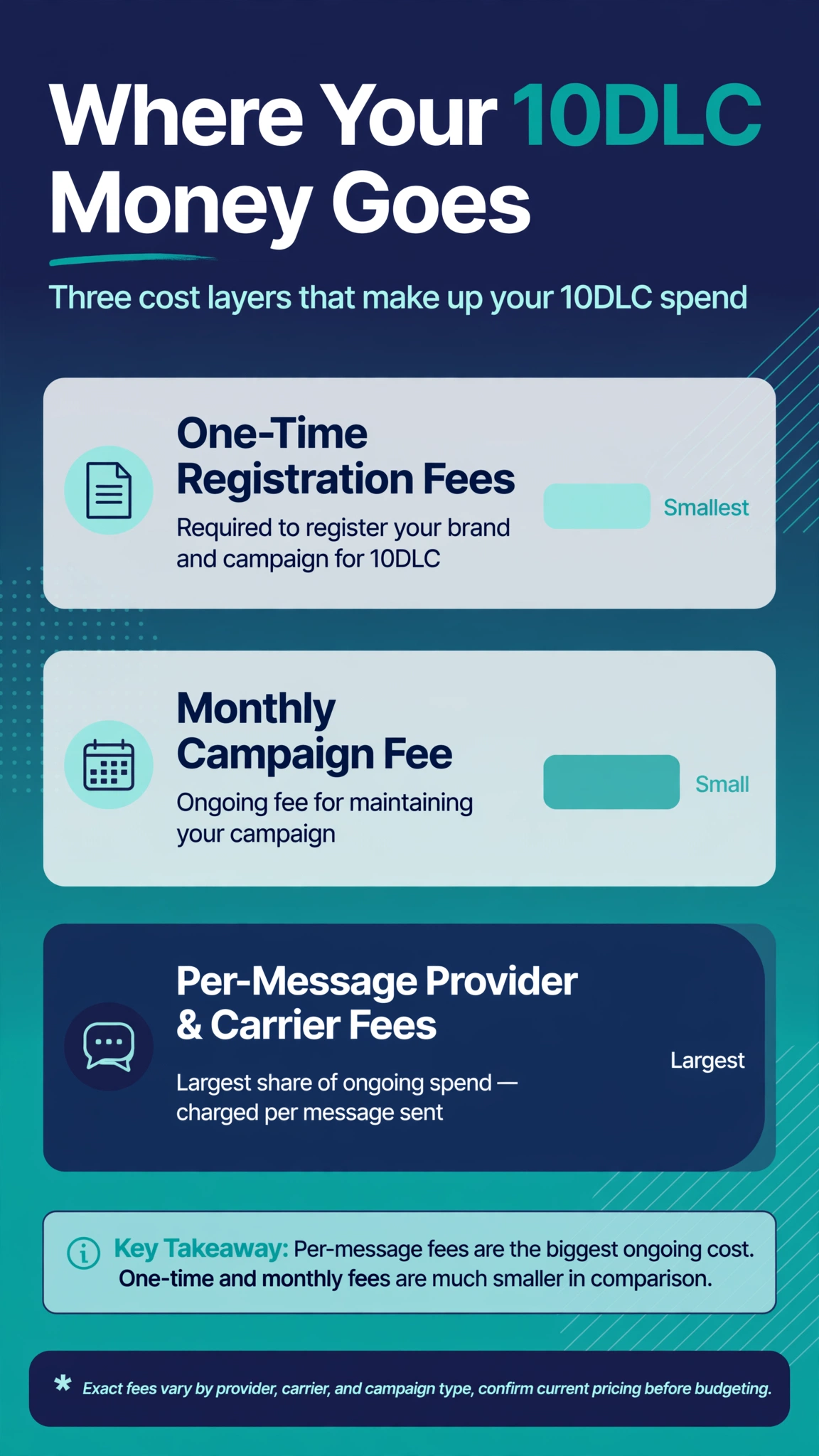
Think of 10DLC pricing as a stack:
- One-time registration fees. You pay TCR to register your brand and your campaign.
- Monthly campaign fees. TCR charges a recurring fee per active campaign, priced by use case.
- Per-message fees. Your messaging provider charges a base rate per segment, and the carriers add their own pass-through surcharge per message. This layer dominates the bill at any real volume.
Providers pass TCR and carrier fees through at cost, but they may also add their own margins or bundle fees into plan pricing. Always ask your provider whether a quoted number is pass-through or marked up.
Layer 1: Brand registration fees (one-time)
Brand registration tells TCR who you are. The figures below were published by Tychron in a fee guide verified July 21, 2026:
- Brand registration: $4.50 one-time per brand. Sole proprietors pay $4.
- Standard vetting: $41.50, optional, but it raises your trust score and unlocks higher throughput tiers. Most real businesses take it.
- Enhanced vetting: $101.50, for brands that need top throughput or special use cases.
A separate pricing change landed August 1, 2025: TCR introduced Authentication+ at $12.50 for public-profit brands, a mandatory two-factor email verification step aimed at stopping brand impersonation. Confirm whether this still applies to your brand type at registration time.
One expensive quirk worth knowing: campaign vetting fees apply per vetting attempt, and hard rejections re-bill the fee. Sloppy submissions do not just cost you weeks, they cost you $15 each time. Get the opt-in description, sample messages, and brand details right on the first pass.
Layer 2: Campaign registration and monthly fees
Campaign registration describes what you are sending: the use case, message flow, and opt-in evidence. The one-time vetting fee per campaign is $15, passed through at cost. Then the campaign carries a monthly maintenance fee with TCR, priced by campaign class (figures from the same Tychron guide, verified July 21, 2026):
- Standard, Marketing, or Mixed: $10 per month
- Low-Volume Mixed: $1.50 per month
- Sole Proprietor: $2 per month
- Charity, 501(c)(3): $3 per month
- Agents and Franchises: $30 per month
A small business running one standard marketing campaign pays $10 a month in recurring registry fees. That is the cheapest layer of the stack, but it never goes away while the campaign is active. If you run separate campaigns for marketing and customer care, you pay the fee on each one.
Layer 3: Per-message fees (provider rate plus carrier surcharge)
This is where almost all of the money goes. Every outbound message segment costs two things added together:
- Your provider’s base rate. Twilio charges $0.0083 per US SMS segment as of figures cited in its help center materials. Telnyx lists about $0.004 per segment. Plivo is around $0.0077 before surcharges.
- The carrier pass-through surcharge. Each carrier charges per message, and these change frequently. Current figures from Tychron’s dated updates feed: Verizon raised outbound SMS to $0.005 per message effective October 1, 2026. T-Mobile set $0.0045 outbound and $0.0025 inbound effective January 19, 2026. AT&T sits at $0.0035. Regional carriers keep adding their own, and Tychron’s feed already shows surcharges moving again on September 1 and November 1, 2026.
Blended across the big three carriers, the carrier surcharge works out to roughly $0.004 to $0.0045 per outbound message in late 2026. Combined with a provider base rate, your real all-in cost per message is typically $0.008 to $0.013 depending on the provider. A common planning number is about $0.012 per outbound SMS on Twilio. One more detail: carrier fees apply to inbound messages too on some networks, with Verizon inbound at $0.007 per the cited schedules. If your program is conversational, inbound volume is not free.
The first-year total cost model
Let us put the stack together for one standard brand with one standard campaign, using Twilio as the reference provider. I am using these inputs, all from sources dated above:
- One-time: $4.50 brand registration + $15 campaign vetting = $19.50
- Monthly fixed: $10 campaign fee + $1.15 number rental = $11.15
- Per-message: $0.0083 provider base + $0.0042 blended carrier surcharge = $0.0125 per outbound SMS
Optional standard vetting at $41.50 is excluded from the core model; add it if you need the throughput. Here is year one, amortizing the one-time fees over 12 months:
| Volume per month | One-time fees (amortized monthly) | Monthly fixed | Per-message cost | Year 1 total per month | Effective cost per message |
|---|---|---|---|---|---|
| 10,000 | $1.63 | $11.15 | $125 | ~$138 | ~$0.0138 |
| 100,000 | $1.63 | $11.15 | $1,250 | ~$1,263 | ~$0.0126 |
| 1,000,000 | $1.63 | $11.15 | $12,500 | ~$12,513 | ~$0.0125 |
Year one all-in totals: about $1,653 at 10K a month, $15,156 at 100K a month, and $150,156 at 1M a month. From year two onward, the one-time fees drop off and the monthly number is $11.15 in fixed fees plus per-message cost.
The pattern is the point: per-message fees are 90 percent or more of the bill at every volume shown. The registration and campaign fees feel like the story because they are the confusing part, but they are a rounding error once you are sending real volume. Budget the per-message layer first, then add the registry fees.
How provider choice changes the model
The registry fees are identical everywhere, since TCR sets them. What moves is the per-message base rate. Running the same 100K messages a month with Telnyx’s roughly $0.004 base plus the same $0.0042 carrier surcharge gives about $0.0082 per message, or $820 in per-message cost, saving around $430 a month versus the Twilio reference rate. Providers also differ in how they bill surcharges: some list them as separate line items, others bake them into a higher headline rate. Compare all-in, not headline.
And the obvious comparison: a short code lease runs $500 to $1,000 per month on top of per-message fees, which is why 10DLC is the default choice for small and mid-size senders. Toll-free numbers skip TCR entirely and use a separate verification path, which makes them worth pricing if campaign review timelines are your bottleneck rather than cost.
Common questions nobody answers clearly
Per-message fees are two charges added together. Your provider’s base rate is one line; the carrier pass-through is set independently by each network and changes several times a year. In 2026 alone, T-Mobile and UScellular moved in January, Verizon in May and October, eighteen regional carriers in July, and more were announced for September and November. Any pricing page that quotes a single flat number without a date is hiding half the story.
Is a rejection really a second bill? For campaign vetting, yes. The $15 vetting fee is charged per attempt, and hard rejections count as new attempts. Some platforms hold a fixable submission for your correction instead of letting it hard-reject, which is one of the more useful things to ask a provider about before you sign up.
Do I pay these fees if my brand registration is rejected? The $4.50 brand fee is charged even if the registration is rejected, so submitting with mismatched legal entity names or bad EIN details is a donation to TCR. Match your legal entity name and EIN exactly to IRS records.
Can one campaign cover multiple use cases? A Mixed or Low-Volume Mixed campaign can include sub-use cases, which is how many businesses keep one campaign and one monthly fee. Declaring separate campaigns multiplies the monthly fee, so plan your use cases before you register.
FAQ
How much does 10DLC registration cost in 2026?
One-time costs are $4.50 for brand registration, plus $15 per campaign vetting attempt. Optional standard vetting for higher throughput is $41.50. Recurring costs are $1.50 to $10 per campaign per month depending on use case, plus about $1.15 a month for the phone number. Then every message costs your provider’s base rate plus carrier surcharges of roughly $0.003 to $0.005 per SMS.
What is the difference between brand registration and campaign registration?
Brand registration verifies your business identity with TCR and produces a trust score. Campaign registration describes a specific use case: what you send, how people opt in, and sample messages. You need both. Brands are registered once per legal entity; campaigns are registered per use case and carry their own monthly fees.
How long does 10DLC registration take?
Brand registration usually clears in one to three business days. Clean campaign submissions typically approve in 24 to 72 hours, though special use cases can take one to three weeks, and peak periods stretch longer. Rejections add a full cycle, generally one to two weeks, plus another $15 vetting fee.
Is 10DLC worth it for a small business?
For most small US businesses sending to US numbers, yes, because there is no legal alternative on long codes: unregistered A2P traffic has been blocked since February 2025. The registry fees themselves are small, usually under $200 for the first year. The real question is your per-message volume, which dominates the cost. If approval timelines are the blocker rather than price, verified toll-free is the usual alternative to evaluate.
Are 10DLC fees refundable?
No. The brand registration fee and the campaign vetting fee are non-refundable, including when a submission is rejected. Monthly campaign fees are charged while the campaign is active. This is the financial argument for getting your submission right the first time.
Do I need to register 10DLC for every provider I use?
Registration is tied to your provider, so campaigns must be resubmitted when you move providers. The fees are set by TCR and are the same everywhere; only the approval queue differs. If you are a platform with your own CSP account, TCR supports sharing campaigns to a connectivity partner without re-registering.
Conclusion
10DLC pricing looks complicated because it is three bills wearing one name: one-time registry fees, a monthly campaign fee, and per-message fees that keep rising as carriers adjust their pass-throughs. But the model above shows the practical shape of it. Registration and monthly fees are a small, fixed overhead. Per-message fees, your provider’s rate plus carrier surcharges, are the real budget line, running about $0.008 to $0.013 per outbound SMS in late 2026 depending on your provider. Build your budget from the per-message layer down, verify every figure against your provider’s current pricing page before you commit, and keep an eye on carrier surcharge announcements, because those are the numbers that move.
Want this set up for you?
I build SMS chatbots and API integrations for businesses. If you would like what this guide describes, done for you, get in touch.